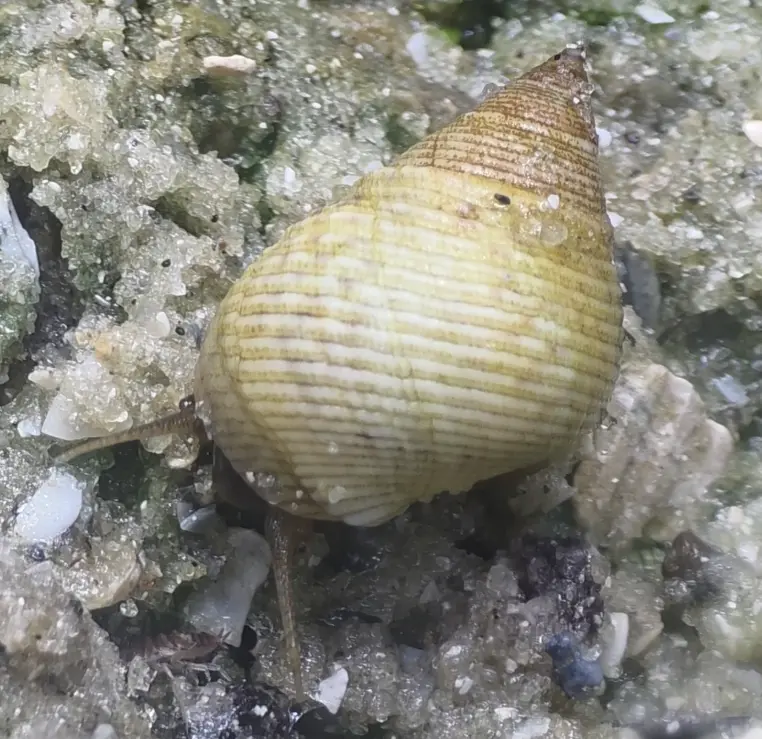
Littoraria irrorata

Marsh Periwinkle

A saltmarsh snail that actively cultivates fungi on cordgrass stems by scarifying the surface with its radula, then grazes the fungal patches, miniBIOTA lacks smooth cordgrass, and the five individuals present have not thrived.

Overview

A saltmarsh snail that actively cultivates fungi on cordgrass stems by scarifying the surface with its radula, then grazes the fungal patches, miniBIOTA lacks smooth cordgrass, and the five individuals present have not thrived.

Identity

  • Common name: Marsh Periwinkle
  • Alternate names: saltmarsh periwinkle, periwinkle snail, littoraria, marsh snail, marsh periwinkle snail
  • Scientific name: Littoraria irrorata
  • Identification confidence: Species-level
  • Uncertainty label: Vulnerable

Taxonomy

  • Kingdom: Animalia
  • Phylum: Mollusca
  • Class: Gastropoda
  • Order: Caenogastropoda
  • Family: Littorinidae
  • Genus: Littoraria
  • Species: L. irrorata

Natural History

Littoraria irrorata is the Marsh Periwinkle, one of the most studied invertebrates of Atlantic coast salt marshes and one of the most ecologically important small animals in those systems. It is found from New Jersey south through Florida and along the Gulf Coast to Texas, living on and around smooth cordgrass (Spartina alterniflora) in the intertidal salt marsh zone.

The standout natural history feature of the Marsh Periwinkle is its fungal cultivation behavior. The snail climbs cordgrass stems and uses its radula to wound the surface of the grass, creating small scrape marks. Its feces contain fungal spores, particularly Ascomycete fungi including Phaeosphaeria spartinicola, which colonize the wounds. The snail then returns to graze the fungal growth that develops on the wounded grass surface. This behavior has been documented as a form of proto-cultivation: the snail actively creates the conditions for its preferred food source rather than simply grazing what it finds. At high snail densities, the cumulative grass wounding can cause significant dieback of Spartina, making this species an important regulator of marsh vegetation structure.

Marsh Periwinkles climb stems above the waterline at high tide and descend at low tide. They prefer the intermediate intertidal zone, tolerating salinities from roughly 5 to 35 ppt, though they are most abundant in lower-to-mid salinity estuarine conditions. They are not strictly marine; the salt marsh intertidal zone is their primary habitat, which is distinct from the full-marine conditions of miniBIOTA's saltwater systems.

Ecological Role

In natural salt marshes, the Marsh Periwinkle plays a structuring role in the Spartina-fungi-snail community: its cultivation behavior determines fungal distribution on cordgrass stems, and its grazing pressure at high densities can suppress grass growth and contribute to marsh die-off events. It is a key link between primary production (cordgrass biomass) and secondary consumers in the salt marsh food web.

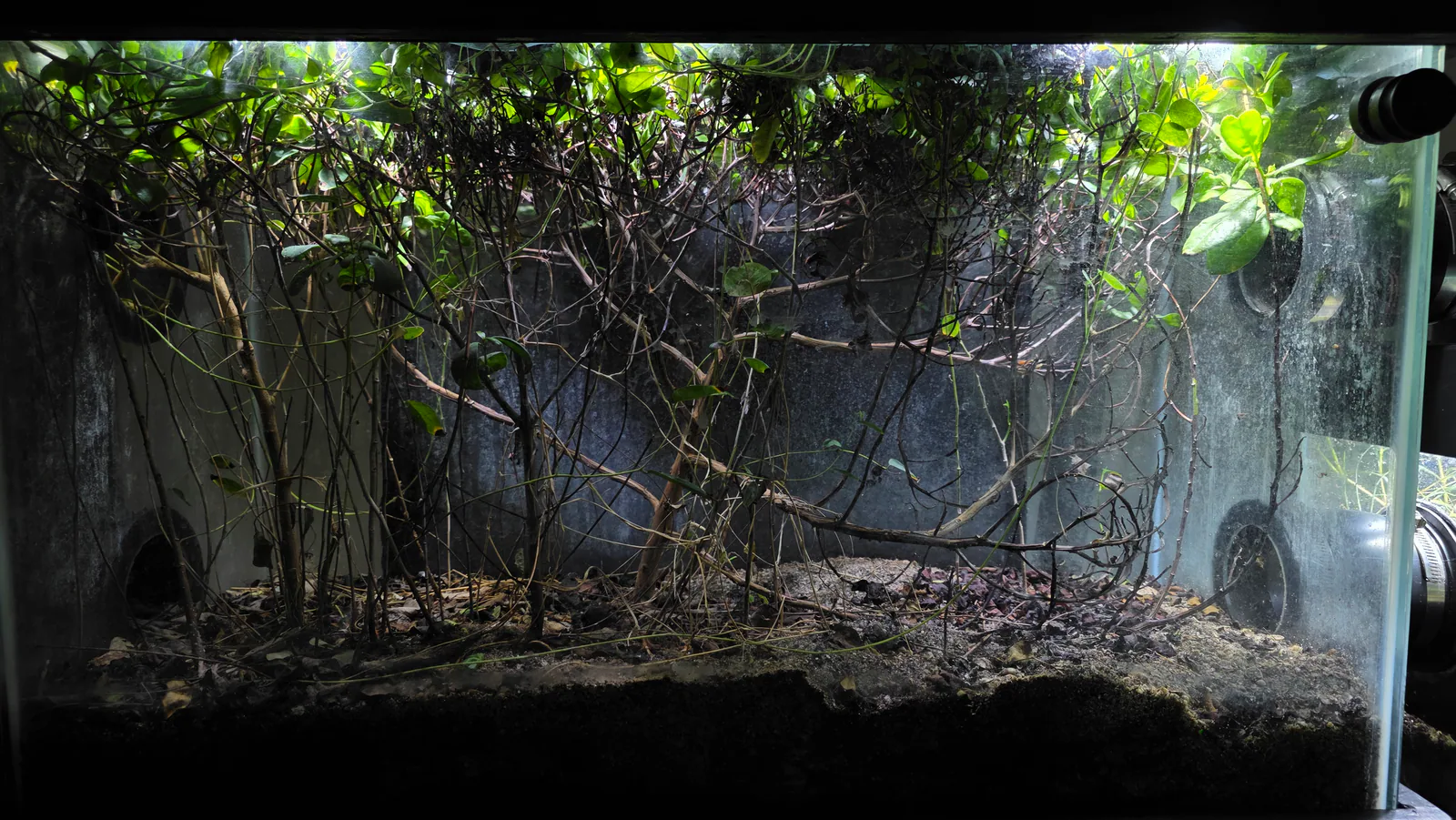
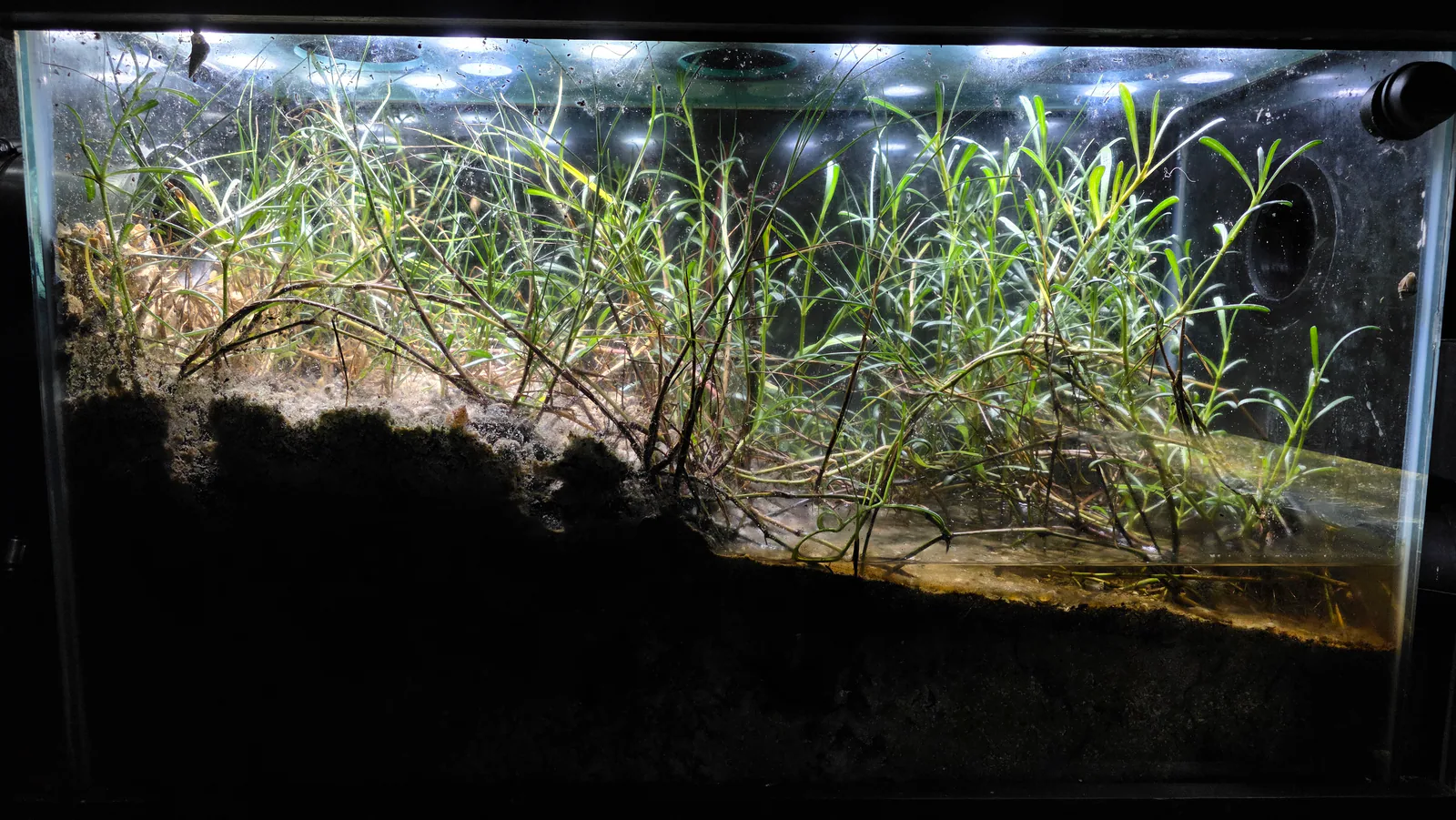
In miniBIOTA, neither smooth cordgrass nor the specific Ascomycete fungi associated with it are present. The Marsh Periwinkle's preferred food, cultivated fungi on Spartina stems, is unavailable. The observer noted this explicitly: "This species requires a special fungi which is their preferred diet and grows on a certain grass (S. alterniflorus). They cultivate this fungi and I don't believe this dynamic will be easily reproducible in miniBIOTA." The species has been placed in the Mangrove Forest and Marine Shore biomes, which provide climbing surfaces and some algal food, but not the ecological context in which this snail thrives.

miniBIOTA Evidence

Introduction context: The Marsh Periwinkle was introduced to miniBIOTA on June 13, 2025. No dedicated observation record exists for the introduction event. Introduction method and source origin are null; local collection from a Florida salt marsh is probable. Note: this species is distinct from the Mangrove Periwinkle (Littoraria angulifera), which was introduced to the Marine Shore in June 2026.

Observation record: No dedicated observation records exist for the Marsh Periwinkle. All evidence comes from the species record.

  • June 13, 2025: date of first introduction. No observation file.
  • 2025 (general): Observer noted the species was "not thriving, possibly due to the full salinity in the biome. These are brackish species that will need a brackish biome."
  • October 2, 2025: Observer noted: "The conservation status has been moved to endangered since learning the crucial role fungi plays in their development. Without this fungi, it can be expected that this species will be driven to extinction." This reflects the observer's updated understanding of the grass-fungi-snail cultivation system and its incompatibility with miniBIOTA's current setup.
  • November 2, 2025: last recorded date. No dedicated observation file.

Confirmed:

  • Introduced June 13, 2025; five individuals estimated
  • Not thriving in miniBIOTA; population Vulnerable
  • Not reproducing
  • Observer confirmed the critical fungi-cordgrass mutualism cannot be replicated in miniBIOTA as currently configured

Inferred:

  • Full marine salinity (vs. preferred brackish conditions) is a contributing stressor
  • Absence of smooth cordgrass (Spartina alterniflora) removes the primary food cultivation substrate
  • Without fungi-on-cordgrass as a food source, the snails are likely subsisting on surface algae and biofilm at lower nutritional quality
  • Long-term persistence without Spartina is unlikely

Unknown:

  • Whether any individuals are still alive as of 2026
  • Exact source and collection location of the June 2025 introduction
  • Whether the snails are consuming any food in miniBIOTA, and if so, what