
Explore the Chronicles
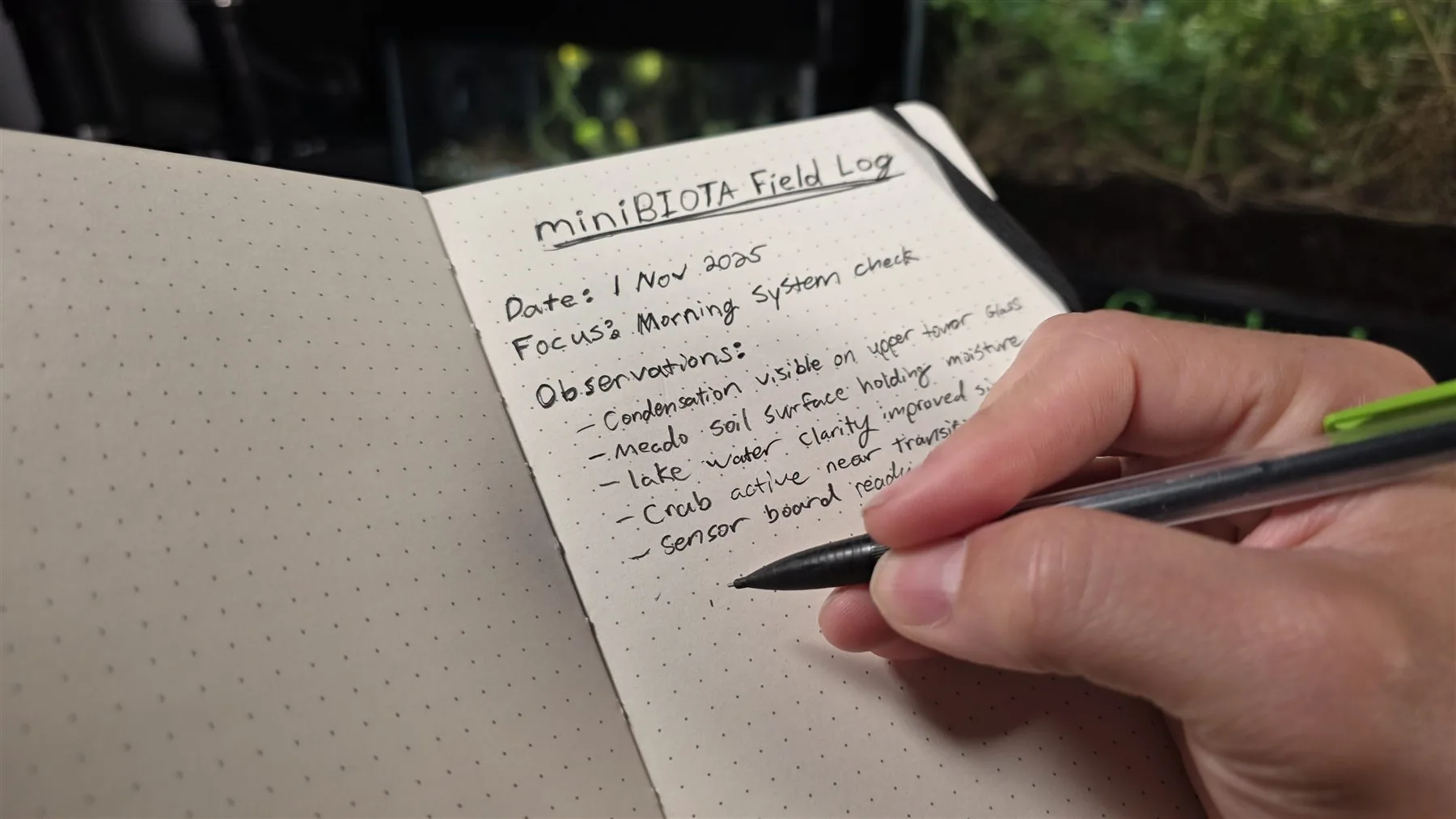
Chronicles are the narrative field archive for observations, milestones, media records, and biosphere story threads. Use this timeline to follow how the living system changes over time.
Archive Scope
The full archive is organized by year. Individual chronicle records may also appear on related species, biome, biosphere, or engineering pages when they provide subject-specific context.
After about a week without sightings, the Gulf marsh crab was rediscovered noticeably larger in the Marine Shore biome, confirming a successful post-introduction molt. He was observed actively feeding on dead seashore paspalum grass detritus, converting tough plant material into presoil poop and crab biomass. This confirms he is successfully finding food and occupying his herbivore-detritivore niche, although long-term persistence and coexistence alongside Atlantic sand fiddler crabs (Leptuca pugilator) remain under observation.
A mole cricket introduced to the lowland meadow caused widespread browning of the grass through extensive tunneling. At night, after a female field cricket partially entered his burrow and touched antennae with him, the mole cricket walled off his entrance using a ball of mud.
Turtle grass, manatee grass, and green feather algae were added to the Seagrass Meadow after winter shoalgrass shedding contributed to nutrient-rich water that helped feed redweed and cyanobacteria. The additions create more producer competition for nutrients, but the green feather algae, Caulerpa taxifolia, remains a risky aquarium species that may need removal if it spreads too far or crashes back too quickly.
Turtle Grass added as part of the producer-diversity hedge against winter nutrient pulses in the Seagrass Meadow.
Manatee Grass added as a second seagrass competitor with a different growth and shedding pattern from established shoal grass.
Green Feather Alga (Caulerpa taxifolia) added as a risky producer to observe; it may need removal if it spreads too much or dies back rapidly.
Shoal grass winter shedding provided the nutrient-pulse context for adding more producer competition.
Graceful redweed is the macroalgae pressure these producer additions are meant to compete against indirectly.
The Mottled Shore Crab (Pachygrapsus transversus) was documented grazing through the macroalgae and cyanobacteria clump in the Seagrass Meadow before sea urchins were added. By the end of March, the cyanobacteria had shrunk significantly and its growth looked checked. The observation marks an important self-correction beat in the meadow: the crab appears to help control one part of the algae pressure, while Graceful redweed remains the light-layer problem over the shoalgrass.
Seagrass Meadow self-correction beat: cyanobacteria looks checked while redweed remains unresolved.
Variegated sea urchins were added to the Seagrass Meadow after Graceful redweed and other macroalgae continued spreading across the surface and shading the shoal grass below it. During acclimation, one urchin immediately ate a small piece of Graceful redweed, making this the first direct food-web response to the meadow macroalgae problem.
Seagrass Meadow food-web intervention: variegated sea urchins added to graze Graceful redweed and other macroalgae shading shoal grass.
Ghost shrimp larvae were documented in the freshwater lake biome for the first time in miniBIOTA. This confirms that the adult ghost shrimp are reproducing after the flagfish were removed from the water column. The observation advances the long-running question of whether ghost shrimp can establish long term, but it does not yet confirm juvenile recruitment.
Two Eastern Melampus (Melampus bidentatus) were introduced to the Marine Shore biome on 2026-04-23. Within minutes, both were observed actively feeding on dead grass detritus at the waterline. This species is a detritivore, but its role extends further than just eating. It tracks low tide to collect nutrients at the waterline and then carries those nutrients back onto land through its droppings. Moving marine-derived nutrients back to the terrestrial side of the coastal biome is the most important function a species can perform here. Two individuals currently present and watching for establishment and reproduction.
Eastern Melampus introduced 2026-04-23. Feeding behavior confirmed immediately, beginning to consume dead grass detritus within minutes of introduction, which is a strong early establishment signal. The Marine Shore biome's constant supply of decaying coastal vegetation provides an abundant food source. Nutrient transport function identified: tracks low tide, feeds at the waterline where nutrients concentrate, then returns to land and deposits those nutrients through droppings. Currently 2 individuals and monitoring for establishment and reproduction.
Four days after introduction, the Gulf marsh crab was observed actively grasping live seashore paspalum blades, pulling them apart, and consuming the finer strands. This confirms its herbivore role in the biome and represents the first direct evidence of grass regulation. On the same date the crab was also observed scavenging a detached fiddler crab leg, which was unexpected and suggests a broader opportunistic diet than its herbivore classification implies.
The Marine Shore biome had been accumulating seashore paspalum overgrowth and detritus without the detritivore layer needed to process it. A field trip to a brackish tidal ditch in Spring Hill, FL with Grant from The Garden of Eder yielded five new species: Gulf marsh crab (Sesarma schubarti), Eastern Melampus (Melampus bidentatus), Ladder Hornsnail (Cerithidea scalariformis), Lawn shrimps (Family Talitridae), and Scorched Mussels (Brachidontes exustus). Each was selected to fill a specific vacancy in herbivory, detritivore layering, and filter feeding. The Gulf marsh crab, classified as a distinct species in 2024, was the most unexpected find.
The Freshwater Lake was reorganized after the flagfish was removed from the water column. One fish had been enough to suppress Daphnia and other microcrustaceans in the sealed lake biome, preventing the middle layer of the food web from forming. The April 17, 2026 longform documents the decision to remove the fish and let the lake rebuild around algae, microcrustaceans, shrimp, and crayfish.
The lake fish-removal event explains why Flagfish is now recorded as Removed from the Freshwater Lake.
Reduced fish predation reopened the possibility of a visible Daphnia layer in the lake.
Removing the fish changed the survival context for ghost shrimp larvae and the post-removal food web.
Freshwater amphipods are part of the post-removal microcrustacean layer being watched in the lake story.
Calanoid copepods are part of the water-column community affected by the fish-removal reset.
Cyclopoid copepods are part of the water-column community affected by the fish-removal reset.
Slough Crayfish remain one of the larger consumers in the rebuilt post-removal lake food web.
Rising temperature and an algae bloom triggered Bladder snail mating after a long period of low population pressure from Seminole Rams-horn competition. The observation highlights the energetic imbalance between cheap sperm production and costly egg production, visible in the recipient trying to dislodge the other snail during transfer.
Snails concentrate calcium into shells and make that mineral available to other land organisms, including hermit crabs. Unlike Cuban Brown Snails and Southern Flatcoils that were quickly eaten, Spike awlsnails have persisted for about a year by spending much of their time underground and surfacing at night.
Hermit crabs are calcium consumers / snail predators in the record.
Southern Flatcoil is mentioned as a prior land snail that was eaten.
Spike awlsnail record is routed to the terrestrial Lowland Meadow/grassland side.
Dozens to hundreds of Slough Crayfish hatched in the Freshwater Lake as a fifth generation inside miniBIOTA. The newborns can access food hidden in Lakeshore vegetation, but as they grow, competition and carrying capacity will reduce the cohort while cycling nutrients back into the adult population.
When dozens of baby Slough Crayfish hatched in the sealed system, the lakeshore vegetation became the deciding factor in their survival. Small enough to slip into the dense plant margin, the juveniles could access food that adult crayfish couldn't reach. Most won't make it to adulthood, but while they forage in the shallows they function as a nutrient transport layer, pulling energy from the lakeshore edge and cycling it back into the deeper food web as they grow and are consumed. The lakeshore isn't just habitat here. It's part of how the system moves nutrients.
Dozens of juvenile Slough Crayfish hatched inside the sealed lake, the first major population event since closure. Rather than destabilizing the system, the food web absorbed the surge. This entry documents the hatch event, the response from competing populations, and what it confirms about the lake's carrying capacity under fully closed conditions.
A large unknown beetle larva was found outside and selected for the Lakeshore because the moist habitat should provide food and cover. A centipede found nearby was explicitly rejected because it would be too predatory for miniBIOTA.
Hermit crab was the local grazing context for the grub introduction.
Centipede was observed nearby but explicitly not introduced.
The biome light fixtures use standard 50-watt-equivalent 6000K home spotlights because they are inexpensive, focused, powerful, and individually replaceable. After years of constant use, failed bulbs can be swapped one at a time instead of replacing an entire lighting panel.
When the chiller failed, dry cool air stopped moving through the system and humidity spiked. Creeping primrose-willow in the Lakeshore responded quickly by growing higher and shading neighbors, showing how mechanical climate control can change plant competition inside the biome.
The Seagrass Meadow is framed as a fight for space and nutrient capture. Suspended algae can dominate the water column first, filter feeders such as mussels, slipper snails, and clams keep that bloom in check, and the released nutrients then become available to attached algae, cyanobacteria, and seagrass.
The Seagrass Meadow enters a succession crisis as nutrients move from suspended algae to filamentous algae, then into larger macroalgae and cyanobacteria that few visible consumers can control. Filter feeders, amphipods, isopods, crabs, shoalgrass, and spring growth all become part of the question: will the meadow reclaim its structured seagrass foundation, or flip toward a macroalgae-dominated state?
Resolved Seagrass Meadow cyanobacteria conflict to species 123 after user clarified it cannot be Nostoc.
After two years of nutrient flow through green water, filamentous algae, Shoal grass, and grazers, the Seagrass Meadow is showing a new shift. Macroalgae now covers a large portion of the biome while seagrass-associated cyanobacteria spreads nearby, raising the question of whether Shoal grass can reclaim space or the biome is changing state.
Seagrass Meadow cyanobacteria; user clarified this cannot be Nostoc.
A 3D printer normally used for ecosystem parts was temporarily redirected to make QR-code bookmarks for Aquashella Orlando. The record marks public outreach preparation for the March 13-14 event rather than an ecology change inside the system.
After three and a half years on the wish list, a Mole Cricket was finally added to the Lowland Meadow. It disappeared immediately into the compacted soil, so the next evidence will come indirectly through tunnels, root feeding, grass changes, or future additions.
With the chiller offline and the atmospheres venting, the project shifted into rebuild mode instead of stopping. The next phase focuses on stronger cloud reservoirs, rain distribution, upgraded lighting, spring 2026 organism additions, and improved species-card and condition tracking.
A burning-plastic smell led to the chiller, where a fuse had blown and the pump/compressor circuit would not restart. With the 220-side distribution relay box suspected, the immediate priority became venting the system to stabilize temperature and humidity while troubleshooting the failed cooling hardware.
Filamentous macroalgae didn't just grow in the Freshwater Lake. It restructured it. This longform entry traces how a single plant species shifted water chemistry, light distribution, and species behavior across the biome. The snail population's response turned out to be the clearest ecological signal of what was actually happening below the surface.
When the plant structure in the Freshwater Lake changed, the effects didn't stay in the lake. Because the biomes share air, water, and nutrients, a shift in one habitat shows up in the others. This longform entry tracks how a transition from macroalgae dominance toward tapegrass establishment changed the lake's nutrient cycling, and what that meant for connected biomes. The ghost shrimp in the seagrass meadow, thriving for over two years, became the reference point for whether the lake could finally support the same species under sealed conditions.
The wave and tide system was rebuilt after the temporary toggle-switch feedback design failed. A rotary encoder mounted to the belt now lets the controller track movement continuously, making the wave motion smoother, quieter, programmable, and stable after more than two months of operation.
Scorched Mussels that arrived attached to oysters persisted in the Seagrass Meadow long after the oysters were presumed lost. Three mussel sightings across months suggest either long-hidden survivors or possible reproduction, extending the list of organisms still being discovered late in the biome.
Oysters are origin context for the mussel hitchhikers.
Rain is still forming inside the system, but two older atmosphere builds are dropping water through vent openings instead of routing it through the rain manifold. The rusted first-generation bearings make this a cloud rebuild problem rather than a simple hose connection.
Eleven Ghost Shrimp were added to the Freshwater Lake as Tapegrass began creating more detritus and cover. The introduction restarts a six-year effort to establish freshwater shrimp and compare their stability with the long-running saltwater shrimp population.
Eleven Palaemon pallidosus ghost shrimp were added to the lake as tapegrass began generating consistent detritus for the first time. Every previous attempt failed. This entry marks the reintroduction under sealed conditions, with the hypothesis that tapegrass substrate, closed nutrient cycling, and reduced physical disturbance may finally give them a foothold.
A Southern Lugworm seen in the coastal substrate helped reinterpret earlier gelatinous egg sacs that had once been suspected to belong to ragworms. The observation suggests the worm, or others like it, may have been present since the original local substrate was added more than two years earlier.
Daphnia are already present, but their numbers differ between the protected Lakeshore vegetation and the open Freshwater Lake. Flagfish predation and limited cover keep open-water populations low, so Tapegrass growth may be the real prerequisite for any larger Daphnia response to suspended algae.
Flagfish predation limits open-lake Daphnia.
Tapegrass growth is expected to provide cover.
Transcript contrasts Lakeshore Daphnia cover with the open lake.
After the large worm disappeared, its tunnel remained as a lighter track through darker Seagrass Meadow substrate. The burrow likely pulled oxygenated water into the sediment, creating small zones where nitrogen transformations could shift around the tunnel wall.
Follow-up tunnel record for the large Southern Lugworm.
A large dark green worm appeared against the glass in the Seagrass Meadow after years of hidden activity. Its visible deposit-feeding behavior raised a new question about how long it has been processing the substrate and why it only became visible now.
The Freshwater Lake has carried a persistent green haze without becoming opaque or collapsing. The working interpretation is that suspended algae are using nutrients released during the plant transition while young Tapegrass roots and builds enough biomass to pull more of those nutrients back out of the water column.
Tapegrass is the plant expected to pull nutrients from the lake water column.
The Freshwater Lake has maintained a consistent green tint in the water column since closure. After weeks of observation, this wasn't classified as a bloom event. Visibility held, the biological community stayed stable, and the suspended algae appeared to be part of the lake's nutrient cycling rather than a sign of trouble. This entry documents the reasoning behind leaving it alone.
In the Seagrass Meadow, egg-laying behavior revealed that two cerith-type snail patterns may be present. One snail was observed laying single dots in a clean semicircle, connecting a mystery egg pattern to a specific animal even though successful recruitment still appears unlikely in a plankton-feeding biome.
A Smokey Oak Millipede has been repeatedly observed feeding across the terrestrial biomes since August 2025, and a second individual was added about a month before this record. Their persistence matters because they are breaking down dead plant matter and pushing nutrients back into the closed system.
Twenty days after closure, the water cycle is working but not efficiently enough. Humidity lingers on the glass, condensation forms slower than expected, and the atmosphere needs testing before more complexity is added. This entry documents an insulation experiment designed to isolate one variable and learn whether temperature control at the atmosphere level can improve rainfall efficiency inside the sealed system.
White mycelium-like clusters along the Lowland Meadow soil line have stayed stable for about three months instead of disappearing quickly. If the patch remains balanced, it may represent a more permanent decomposer network moving nutrients through meadow soil.
A legume is spreading through the Lowland Meadow, adding a potential nitrogen-fixing pathway to the closed soil food web. At the same time, brown freckling and patchy leaf color show that the plant is under stress, making it a live test of whether growth or decline will dominate.
Tiny unidentified flies appeared on Tapegrass leaves above the waterline after river-edge plants were collected for the Freshwater Lake. Their role is still unknown: they may become spider prey, establish their own niche, or disappear as the sealed system filters accidental arrivals.
Unidentified flies were observed on tapegrass leaves.
Ramshorn snail shells are showing a clear boundary between older eroded growth from a more acidic lake phase and smoother new growth after conditions improved. The shells preserve a physical record of the Freshwater Lake moving toward healthier pH balance even while algae and haze remain visible.
At about 50 F inside miniBIOTA, a sluggish Florida woods cockroach became an easy target. A Mangrove Tree Crab approached but walked around it to collect nearby leaf litter instead, suggesting the cockroach repellent or prior experience may help this roach persist despite opportunistic predators.
Mangrove Tree Crab / Red Mangrove context.
Red House Spiders are reproducing throughout the terrestrial areas even though no new insects are being added and prey remains are rarely visible. Their success points to a hidden flow of small arthropods and micro-prey moving through the closed food web.
Florida woods cockroaches moved into the atmosphere tank after the system was sealed and began leaving waste where rainwater collects. The concern is mechanical: future rain events could carry particles into the rain lines and slowly clog the distribution system, so the fix needs to protect the plumbing without blocking organism movement.
Slough Crayfish are stirring the Freshwater Lake detritus layer, especially along the glass where buildup tends to compact. Their digging keeps nutrients mobile between the sediment and water column, while the newly planted Tapegrass is deep enough to withstand their attempts to reach the roots.
Transcript-supported sediment engineer for this lake record.
The Slough Crayfish's digging behavior isn't just foraging. It's the primary mechanism preventing sediment compaction and surface biofilm buildup in the sealed lake. Their activity at the glass and substrate keeps the detritus cycle active and the water column from stratifying. Without them, the lake's surface begins to seal over.
Before sealing the system, the Freshwater Lake needed a plant reset. Creeping primrose-willow had made the water clear by absorbing nutrients aggressively, but it also locked the lake into a dense tangle. Replacing it with Tapegrass reopened the water column and revealed active microcrustaceans moving through the new nutrient haze.
Transcript context: removed overgrown creeping primrose-willow from the lake.
Transcript context: tapegrass was collected and planted as the replacement.
In the days before the Freshwater Lake was sealed, Creeping Primrose Willow was replaced with a species better suited to closed-system conditions. This entry records the decision and the lake's plant baseline on the day of closure, the starting point from which the sealed system would build its ecology.
Five days into the sealed test, land isopods stayed active and the newly added Tapegrass produced steady oxygen bubbles. Crayfish and snails also continued moving normally, giving the closure test its most important early signal: the system was still holding balance.
Slough Crayfish remains sealed-test animal-response context.
Five days into sealing the ecosystem, miniBIOTA enters one of its first serious closed-system tests: whether the connected food web can keep oxygen and balance stable with no additions or removals. The video follows the system after major lake corrections, especially the removal of most Creeping Primrose Willow, and frames the sealed run as a shift from asking whether miniBIOTA could work to observing how it behaves as a biosphere.
Resolved Planorbella duryi / Seminole Ramshorn Snail to canonical species 165.
miniBIOTA was prepared for a week-long airtight closure test to see whether the new balance could hold oxygen without outside exchange. The test would run while the willow-to-tapegrass transition continued through rain, grazing, decomposition, and time.
Tapegrass was chosen as the intended replacement structure for the Freshwater Lake because it stays rooted, leaves the water column open, supports snails and microcrustaceans, and can help stabilize calcium, alkalinity, and pH through its leaf chemistry.
Freshwater Lake context for Tapegrass establishment.
Slough Crayfish remains animal-response context; Tapegrass is the primary lake replacement subject.
As Creeping Primrose Willow was cleared from the water column, tapegrass was given room to grow for the first time. A native Florida submersed plant, tapegrass provides structured habitat, consistent detritus production, and a root system that works with the Slough Crayfish's digging behavior rather than against it. Its establishment marks the shift to the plant architecture the lake was designed around.
Harvested Creeping Primrose Willow was blended into a nutrient-rich slurry, but returning it directly to the lake risked algae and oxygen collapse. The safer path became moving that material into the Lakeshore soil, where nutrients could reenter the system slowly.
Corrected from Mangrove-only context; willow slurry was redirected to Lakeshore soil.
Slough Crayfish remains consumer context for processed plant material.
Filamentous macroalgae remains oxygen-risk context.
Orangeclaw Hermit Crab remains nutrient-processing context.
Duckweed and Water Spangles were added as a floating-plant challenge to the Creeping Primrose Willow, but crayfish consumed them and the willow grew upward to shade them. The failed intervention showed how niche competition can reverse expectations in a living system.
Filamentous macroalgae remains freshwater producer context.
Slough Crayfish remains grazing-pressure context; Duckweed/floating plants are the primary intervention subject.
Creeping primrose-willow originally stabilized the Freshwater Lake, reduced algae, and created habitat, but it grew too successfully. The plant began locking up nutrients and dominating the water column, turning a successful intervention into the next ecological problem to solve.
Freshwater Lake context for Creeping primrose-willow takeover.
Slough Crayfish remains grazing-pressure context.
Filamentous macroalgae remains water-quality context.
Least Killifish remains habitat-benefit context.
Introduced to give structure to the water column and absorb pressure from the Slough Crayfish's relentless digging, Creeping Primrose Willow didn't hold a balance. It took over. Stems and roots filled the lake until visibility was compromised and the plant itself became the problem it was meant to solve. This entry opens the lake's plant revision phase.
Creeping Primrose Willow was introduced to the Freshwater Lake as a fast-growing plant that might survive crayfish grazing and provide structure for fish and snails. Instead, it became the dominant force in the water column, locking up nutrients and obscuring the system's signals. This entry records the moment a solution became the problem and opens the lake's careful correction phase.
As miniBIOTA approached full closure, the project paused to take stock of how land, water, air, organisms, and infrastructure had shaped each other. The closed phase would leave light and temperature as the main outside influences while air and water cycled internally.
In the final weeks before the Freshwater Lake was sealed into a closed biosphere, each major population had reached a working equilibrium. This longform entry documents the ecological baseline at the moment of closure: what had stabilized, what was still uncertain, and what it looked like for a freshwater system on the edge of becoming fully self-sustaining.
miniBIOTA had reached a point where short clips could no longer carry the full context of slow ecological change. The content plan shifted toward longform YouTube stories that can connect causes, consequences, infrastructure, and organism dynamics over time.
The wave system was repaired enough to run again, putting full closure back within reach. The next planned upgrade would replace limit switches with a rotary encoder so the wave motion could be programmed with position feedback.
The temporary wave system failed again after belt and switch problems, forcing the bubbler back onto the saltwater side. The failure delayed sealing the biosphere and reinforced the need for a more reliable redesigned wave system.
The rain distribution design separated rising air from pooled water and routed water through manifold ports into silicone tubing and soaker hoses. The system was not fully connected yet, but it laid out how atmosphere water would eventually spread across each biome instead of falling in one spot.
The rain system moved away from siphon logic because the reservoirs fill one drop at a time. A triangular tipping reservoir solved the problem by shifting its center of mass as it filled, letting one final drop trigger a smooth gravity rain event.
Early sealed-atmosphere operation showed comfortable conditions in the coastal biome but humid glass pockets in the grassland and mangrove forest. The pattern revealed plant-created microclimates and showed where stronger convection and chiller efficiency would matter most.
For the first time, every biome in miniBIOTA was sealed from the room, creating a full self-contained biosphere run by external light, temperature, gravity, and internal cycles. The atmosphere system began moving humidity upward, condensing water, and returning it as rain without fans or pumps inside the habitats. This entry marks the beginning of a new chapter: watching a connected miniature world regulate itself from inside the glass.
Creeping primrose-willow appeared unexpectedly in the Lowland Meadow, likely carried from the wet side by a moving hermit crab or another animal. Its arrival raised a new question: whether the competitive grassland could contain a plant already gaining ground at the water edge.
Lowland Meadow context for the plant crossing into grassland.
A light fog test made the closed-system airflow visible in the Marine Shore. The fog showed a downdraft entering the habitat and an updraft returning to the atmosphere, while early temperature and humidity sensors confirmed that air was mixing even before final efficiency upgrades.
After spider predation nearly erased the cricket population, a tiny field cricket hatchling appeared in a quiet corner. The discovery showed that the last adult pair had reproduced, giving the cricket layer a chance to rebound in the sealed, lower-predator system.
The working climate system removed humidity from the habitats, captured water in the atmosphere towers, and returned drier cooler air below. Clear glass confirmed that convection was doing the needed work, opening the path toward sensors, gas monitoring, and full closure.
As the new atmosphere system was being finished, humidity sat near 100% and created risk for some terrestrial insects. Fans were used to vent moisture while millipedes, hermit crabs, and Florida woods cockroaches remained active, making this a transitional stress test before the climate system could balance itself again.
3D printing continued to make miniBIOTA practical by producing light fixtures, tank connectors, rain-system parts, wave-system components, and clean electronics housings. The approach kept costs down and turned custom ecosystem ideas into usable hardware.
A prototype sensor system began tracking temperature and humidity in the biomes and atmospheres. The readings would guide pump-driven heat-exchanger flow, with OLED displays and controllers bringing miniBIOTA closer to automated closed-climate operation.
As miniBIOTA neared full closure, small 3D-printed ducts and PC fans were added to push air through the heat exchanger panels and speed glue curing. The airflow shortened a process that could have taken weeks, helping the atmosphere tanks move closer to installation and closed-system testing.
Condensed water collected in cloud reservoirs inside the atmosphere tower until the weight shifted and each reservoir tipped by gravity. The cascading release showed how the system could create unpredictable rain events even before the final rain manifold was connected.
All four atmosphere tanks survived heat-exchanger removal and refurbishment, even though one old epoxy joint pulled shallow chips from the glass. With the new heat exchangers ready to glue on, miniBIOTA moved closer to closing the room connection.
Two unidentified millipedes found inside the house were added to the Lowland Meadow as possible detritivores. One immediately entered the soil while the other explored the grass, expanding the decomposition layer alongside the established Smokey Oak Millipede.
Lowland Meadow context for unknown millipede addition.
Smokey Oak Millipede remains established millipede comparison context.
Orangeclaw Hermit Crab remains detritus-processing context.
Caribbean Hermit Crab remains nutrient-processing context.
While replacing an old heat exchanger behind the Seagrass Meadow, the back glass was found covered in slipper snails and young recruits. The hidden surface also held a thriving sea anemone, showing that life was flourishing in low-visibility spaces as the system moved toward closure.
After the Regal Jumping Spider was removed, a pair of Southern Two-Striped Walkingsticks was reintroduced. The pair survived the first three days, stayed mostly still by day, and became a new test of whether a large herbivore could fit the terrestrial food web.
Regal Jumping Spider remains prior-predator context after removal.
A rare Cuban cockroach introduced to miniBIOTA was later found trapped by a Red House Spider in the Mangrove Forest. The loss showed that some new arrivals fail quickly under remaining predator pressure, while better-matched roach species continue to fit the system.
A tiny jumping spider appeared in miniBIOTA when the system was supposed to be getting a break from predators. It resembled a second jumping spider species added months earlier, raising the question of whether it was a juvenile from that lineage or a new hitchhiker that found its way into the habitat.
Green midge flies emerged two days after bloodworms were added to the freshwater realm, opening a possible new food-source loop for miniBIOTA.
The Regal Jumping Spider was removed and shipped to Mercedes May Regius after four months in miniBIOTA. It produced strong stories but hunted too efficiently for the system scale, so rehoming let its story continue while reducing predator pressure.
Non-biting midge larvae appeared in rainwater collected outside and were added as a possible nutrient bridge. Their aquatic larvae feed on decaying matter, while tiny adult flies could move that stored lake energy onto land and into the predator food web.
The regal jumping spider's time inside miniBIOTA ends after four months of intense predation. The spider helped suppress black widow spiderlings and other insects, but also wiped out ebony bugs in the grassland and placed heavy pressure on the food web. Removing her to a new home closes one predator chapter, gives remaining insects and roaches room to recover, and opens space for a newly found Cuban cockroach to attempt establishment.
Midge fly larvae collected from an outdoor rainwater bucket were introduced to the Freshwater Lake as a potential sediment-layer decomposer. Their red coloring points to hemoglobin adaptation for low-oxygen environments, which makes them a practical fit for a detritus dweller in a sealed system. This marks the first deliberate introduction of an invertebrate chosen specifically for its role in the lake's decomposition layer.
A large lubber grasshopper was considered for miniBIOTA because it was a charismatic herbivore, but its size and water needs made it a poor fit for the current system. The observation stayed outside the ecosystem rather than becoming an introduction.
After the black widow was removed from the Lakeshore, Florida woods cockroaches began exploring open areas and feeding on Dollar Weed. Their grazing showed the food web returning to a plant-herbivore-predator structure, with roach offspring likely becoming future prey.
The external wave and tide system kept saltwater moving without internal pumps or blades, but eight months of use revealed belt, mount, and noise problems. It remained useful at minimum operation while a phase-three redesign was planned.
Common Atlantic Marginella snails had suppressed other snail recruitment in the Seagrass Meadow by eating young snails. Direct removal began after predator-control options looked too risky, with dozens already removed and more still present.
The original Southern Black Widow was removed by slowly twisting a rubber tie through her web tunnel and transferring the web, spider, and egg sacs into a ventilated container. The removal revealed eight egg sacs, showing that more waves had hatched inside miniBIOTA than previously counted.
The black widows were scheduled for removal, with the original female and egg sac to be contained before another hatch. The record reframed the spider plan toward smaller ground spiders or tiny jumping spiders while the Regal Jumping Spider and new armyworms remained under review.
A walking stick was killed by the Regal Jumping Spider, and later an adult scorpion was found caught in a large black widow web. The losses showed that predator pressure had become too strong, leading to plans to rehome the widows and rebalance the system for the next phase.
A puffball mushroom was added to seed fungal decomposers across the terrestrial realms. Mold rarely takes over in miniBIOTA, likely because nutrients are tied up and springtails are active, but the spores could eventually find small niches and expand the decomposition web.
miniBIOTA prepared for a closed and modular phase where air and water would be contained from the outside room. The next questions focused on gas balance, sensors, dew, lightning, nitrogen fixation, ozone, flying insects, and weekly public tracking on YouTube.
The heat exchanger finally reached the performance needed for closed-system climate control, transferring temperatures down to minus 30 degrees Celsius without dangerous pressure risk. The milestone allowed miniBIOTA to move toward sealed operation, condensation tracking, rain-system work, and biome rebalancing.
A male and female Southern Two-Striped Stick Bug were collected for miniBIOTA as possible herbivores. Their defensive spray made handling risky, but their plant-feeding behavior could add a new herbivore role if they adapted to the system.
Water Spangles struggled after being added to the Freshwater Lake. Primrose willow grew upward to reclaim light while crayfish grazed the floating plants from below, squeezing the new producer between plant competition and herbivory.
Freshwater Lake context for Water Spangles decline.
Slough Crayfish remains grazing pressure context.
This entry lays out one of miniBIOTA's core ecological lessons: balance is not a fixed state, but a moving target created by many overlapping pressures. Predator-prey dynamics, snail losses and recoveries, algae, humidity, nutrient cycling, and species additions all become examples of how small changes can push the system toward collapse or resilience. The conclusion is that stability comes from complexity, redundancy, and continued evolution.
A Harvestman found while searching for cockroaches was added to the Lakeshore because its omnivorous diet could fit miniBIOTA differently from true spiders. It survived the first night among black widow webs, giving the new arachnid a promising start.
The second trap night brought in more Florida woods cockroaches and at least one roach that might be another species. The additions strengthened the detritivore layer that turns dead leaves into frass and soil for the rest of the terrestrial food web.
A roach trap was set to find mating pairs and strengthen the cockroach layer in miniBIOTA. The effort produced a Florida woods cockroach and other candidate species, supporting the goal of building a self-sustaining detritivore population that can convert dead leaf matter into usable food-web energy.
When the atmosphere tank above the Lakeshore was removed for heat-exchanger work, spiderlings began escaping through the opening where air flowed outward. Their movement showed that black widow dispersal followed air currents rather than random direction choice.
With all six biomes connected in the new space, miniBIOTA begins shifting from a collection of tanks into a living garage biosphere. The update surveys new biodiversity, expanding food webs, and the engineering still needed for climate control, waves, tides, and seasonal influence. It captures the project in an active growth phase where ecological complexity and mechanical design are both accelerating.
A new Wi-Fi light controller added five channels, high current capacity, smooth 20 kHz dimming, and sensor integration. The controller can support sunrise-to-midday-to-twilight simulations while eventually coordinating light, temperature, humidity, pumps, and the heat exchanger.
Common Atlantic Marginella snails were seen pulling clams from the Seagrass Meadow sand and eating them one by one. Their predation threatened the filter-feeder layer and raised the question of whether mud crabs might be needed again despite their own risks.
Seagrass Meadow context for clam and marginella predation.
Filamentous macroalgae remains seagrass condition context.
Mud crabs remain possible predator-management context.
The original Southern Black Widow produced another hatch, but this brood was smaller than earlier waves. The smaller generation may reflect food scarcity or the female nearing the end of her egg production, while a male nearby suggested the next generation could continue the cycle.
Moths began appearing after wild Water Spangles were added to the Freshwater Lake. Instead of being wiped out by black widow webs, multiple moths persisted for weeks, raising the possibility that a flying-insect layer could move nutrients out of the water realm.
A cricket seen near the Lakeshore water edge was later caught high in a black widow web. The widow pulled the prey upward, showing that the Lakeshore widow population remained strong even as grassland widows declined and cricket numbers came under pressure.
A grizzled mantis and a larger green mantis were observed outside the system, but not introduced because miniBIOTA already had too much predator pressure. The record preserves the consideration point: mantises are fascinating, but even one could tip the balance in a small biosphere.
A young Hentz striped scorpion born in miniBIOTA became trapped in a Red House Spider web. Even after the scorpion struck with its tail and claws, the spider pinned the dangerous parts with silk, delivered a bite, and turned another predator into prey.
A Regal Jumping Spider was caught stalking and pouncing on a young black widow, confirming it as a major predator of the spiderlings in the Lowland Meadow. The black widows may still survive elsewhere, but the grassland group faced heavy hunting pressure.
A 3D-printed magnetic glass cleaner was built from sealed magnets, silicone, and hook-and-loop pads to clean viewing glass with less disruption. The first test dramatically improved visibility, starting a durability test for whether the tool can work long term.
Water Spangles were browning under lights that were too strong, so temporary XL4016 modules were added to reduce voltage on the fixtures. The adjustment aimed to keep the plants healthy until a new lighting system could be built, while crayfish grazing remained an ongoing pressure.
Slough Crayfish remains grazing-pressure context.
An Orangeclaw Hermit Crab repeatedly moved between the Lakeshore and coastal side, disturbing the black widow web corridor as it scavenged. By keeping that pathway from sealing shut, the crab helped insects continue moving between biomes and reduced the chance of one web cutting off traffic.
Lakeshore side of the corridor kept as movement context.
Black widow web remains obstacle context.
Marine Shore/coastal side context for Orangeclaw Hermit Crab corridor movement.
Slipper snails continued spreading across the Seagrass Meadow as stationary filter feeders with no obvious population ceiling. Tiny clams were added to the saltwater sand bed as potential competitors, creating a test of whether competition can slow the slipper snail boom.
A red house spider released a new generation of spiderlings, likely the grandbabies of the original spider introduced in March. With at least eight adults counted across the Mangrove Forest and coastal biomes, this entry marks the start of a possible stable red house spider lineage inside miniBIOTA.
Wild Water Spangles added to the Lakeshore brought both risk and opportunity. A predatory water bug appeared near vulnerable least killifish, while water fleas, scuds, larvae, and persistent Dollar Weed signaled a more active freshwater food web.
An Australian Cockroach matured in miniBIOTA, confirming three cockroach species in the ecosystem alongside Surinam cockroaches and Florida woods cockroaches. The roach layer turns dead leaves and other locked-up nutrients into soil, frass, and prey for the wider food web.
Black widow spiderlings spread into the Mangrove Forest and coastal side, but Red House Spiders already occupying those areas appeared to push their numbers back. The record frames a territorial contest between related cobweb spiders as widow waves keep arriving.
Black widows remain pressure entering red-house-spider territory.
Red mangrove remains habitat context.
A week after Dollar Weed and Water Spangles were added, Dollar Weed kept sending out new growth despite grazing from crickets, crayfish, roaches, and snails. Water Spangles were hit harder by crayfish, so more were added to give the plant a better chance to establish.
Water Spangles remain paired freshwater plant trial context.
Freshwater Lake context for Water Spangles and freshwater plant competition.
Resolved Planorbella duryi / Seminole Ramshorn Snail to canonical species 165.
Slough Crayfish remains grazing pressure context, not the primary plant subject.
Lakeshore context for Dollar Weed establishment.
Juvenile Hentz striped scorpions were seen under blacklight in the Mangrove Forest while adults were active in the Lakeshore. The sighting confirmed reproduction and established scorpions as another ground-level predator lineage inside miniBIOTA.
Mangrove Forest context for juvenile scorpion sighting.
Lakeshore context for adult scorpion sighting.
A fourth wave of Southern Black Widow spiderlings hatched from the original female tunnel and began spreading through the web network across all six biomes. With soldier flies declining, the spiderlings turned toward other prey such as young cockroaches as the population approached its system limit.
Black widow spiderlings caught a queen Common Crypt Ant during her nuptial flight. The ant nearly escaped by tearing through silk, but two spiderlings worked from opposite sides until she tired and became a shared meal.
Black widow spiderlings continued finding meals after the soldier fly pulse faded because crickets began climbing toward flowers and nectar. The flowers gave the crickets a reward, but they also drew them into web-covered spaces where widows could keep feeding.
One day after Water Spangles and Dollar Weed were added to the freshwater realm, animals were already feeding on them. Apple snails grazed dollarweed roots, crayfish tore into Water Spangles, flagfish searched the floating plants, and a Florida woods cockroach fed on dying leaves at night.
Dollar Weed context for freshwater-to-land plant feeding.
Freshwater Lake context for the new plant-feeding trial.
Flagfish remains grazing/foraging context, not the primary plant-trial subject.
Slough Crayfish remains grazing pressure context on Water Spangles.
Duckweed remains freshwater floating-plant comparison context.
Water Spangles were introduced to compete with the primrose willow dominating the Freshwater Lake, while Dollar Weed was added to the Lakeshore as another fast-growing challenger. The record begins a plant-competition trial testing whether new edible producers can establish or be eaten out.
Duckweed remains prior comparison context; the new trial centers Water Spangles.
Freshwater Lake context for Water Spangles plant-competition trial.
Dollar Weed added to the Lakeshore as the paired fast-growing plant trial.
Lakeshore context for Dollar Weed addition in the paired plant trial.
A Regal Jumping Spider was observed tracking and leaping onto a soldier fly, capturing the prey in one quick strike. The hunt confirmed how actively the spider was using the new fly emergence, even if soldier flies might only be a temporary food source.
The regal jumping spider returned after molting and immediately began hunting abundant flies. At the same time, red house spiders in the coastal biome appeared to be holding territory against black widows, while a third wave of widow spiderlings was maturing faster thanks to fly prey.
The third wave of black widow spiderlings formed a web net across the top of the Lowland Meadow, where soldier flies repeatedly broke through or became temporary prey. Fruit flies were also added through a custom funnel, creating a test of whether flies could establish while also feeding the developing widow generation.
Silverhead was added to the Marine Shore after a test showed isopods consumed it much faster than beach grass. The plant could pull nutrients from the soil and make them available at the surface, while grass still helped stabilize the shoreline and build a slower organic layer.
Beach Pillbug/woodlouse remains consumer context for Silverhead breakdown.
Woodlouse/beach pillbug remains consumer context for Silverhead breakdown.
Fiddler crab remains shoreline sediment context.
A third wave of black widow spiderlings emerged, and some quickly established in the Lowland Meadow while the Regal Jumping Spider was absent. Their webs along the grassland edge raised the question of whether this wave could gain a stronger foothold.
Soldier flies began emerging and were quickly caught by the black widow and Regal Jumping Spider. Because their larvae turn organic waste into adult bodies that predators can eat, the emergence created a new protein pulse that could reshape predator pressure in miniBIOTA.
Legume plugs finally took hold in the Lowland Meadow after earlier failures. Because legumes can partner with root bacteria to fix atmospheric nitrogen, their growth could return nitrogen to the land side as plants grow, get eaten, and decompose.
Predator pressure from the black widow and Regal Jumping Spider had become worrying, but the first emerging soldier fly shifted the calculation. Sherman caught one of the new flies, suggesting that a coming fly emergence could support the predators instead of requiring immediate removal.
The new atmosphere heat exchanger began working well enough to prove the climate-control concept. It still needed stronger cold transfer, insulation, and sensors, but the test showed miniBIOTA moving toward a closed biosphere with controlled weather patterns.
Regal jumping spiders began hunting the ebony bugs that had used a broadleaf host plant for nearly three years. The usual cluster was suddenly missing, leaving only one ebony bug found deep in the grass, so the record marks a possible collapse point for that long-running meadow population.
Regal Jumping Spider remains predator context, not the primary endangered subject.
Broadleaf host plant context; identity remains represented by species record 136.
Lowland Meadow context for ebony bug host-plant population.
The new atmosphere heat exchanger was nearly ready to connect to the chiller. If the system could regulate air temperature and return condensed water as rain, miniBIOTA would be closer to sealing the tanks as a controlled closed biosphere.
Flightless fruit flies and soldier fly larvae were introduced to see whether flies could breed, feed, and repeat inside miniBIOTA. The goal was to test a new renewable prey layer for spiders and other predators, even if these first fly species might not be the final fit.
Soldier fly larvae added near the Lakeshore entrance landed under the black widow web, but the spider appeared to remove rather than eat them. Fruit flies were also caught in the web, yet some walked across it and reached the land below, where they began exploring.
A Green Porcelain Crab was seen carrying eggs in the Seagrass Meadow for the first time since introduction. Earlier imported eggs had hatched but failed to reach adulthood, so this new egg formation marked a fresh reproduction signal under different system conditions.
An unidentified group of insects moved together in a tight line, froze at the same time, and then restarted in sync after one individual twitched. The behavior looked coordinated rather than random, making the observation a clear identification and behavior question.
A second katydid was added after the first was lost to the black widow, and it immediately began grooming in the brush. Later, a new unknown millipede found on the garage floor was introduced as another detritivore and quickly burrowed into the Lowland Meadow soil.
Unknown millipede added as detritivore context in the Lowland Meadow.
Black widow remains prior-predation context, not the primary added organism.
Black widow spiderlings disappeared from the web network across the Lakeshore and nearby areas. Regal Jumping Spider predation explained some losses, but other areas without the spider also emptied out, suggesting starvation, cannibalism, or broader ecosystem pressure before a third egg sac appeared.
A water treader attacked a cricket nymph that fell onto the water surface, then another water treader displaced it and took over the meal. The observation showed that even the freshwater surface had become an active predator zone.
Cricket remains prey context for water treader behavior.
Lakeshore/freshwater surface context for water treader predation.
A third generation of collared ground crickets appeared as a larger field cricket generation entered the food web. The record frames a coming competition between two omnivorous cricket groups that convert overlooked nutrients into prey for higher-level predators.
The Southern Black Widow second egg sac hatched into a prepared web network, letting spiderlings fan across the Lakeshore and into the Lowland Meadow. A Regal Jumping Spider began hunting them, but many spiderlings still reached the grassland and started building webs.
The next engineering focus shifted to rebuilding atmosphere heat exchangers and connecting the chiller. Those systems would let miniBIOTA regulate upper and lower tank temperatures, drive weather, and eventually control seasonal conditions across the biosphere.
After three weeks without a confirmed meal, the black widow caught and fed on the katydid that had been added two weeks earlier. She consumed the legs, clipped away the web around the body, and dropped the empty husk, leaving the remaining nutrients to cycle back into the soil through other organisms.
Apple snails and Malaysian trumpet snails were added to the Freshwater Lake to disturb a stable Ludwigia-dominated system. The goal was to increase grazing, stir the substrate, release trapped nutrients, and push the lake into a more dynamic stage.
After five years of development, miniBIOTA was moved to a new home where the system could expand further. The move required removing atmospheres, lights, and connected modules while minimizing disturbance to the living habitats. This entry records a logistical and strategic turning point: miniBIOTA leaving its old room, surviving a complex relocation, and preparing for a larger public-facing phase with species data tracked on miniBIOTA.com.
The first wave of black widow spiderlings appeared to be gone, leaving only old webbing behind. A nearby Regal Jumping Spider had been hunting in the same area, making predation a likely explanation, while the mother black widow still carried another egg sac.
Another Atlantic Sand Fiddler Crab released abundant zoea into the Seagrass Meadow water column. Unlike the earlier spawn, this attempt happened after wave movement and temperature control were in place, giving the larvae a better chance to persist.
A large cricket crossed into the coastal marine side and used its ovipositor to lay eggs deep in the beach sand near a fiddler crab tunnel. The observation raised an open question about whether cricket eggs could hatch in the salty shoreline environment.
Corrected from Lowland Meadow; transcript says the cricket laid eggs in the salty coastal marine beach.
Fiddler crab tunnel is shoreline context, not the primary egg-laying subject.
Night observation showed a Hentz striped scorpion feeding on a small cricket, confirming that the new predator was catching prey in miniBIOTA. A UV check also revealed the second scorpion nearby, suggesting both individuals were active and surviving after introduction.
A second Hentz striped scorpion was found in the house and added to miniBIOTA, where the first scorpion was already active. The size difference raised the possibility of a male-female pair, which could help regulate the expanding cricket population if both survived.
A Regal Jumping Spider found on the house was added to miniBIOTA even though predator pressure was already a concern. The spider immediately disappeared into the brush, entering a large habitat with springtails, isopods, and young roaches as possible prey.
The first wave of black widow spiderlings had already thinned and moved upward, likely under heavy competition and disturbance from larger insects. Meanwhile, the mother carried a new egg sac, setting up another wave even if most of the first generation failed.
A UV flashlight finally revealed the Hentz striped scorpion that had been missing since its introduction to the Mangrove Forest. The scorpion fluoresced clearly under the light, appeared to be feeding well, and could now be tracked more reliably inside the biome.
A second-generation red house spider in the Marine Shore captured a two-lined spittlebug much larger than itself. The spider ignored the prey's defensive liquid, wrapped it, delivered a fatal bite, and pulled it into the web corner, showing that the red house spider lineage had become an active predator in the coastal biome.
Two ant species that had coexisted in miniBIOTA for years surfaced after extra water was added to offset evaporation. Ghost ants and a likely Hypoponera or Ponera-type crypt ant both moved around to stay dry, turning the watering event into an identification and behavior check.
The introduced Southern Black Widow egg sac hatched, spreading tiny spiderlings through the biosphere. Most were expected to die through competition, predation, or dispersal, but the hatch transformed the question from one predator to a possible population-level shift.
The Southern Black Widow did not settle in the expected mangrove corner. Instead, she built in the dark corridor between the Lakeshore and Lowland Meadow, turning a major crossing route into a web trap for crickets and other travelers.
Corrected from Mangrove Forest; transcript places the web in the corridor between Lakeshore and Lowland Meadow.
Lowland Meadow side of the corridor where the black widow web intercepts traffic.
A large female Southern Black Widow found under the grill was captured with her egg sac and introduced to miniBIOTA. The transfer marked the start of a major predator experiment, with the spider settling into the brush after being released from the container.
Viewer help narrowed the mystery worm swarm to spaghetti worms, and the colony had already reproduced widely through the marine sand. Their buried feeding tentacles process detritus, and their tendency to emerge first during oxygen stress makes them a living early-warning signal rather than a pest.
A large Southern Lubber grasshopper found outside miniBIOTA was documented but not introduced because it was too large for the ecosystem. The record now routes to the Southern Lubber species entry while preserving that this was an outside observation, not a miniBIOTA introduction.
A week after addition, the duckweed was nearly gone while the water looked clearer and eelgrass and hornwort appeared to be helping pull nutrients from the system. The result pushed duckweed out of the sustainable plant plan and kept the focus on plants that could persist without constant re-adding.
Filamentous macroalgae remains nutrient/water-clarity context.
Hornwort remains alternative plant context.
Corrected from hidden Marine Shore review state: user confirmed duckweed was added to the lake biome and lakeshore.
Freshwater Lake context: user confirmed duckweed was added to the lake biome and lakeshore.
A dense cluster in the Seagrass Meadow was inspected closely and identified as fiddler crab spawn. The event marked the first observed spawning from the fiddler crabs after about a year in the system, even while water quality and wave movement were still under repair.
Seagrass Meadow context for observed spawn.
Filamentous macroalgae remains water-quality context.
A female fiddler crab was observed carrying eggs after earlier courtship activity on the marine side. The timing increased pressure to restore the wave system, since the crabs were still holding on while water movement was not yet fully repaired.
Marine Shore context for fiddler crab reproduction.
Three days after addition, roughly half of the duckweed was already gone as flagfish, snails, shrimp, and crayfish grazed it down. Water spangles appeared more resilient, and eelgrass and hornwort were added as alternative plants that might redirect feeding pressure.
Flagfish remains grazing pressure context.
Slough Crayfish remains grazing pressure context.
Freshwater Lake context: user confirmed duckweed was added to the lake biome and lakeshore.
Lakeshore context: user confirmed duckweed was added to the lake biome and lakeshore.
Duckweed added to the Freshwater Lake was immediately grazed by flagfish, raising doubt about whether it could establish before being eaten. Salvinia minima was also present as a competing floating plant, making the trial a test of both plant competition and animal grazing pressure.
Freshwater Lake context: user confirmed duckweed was added to the lake biome and lakeshore.
Flagfish remains grazing pressure context.
Water Spangles remains competing floating plant context.
Lakeshore context: user confirmed duckweed was added to the lake biome and lakeshore.
Termites were added to the Lowland Meadow as a possible biological answer to accumulated dead grass. Because they can feed on cellulose and burrow underground, they became a candidate detritivore population that might reproduce quickly and help break down grass without hand-removal or risky fire-based disturbance.
A mass of worms or wormlike tentacles emerged while oxygen levels were low in miniBIOTA. The organism was not confidently identified from the footage, so the chronicle preserves the observation as an open identification question tied to low-oxygen behavior.
Clip of a clump of spaghetti worms that came out of the substrate due to a low oxygen situation in the Seagrass Meadow.
A sticklike grasshopper found at the new location was captured and introduced to the Lowland Meadow while added airflow was running. The record marks the first addition of the long-headed toothpick grasshopper and preserves the early uncertainty about how it would fit the meadow niche.
After the move, the tanks were reconnected and the lights were running, but the atmosphere and wave systems were still waiting. Most freshwater and saltwater organisms appeared stable, while one clam and the recently tested grasshoppers showed losses or stress tied to the transition.
After the move, miniBIOTA was not fully assembled yet, but the new garage setup was taking shape. Temporary air conditioning was installed first to hold the room near 76 F, aeration was keeping the tanks stable, and the next step was reconnecting the wave system and linking the tanks back together.
Moving day closed one chapter of miniBIOTA and opened the next. The short reviewed the six biomes, the risk of moving cracked and patched tanks, and the challenge of transporting the living system with minimal disturbance before documenting the larger move in longform.
After a week with added airflow, all ten grasshoppers introduced to the Lowland Meadow were still accounted for and some were mating. The result supported humidity and ventilation as major factors in whether grasshoppers can persist in the biosphere.
The Lowland Meadow was losing nitrogen through the water cycle, and white Dutch clover seedlings were being heavily grazed by abundant snails. A second legume-like plant was added as a possible nitrogen fixer that might establish faster, tolerate wet soil, and avoid the same grazing pressure.
Resolved White Dutch Clover to species 135.
A snail added to the Freshwater Lake roughly a year and a half earlier emerged from the sand after disappearing almost immediately after introduction. Its pointed shell resembled a Malaysian trumpet snail, leaving the identification open for confirmation while preserving the rediscovery event.
Grasshoppers were reintroduced while the atmosphere tanks were still offline, so a temporary fan was added to push drier air into the biosphere. The test was designed to see whether excess humidity had been the missing factor behind earlier grasshopper failures.
Bladder snails began recovering in the Freshwater Lake after earlier losses to squareback marsh crab predation. Their soft shells and algae-grazing behavior make them an important pathway for turning surface film and algae into prey that crayfish can use.
Freshwater Lake context for bladder snail recovery.
Slough Crayfish remains food-web consumer context, not primary subject.
Filamentous macroalgae remains food source context.
The custom miniBIOTA light fixture was shown as a 3D-printed housing built around MR16 bulbs, snap connectors, and simple low-voltage wiring. The demonstration preserved the assembly method behind the modular lighting system used across the biosphere.
The lighting system used inexpensive 6000K MR16 bulbs in modular 3D-printed fixtures instead of conventional aquarium lights. The design made failed bulbs easy to replace, let fixtures be resized, and continued supporting Ludwigia, mangrove, grasses, and other plant growth.
Two days after duckweed was added, the floating plants had been completely eaten instead of spreading like they often do in aquariums. The result framed duckweed as a highly palatable food input for the freshwater food web rather than an immediate nuisance plant in miniBIOTA.
Freshwater Lake context: user confirmed duckweed was added to the lake biome and lakeshore.
Lakeshore context: user confirmed duckweed was added to the lake biome and lakeshore.
A male Atlantic sand fiddler crab displayed from his burrow and briefly attracted a female, but the courtship also drew in another male. The rival was pushed away, the female moved on, and the event preserved a failed but behavior-rich mating attempt on the Marine Shore.
A small amount of duckweed collected from Orlando lakes was added as a possible competitor against the algae in the freshwater side. The trial began with uncertainty: the duckweed could either be eaten quickly or establish enough surface growth to change the plant balance.
Filamentous macroalgae remains competing producer context.
Freshwater Lake context: user confirmed duckweed was added to the lake biome and lakeshore.
Lakeshore context: user confirmed duckweed was added to the lake biome and lakeshore.
A dozen wild freshwater shrimp, including four pregnant females, were added to the Freshwater Lake after years without shrimp. The goal was to test whether the lake now had enough food and water-column life to support them, while added lake water might also bring in zooplankton for a stronger food web.
A red house spider in the biosphere corner captured one of the crickets and was also carrying a third egg sac. The observation confirmed that the spider was filling a predator niche and that cricket-to-spider energy transfer was occurring inside the connected system.
Water tests in the lake biome showed ammonia, nitrite, nitrate, phosphate, and pH all in good condition, even as algae and clam surfacing continued. The update pointed toward nutrient competition, Ludwigia root effects, crayfish activity, and crickets spreading across biomes rather than a simple water-chemistry failure.
Corrected from Marine Shore; transcript centers lake-biome chemistry.
Two new bay barnacles appeared on the back glass of the Seagrass Meadow after a decomposing algae clump broke apart. Their growth suggested a new recruitment event even though no first-generation barnacles were visible, while oysters and other filter feeders kept food availability competitive.
Seagrass Meadow context for barnacle recruitment.
Eastern oysters remain filter-feeder competition context.
A sample from the suspended green algae in the Freshwater Lake was checked under the OpenOcular microscope adapter. The cells were photosynthetic and actively motile, with a tentative comparison to Chlamydomonas, but the identity remained open for expert review.
The escaped Hentz striped scorpion was recovered from a chair and safely transferred into the biosphere. Its small size and the available crickets and isopods made it a candidate predator, but its long-term effect on the terrestrial food web remained uncertain.
A small Hentz striped scorpion found at the new house was considered as a future predator for the connected biosphere. The first handling attempt failed when the scorpion ran up the keeper's arm and disappeared into the room, turning the introduction into an unresolved capture event.
After Ludwigia expanded in the lake biome, clams began surfacing and suspended algae increased. CO2 testing did not show high levels, leaving open questions about oxygen, root effects, water movement, and why the lake changed after years of stability.
The first wild-born crickets from the biosphere reached adulthood after about three months, with adult males beginning to sing. Their survival confirmed that crickets were not just hatching but completing development inside the ecosystem.
The marine wave system failure was traced to a slightly angled motor mount that shredded the belt. A redesigned adjustable mount got the system running again, but the outage caused at least one slipper snail to die after losing access to tidal water.
After the squareback marsh crab was removed, southern flat coiled snails were added to test whether the mangrove crab would prey on them or keep eating mangrove leaves. The mangrove crab stayed with leaves, but the orangeclaw hermit crab unexpectedly began hunting the snails, changing the predator story in the Lowland Meadow.
A nighttime survey found suspended algae in the lake, third-generation crayfish in the Lakeshore nursery, fewer insects in the terrestrial biomes, active coastal isopods, and many amphipods and isopods in the Seagrass Meadow. The squareback marsh crab appeared to be suppressing insects enough that removal became the next balancing step.
Red house spider babies hatched in the coastal biome and began appearing near their mother and around the tank. With crickets also establishing across multiple biomes, the spiderlings gained a likely food source and a chance to spread through the system.
A shredded belt stopped the marine wave system after the belt began riding up against an edge. The failure forced a redesign around the motor mount and returned the tank to bubbler support until the wave system could be repaired.
Clearer water made it possible to see how strongly the mottled shore crab was shaping the Seagrass Meadow. One female was eating dead grass blades and keeping her side of the meadow cleaner than areas without the same crab activity, pointing to a practical detritivore role for the species.
White Dutch clover seedlings began sprouting after an earlier suspected clover turned out to be wood sorrel. At the same time, the original red house spider was found with an egg sac after a second spider disappeared, suggesting the male had been eaten and a new spider generation might enter the ecosystem.
Resolved White Dutch Clover to species 135.
miniBIOTA's next location was announced: a full garage dedicated to the ecosystem. The move would allow more tanks, more biomes, and future additions such as river, estuary, and possibly reef habitats within the Florida ecosystem concept.
A closer look showed that limpets were already established, including many young limpets carried on an orangeclaw hermit crab shell. The concern shifted when a marginella snail was seen eating baby limpets, suggesting predation might naturally control the limpet population without intervention.
A large limpet in the Seagrass Meadow appeared to have produced many small offspring on the glass. Because the adults had no obvious predator and could block the view if they all grew, the observation raised the question of whether removal would be needed.
The Seagrass Meadow receives the wave and tide function it had been missing. Because no powered mechanical devices can operate inside the closed habitat, the solution uses external motion to move a PVC chamber and push water in and out of the biome. This entry marks a key engineering response to the meadow's oxygen, nutrient, and algae-pressure problems: recreating coastal movement without violating the sealed-system rule.
A clover appeared after years of failed attempts to establish nitrogen-fixing plants in the terrestrial habitat. The same observation also found a second widow-like spider near the coastal side, adding both a plant milestone and another predator observation to the system.
The atmosphere tanks were identified as the next major closure priority because they prevent stale, saturated air and drive the internal rain cycle. The rebuilt system needs heat exchangers, cloud reservoirs, rain routing, and a chiller loop capable of condensing water back into the habitats.
Two land hermit crabs were added and emerged from molting with immediate digging behavior. Their burrowing and soil-turning could help break up tough substrate, move material around, and reshape the terrestrial side of the biosphere.
Leaf litter was building up on the Mangrove Forest floor, but fiddler crabs were helping bury it by digging and throwing sand over the leaves. Once buried and kept moist, the leaves could break down with bacteria, fungi, and small detritivores, slowly turning sand into soil.
A baby cricket was found in the Lakeshore biome, confirming a second generation of crickets inside the biosphere. Unlike an earlier attempt that ended when a frog ate the crickets, this generation had a chance to mature and establish an omnivore link in the food web.
Corrected from Marine Shore; transcript explicitly says Lakeshore biome.
The wave system ran overnight without the airstone, and the usual low-oxygen warning signs did not appear. Worms stayed in the sand instead of rising for oxygen, showing that the wave motion could keep the marine water oxygenated and move the project forward.
Community feedback helped narrow an unidentified coastal spider to red house spider. A closer look at the abdomen supported the match, while the entry preserved the possibility of further confirmation if the identification needed refinement.
The connected biosphere's six tanks were named as Lake, Lakeshore, Grassland, Mangrove Forest, Coastal, and Seagrass Meadow. The nameplates made each modular habitat easier to understand while leaving room for future renaming and expansion into more biomes.
The wave-system stepper motor was overheating while holding position, so a fan-cooled housing was designed and tested around it. After running all day, the motor measured about 36 C, showing that the cooling assembly could keep the mechanism warm rather than dangerously hot for full-time operation.
Limestone in the biosphere was visibly chipping and breaking down without direct intervention. Heat, cold, salt, and internal weather patterns may have been driving a real weathering process inside the habitat, turning rock breakdown into another long-term ecosystem dynamic.
The biosphere was down to its last visible grasshopper, so humidity and temperature were measured directly. Daytime readings were moderate, but nighttime humidity reached about 93 percent, suggesting that overnight moisture may be one reason the grasshoppers were failing to persist.
The marine wave system began running with a basic sine-wave program, pushing and pulling water while keeping the mechanism outside the habitat. The motion was gentle, oxygenated the water, and showed that future tide-chart programming could build on the same system.
The wave system prototype moved onto a belt-driven linear drive powered by a stepper motor. The rough assembly was designed to pivot a pipe up and down, eventually allowing miniBIOTA to generate programmable wave conditions and follow a tide chart from outside the sealed habitat.
Long-headed toothpick grasshoppers were still failing to establish beyond a second generation. Humidity, temperature, and possible squareback marsh crab predation remained likely pressures, while the grass itself appeared to compensate for grazing by producing new shoots.
Bladder snails were reintroduced after earlier losses to crayfish and squareback marsh crab predation. Ludwigia growth created surface-level shelter where a few snails could stay out of reach, giving the population a better chance to persist and eventually feed energy back to the crayfish.
Crayfish remains context predator/prey pressure, not primary subject.
Corrected from Marine Shore; transcript centers lake/freshwater habitat.
The earlier wave mechanism was retired in favor of a belt-driven stepper motor design that could be programmed with different wave patterns. Early tests showed the motor following a sine wave, opening the door to waves tuned for speed, period, and tank resonance.
This longform frames miniBIOTA's early post-integration challenges: building a balanced food web, adding wave and tide energy to the marine side, and linking freshwater and saltwater water levels without breaking the closed-system design. It captures the project at a point where ecology and engineering had become inseparable, with organism choices, humidity, water movement, and atmosphere rebuilds all shaping the next phase.
The wave maker improved after the guide arm was redesigned with three bearings contacting the PVC pipe instead of plastic rubbing directly on it. The change reduced sticking and moved the mechanism closer to reliable operation, though more refinement was still needed.
The freshwater and saltwater sides needed connection for a closed biosphere with a shared water cycle, but groundwater linkage allowed salt to move too quickly. An estuary-style transition tank with baffles was designed to maintain a continuous water path while holding back the denser salt wedge.
The Marine Shore wave system was fully hooked up in rudimentary form and successfully pushed small waves across the habitat. The concept worked, but sticky resistance and motor heat showed that the machine still needed another redesign before it could run continuously.
Grasshoppers were added to reduce dead grass accumulation before it overwhelmed the detritivore layer. The ecosystem already held roaches, isopods, worms, ants, snails, and other decomposers, but dead plant matter was still persisting, possibly because rainfall was not yet sufficient.
With miniBIOTA established but carrying too much dead grass and detritus, 20 grasshoppers and 7 crickets were added to increase herbivory. The goal was to see whether a stronger insect layer could consume aging plant material and visibly transform the landscape over the following weeks.
Two weeks after the freshwater and saltwater systems were brought together, new insects were added to increase grazing, detritus processing, and terrestrial food-web complexity. Grasshoppers and crickets entered an overgrown system where vegetation and detritus needed more consumers, making this a practical test of whether small herbivores could help shift the balance inside the connected biosphere.
The new wave mechanism used a stronger window lift motor and ran more smoothly than the earlier version. The motor could lift against significant force, making it a better candidate for driving the wave pipe while a linear actuator controlled tide height.
This short announced that miniBIOTA updates would move more heavily onto YouTube, with both shorts and longer videos documenting the build in greater detail. It also captured a moment when the system was chemically balanced but visually stressed, with major changes ahead for the habitat and content workflow.
This entry marks one of miniBIOTA's major integration milestones: the freshwater and saltwater systems were moved into one room and arranged into a single connected ecosystem stretching from lake to coast. The build created new physical links between habitats, exposed the next wave and tide engineering challenges, and set up the project to function as one larger biosphere instead of separate systems.
The freshwater lake and coastal marine systems were linked so water levels could equalize across the larger biosphere. The key question became whether saltwater would slowly creep into the freshwater side, or whether the rain system would wash salt back before it destabilized the lake.
The lakeshore ecosystem had been moved into the room and connected to the marine ecosystem, creating a transition from lake to lakeshore, grassland, mangrove forest, beach, and marine side. The animals and plants appeared to handle the move well, though the marine water still needed balance.
After the move, the ocean tank, beach, mangrove, grassland, lakeshore, and lake habitats were all in one room and preparing to become a larger connected miniBIOTA. The system still had no lights in places and a small connector leak, but the combined layout was taking shape.
The wave system was delayed so the lakeshore ecosystem could be moved and connected to the marine ecosystem. The planned layout would run from freshwater tank to transition, grassland, mangrove, beach, and ocean, creating one connected lake-to-ocean miniBIOTA system.
Green water returned after the sponge declined, while filamentous macroalgae disappeared from the grass blades. The shift suggested that available nutrients were moving into whichever algae layer could capture them without being eaten, revealing a balance between plankton, microalgae, and macroalgae.
The wave system was nearly abandoned because the original motor lacked torque and moved too quickly. A 12-volt window lift motor changed the direction, offering slower, stronger rotation that could drive the main gear and integrate with the linear actuator for tides.
Baby grasshoppers appeared in the Lowland Meadow, confirming that the grasshoppers had begun breeding inside miniBIOTA. The observation also noted a Cuban brown snail after rainfall and a growing diversity of insects across the grassland.
The wave and tide system was running with basic controls, but the mechanism was too loud and only produced gentle waves. It could still become useful for slow tide movement across a day, while the released longform video documented the broader system.
This tour records the early coastal marine miniBIOTA as a closed ecosphere with mangrove, shoreline, and marine elements developing inside a sealed system. The video walks through the living habitat and support equipment, showing how plants, crabs, oysters, algae, and external hardware fit into the larger goal of a modular biosphere that can expand into more biomes over time.
The second wave and tide design worked but was noisy, so a linear actuator was added to move the mechanism in a more controllable way. The update showed the system moving toward programmable tide control while keeping all powered mechanics outside the ecosystem.
After heavy algae pressure, most of the sponge appeared lost, but a small colored section still suggested possible survival. The light period was reduced to slow algae growth, and the oysters on the other side still appeared to be doing fine while the system waited for better water movement.
The land and mangrove areas remained fairly stable, but the marine side became cloudy again after filamentous algae was physically removed from the grass. With the sponge failing and oyster condition uncertain, the next focus shifted toward improving water flow before restocking for balance.
The marine tank looked artificially different after a major manual algae removal. Although the mottled shore crab had been grazing algae, the sponge appeared overwhelmed, so algae was removed by hand to restore water flow around the sponge and try to keep it alive.
The green sea slug was identified as Elysia chlorotica, and the eggs on the glass were also tied to that individual. Under the microscope the eggs were visibly developing and beginning to hatch, turning one isolated slug into a possible reproductive milestone for the coastal system.
A rough 3D-printed prototype demonstrated the core wave and tide concept: a pipe would push and pull water to create waves, while the whole mechanism could move vertically to change tide level. The prototype was noisy and rough, but it proved the mechanical direction.
Ludwigia in the lakeshore ecosystem was establishing better than expected despite crayfish pressure. As the plants produced dead leaves, they were expected to feed and shelter amphipods and isopods, while grasshoppers on the land side continued to graze but may have been escaping through vented atmosphere openings.
The ecosystem project was beginning a shift toward longform videos, which meant fewer shorts while the wave system and broader documentation continued. The update also introduced the OpenOcular smartphone-to-microscope adapter and the plan to use it for close-up observations.
Turbo snails were added to reduce algae overgrowth, but progress was slower than expected and possible snail eggs appeared on the glass. At the same time, the sponge was growing steadily, adding a new branch and showing that it was still feeding despite clearer water.
A wave and tide system was being designed from scratch for the coastal marine ecosphere. The design needed to be gentle on plankton, strong enough to create realistic current, able to simulate tides, contain water, and remain repairable from outside the future closed system.
With algae running out of control, turbo snails were added as fast grazers to consume filamentous algae. The expectation was that their waste would release nutrients back into the water, feeding plankton that could then be filtered by oysters and sponges, creating a more complete producer-consumer loop.
After sponges and oysters cleared the plankton, nutrients shifted into filamentous algae growing across the marine system. More shore crabs became the next proposed control layer because existing females were already eating the algae, but males were needed for a reproducing population.
A second jellyfish species appeared in the coastal ecosystem, perching with tentacles spread like a web while small plankton and a swimming worm moved near it. Its identity was still unknown, making this another unexpected marine diversity record.
miniBIOTA 2 received Ludwigia, dwarf hairgrass, and about a dozen grasshoppers to increase productivity and nutrient cycling. The plants were intended to create more food and habitat, while grasshoppers began grazing the land plants and returning nutrients through droppings.
A nighttime marine observation showed the sponge actively ejecting filtered water, tiny jellyfish in medusa stages using the current, and another round of porcelain crab zoea drifting through the system. The entry captures a dense nighttime food-web scene shaped by sponge-driven water movement.
miniBIOTA 2 became muddy after new plants were added, but the mess was expected while the plants established and crayfish rearranged the habitat. Grasshoppers were also introduced on the land side to graze grass and return nutrients to the soil, setting up a multi-week test of nutrient turnover.
Corrected from Marine Shore after user clarified miniBIOTA 2 was the older freshwater-side system.
After sponges and oysters cleared the plankton, dissolved nutrients became available to macroalgae growing over the seagrass. The algae bloom looked messy, but it created food and shelter for amphipods and isopods, setting up a possible trophic cascade into higher-level animals.
A modular marine ecosystem inventory recorded a dense food web: crabs, shrimp, worms, macroalgae, snails, hermit crabs, pipefish, a sea slug, isopods, amphipods, tiny sea anemones, porcelain crabs, and multi-generational marginellas. The entry functions as a snapshot of the system's diversity before later changes.
The wave system build advanced with a brace that kept the U-bend still so it would not add pressure to the glass or coupler. The flexible coupler remained the moving part, allowing a future actuator to raise and lower the chamber and push water in and out of the ecosystem.
A new sponge that had acclimated for a week showed short-term success, with open oscula and a visible current of filtered water. Porcelain crabs and a fiddler crab used it as habitat, while the sponge added another biological filter for the smallest suspended particles.
A nighttime observation in the clearer saltwater system revealed a pipefish hunting through the grass and tiny zooplankton moving through the water. The plankton were identified as porcelain crab zoea, meaning the porcelain crabs were reproducing inside miniBIOTA.
A pistol shrimp expanded a simple burrow into a deeper tunnel network visible against the glass, even cutting through roots with its claw. Another pistol shrimp used shells as functional barricades around its home, apparently trying to keep porcelain crabs out.
With the water clearer than it had been in a long time, the oysters made it possible to see more organisms and test the wave and tide system manually. The entry connects biological filtration to the next engineering check inside the marine habitat.
A day and a half after the oysters were added, the water looked much clearer as the oysters filtered plankton and algae from the water column. Their waste also became a new food source for shrimp, creating a visible new connection in the food web while the wave and tide system was still unfinished.
Five oysters donated through a viewer connection were added to the marine ecosystem and began affecting the algae within the first two hours. The test asked whether five oysters could provide the right amount of filtration for the system before they were permanently attached in place.
After an earlier sponge declined and had to be removed, oysters and a few small clams became the next candidates for controlling free-living plankton. The plan was cautious because too many filter feeders or a failed addition could quickly destabilize the ecosystem.
Work on the wave and tide system paused while OpenOcular was prepared for Maker Faire Orlando. The wave project still needed a stabilizing frame and linear actuator before the reservoir could be driven up and down automatically.
A duplicate update recorded the same pause in wave and tide system work while OpenOcular was prepared for Maker Faire Orlando. The remaining build steps were the stabilizing frame and linear actuator for automated reservoir movement.
A squareback marsh crab escaped from the system during an atmosphere refurbishment and was found crawling on Josue's leg. The incident exposed a temporary escape path while the atmosphere tanks were being rebuilt, and the crab was returned to the habitat.
miniBIOTA 1 was supporting a thriving population of Common Atlantic Marginella snails, including a confirmed second generation. The appearance of baby marginellas showed that the system could sustain detritus- and meat-eating snails through reproduction, not just survival.
The saltwater ecosystem had been running without pumps or filters because the plankton layer was feeding baby shrimps and other life in the water column. A sponge became a candidate filter predator that could reduce excess plankton while also creating habitat and passing energy through the food web.
The Marine Shore wave and tide system was manually tested before the support structure was built. Moving the reservoir produced visible turbulence, wave action, tide transfer across the beach, and nutrient circulation, confirming that the external mechanism could influence the closed ecosystem.
Condensation forming high on the atmosphere glass revealed the basic physics miniBIOTA would rely on for a closed water cycle. Warm humid air rose, cooled against the upper glass, and condensed there; once connected to the chiller, that same process could be used to drive rainfall without manually adding water.
The flat-backed millipede population remained strong after close to a month in the miniBIOTA 2 system, with no predators visibly reducing their numbers. The entry supports the idea that this detritivore group could persist long enough to help process dead plant matter.
A parasite was removed from a tiny shrimp using forceps and a dental scraper under the microscope. After the parasite was separated, the shrimp was returned to the ecosystem to continue living parasite-free.
The second wave and tide system update showed how water movement could be driven from outside the sealed ecosystem. The planned mechanism would move a chamber up and down to create waves, hold high tide, and lower the water again without disturbing the animals inside.
A possible shore crab pair was observed away from the fiddler crabs, with the female appearing to fan eggs. The species identity was still unresolved, but the egg-bearing female marked another reproductive event in the coastal system.
A pistol shrimp was observed defending its burrow by stacking shells near the entrance, apparently blocking a mud crab from sneaking into the space. The behavior turned a small pile of shells into a clear territorial engineering moment inside the coastal food web.
The early wave and tide concept used a moving reservoir that could raise and lower water to create both wave motion and tide effects. The design still needed refinement, but it established the basic direction: an external motorized mechanism that could move water rhythmically without placing powered equipment inside the habitat.
A visual update recorded the Marine Shore after 316 days of development. The entry preserves this stage of the coastal biome as a progress marker before later mechanical and ecological changes reshaped the system.
A new PETG rain system was installed on miniBIOTA 2, using glued channels, soaker hose, capped ends, and silicone tubing from the atmosphere tank. Once water ran through the cloud reservoirs and into the hoses, it fell back into the biome as rain.
The day after the clams were added, the water was already clearer, but mud crabs were harassing the clams and at least one clam was lost. Rooted substrate also prevented the clams from burrowing, making the addition useful but temporary while the system's balance was reassessed.
Twenty-three clams were added to miniBIOTA to test whether they could filter the plankton bloom and clear the water. A mud crab immediately tried to pry one open, confirming crab predation pressure and raising the likelihood that mud crabs would need removal for a more balanced system.
A nighttime flashlight check showed that the previously noticed plankton had developed into abundant baby shrimps in the mysis stage. The same observation also revealed a surprise baby pipefish hunting among copepods, adding a new hitchhiker predator to watch.
The Seagrass Meadow was visibly producing oxygen through photosynthesis, with tiny bubbles forming on the grass blades. Even though the water remained cloudy from plankton, the seagrass was acting as a major oxygen engine while the next corrective step was to add clams that could help check the plankton population.
A Cocoa Beach estuary search for suitable clams did not produce the right bivalves for miniBIOTA, but it revealed horseshoe crabs, macroalgae, and other organisms from the local ecosystem. The entry records both the field context and the next potential stocking material.
Two land crabs emerged in the coastal system, possibly representing different species collected from different areas. Their identities were still uncertain, but the observation captured the early work of figuring out which crabs were present and how they were using the shoreline and ocean zones.
A male Atlantic Sand Fiddler Crab spent hours performing a display dance on the Marine Shore, apparently trying to attract a nearby female. The female moved on, leaving the courtship attempt unresolved for another observation.
miniBIOTA 2 had been running for more than two years, with crayfish, fish, snails, roaches, isopods, insects, and other arthropods cycling through multiple generations. The entry documents a stable closed-system food web sustained by light alone.
The observation moved from underwater life to the land and Mangrove Forest zones, showing hermit crabs, fiddler crabs, and mangrove-side crabs using different parts of the same light-powered ecosystem. Fog on the glass also showed that full convection control was still a work in progress.
miniBIOTA 1 was holding steady, and baby Cerith snails were visible across the grass blades after earlier uncertainty about whether the snails were maturing. Along with Lightning Nerites, the young snails were grazing algae from surfaces and helping the tank stay clearer without pumps or filters.
Nerite snails are mentioned as grazing algae in the transcript.
A nighttime look into miniBIOTA revealed a shrimp carrying eggs and many tiny larval crustaceans moving through the water column. Their exact identity was still unknown, but the observation added a new reproductive signal to the marine system.
Hurricane Milton passed without taking power from the Orlando site, leaving miniBIOTA safe from the expected outage risk. With the immediate threat over, the next recovery step was to restock the tank with clams that could help clear the water.
Two solar panels were prepared as a backup power plan for the tank most vulnerable to oxygen loss during Hurricane Milton. The setup was meant to keep light reaching the system if grid power failed, while the other systems would have to endure darkness for as short a time as possible.
With Hurricane Milton threatening Orlando, miniBIOTA 2 faced a possible power-loss event. The system appeared less vulnerable than the earlier crash because the water held less algae and therefore less immediate oxygen-collapse risk, but the lake still contained fish, crayfish, snails, and other diversity that could be affected by a prolonged outage.
With Hurricane Milton approaching Orlando, miniBIOTA faced a serious power-loss risk. The aquatic system depended on light-driven oxygen production, and even a day without power could have pushed the water column toward ecological collapse.
Flat-backed millipedes were added as detritivores to help process dead plant matter across the grassland and shoreline habitats. About 20 individuals were introduced, making this an early test of whether they could establish and recycle plant litter inside miniBIOTA.
Grassland habitat context from transcript.
Cloudy water was linked to microorganisms drawing down oxygen in the water column, especially at night when grasses were no longer producing oxygen. The entry identifies the bloom as both a visibility issue and a water-quality stressor.
The coastal system was still running, but cloudy water revealed a dense layer of microorganisms in the water column. A pistol shrimp was pregnant again, raising the possibility of another reproductive event, while the failed small clams pointed toward a future need for larger natural filter feeders.
A mottled shore crab eating algae off of shoal grass in the Seagrass Meadow. Two cerith snails also visible in the clip.
A ragworm was recorded in an extreme close-up while moving within its chamber in the Seagrass Meadow. The entry captures a striking behavior moment from the marine sediment layer.
The old drip-style rain system was replaced with a new 3D-printed rain delivery setup for testing. This entry records the first trial of that replacement as part of miniBIOTA's continuing water-cycle engineering work.
A Daggerblade Grass Shrimp was recorded up close in the Seagrass Meadow, grooming and reaching around its body. The entry preserves a small behavior detail from one of the marine system's shrimp inhabitants.
A custom 3D-printed LED light fixture was built to support the ecosystem while reducing reliance on less efficient lighting. The change was part of the broader effort to manage plant and algae growth without letting fast growth become a long-term imbalance.
Warm water was causing biodiversity loss in the ecosphere, and added snails were not doing well under the conditions. The entry identifies temperature stress as a major constraint that needed correction before the system could recover diversity.
A ragworm rising out of its chamber to eat filamentous algae - first confirmed observation of diet. Seagrass Meadow biome.
Fiddler crabs were visible living on the Marine Shore, with a Bruised Nassa also briefly present. The entry documents early beach life as the coastal habitat moved from setup into everyday animal activity.
A short visual entry preserved a lady crab feeding moment inside the coastal system. The record keeps the animal behavior in the public timeline even though the transcript itself captured mostly music rather than narration.
One of the pistol shrimps made a new home in the front right corner of the Seagrass Meadow biome - spent the morning excavating, then ventured out and met the other pistol shrimp. Green coloration visible underneath confirmed as eggs. Graceful redweed also shown.
15-second clip showing multiple uncatalogued species in one shot from the Seagrass Meadow: Unknown sea bunny, Daggerblade Grass Shrimp, Bruised Nassa, Eelgrass Isopod, McLaughlin's hermit crab.
The coastal ecosphere was running, and crabs were active on the sandy beach. The entry records an early stability signal after setup, with visible animal activity confirming that the rebuilt shore was functioning as habitat.
By day seven, the coastal ecosphere habitat was set and ready for observation. The entry marks the point where the build shifted from setup work into watching how the habitat would behave over time.
New leak discovered; drained tanks to reglue damaged connector using high-strength flexible epoxy with clamp. Sand restored to Marine Shore, shoal grass added to Seagrass Meadow. System recovered despite setback.
The coastal ecosphere rebuild reached day five. This short entry preserves the system's early rebuild stage before later observations showed whether the habitat structure and organisms were stabilizing.
A beach seed addition was recorded for the coastal ecosphere, marking another step in establishing the Marine Shore environment. The entry functions as a stocking and setup marker for the rebuilt coastal system.
Rebuilding the Marine Shore biome - cutting connections to neighboring biomes with a hole saw. Ready for installation the following day.
Day 1 of coastal ecosystem rebuild after previous night's Marine Shore blowout and flood. Two new tanks purchased, new 3D-printed connectors glued and drilled. Squareback marsh crab visible.
The miniBIOTA 1 revamp was interrupted when changing sand led to a tank-bottom failure and a major water release. The immediate focus shifted from rebuilding the habitat to cleaning up the flood and finding a way forward.
A Southern Leopard Frog tadpole in the Freshwater Lake was developing legs, marking its progress toward the frog stage. The entry captures an important life-stage transition inside miniBIOTA 2's freshwater habitat.
miniBIOTA 1 was scheduled for an update after the earlier habitat crash. The coastal side was expected to remain mostly stable, while the beach side needed revision as part of the recovery and rebuild plan.
A new rain distribution design was tested as an alternative to the earlier approach. The goal was to find a way to move water across miniBIOTA's biomes more evenly and reliably before the atmosphere system became fully enclosed.
The apex wolf spider in the Mangrove Forest became a mother - babies visible on her back. Warning to grazers in the system.
This build update documents the engineering work needed to influence weather from outside a sealed habitat. Cooling liquid is routed behind glass so temperature gradients can drive condensation, humidity movement, and internal weather without powered devices inside the ecosystems. It captures miniBIOTA in a transition phase: still under construction, but moving toward a full atmospheric control system.
The high-power chiller was connected to miniBIOTA's atmosphere system for the first time. Only the cold side was online at this stage, but the connection made it possible to begin testing whether the atmospheres could function as designed.
Testing the chilled-water distribution reservoir exposed leaks in both the reservoir and the heat exchangers behind the habitats. The failure showed that the glue used on the exchanger assemblies was not strong enough, forcing a rebuild before the external cooling system could reliably support miniBIOTA's atmosphere.
A prototype distribution reservoir was tested for the atmosphere chiller, but pressure in the heat exchangers caused the beach atmosphere to spring a leak. The failure exposed a weak point in the cooling system before the final atmospheric build could proceed.
The ecosystem's habitats were physically linked through separate pathways for air, surface movement, and underground soil connections. Those links allowed the habitats to behave less like isolated tanks and more like connected parts of one biosphere.
A 240-volt chiller capable of reaching about minus 30 degrees Celsius was connected for miniBIOTA's atmosphere system. The cold loop is meant to drive convection: cold air falls, warm humid air rises, water condenses into reservoir clouds, and later returns to the habitats as rain.
Day 3 after restocking. Abundant macro algae added to establish and provide food. Sponges added - doing well clearing water. High species diversity settling in with algae and seagrass as food and habitat. Seagrass Meadow biome.
Additional plants and animals, including filamentous macroalgae and sponges, were added to increase biological opportunity inside miniBIOTA. The system looked chaotic, but the new diversity created more surfaces, niches, and food-web potential.
Day 21 of the marine ecosystem - life flourishing in the new year. Caulerpa prolifera covering ground quickly. Sand hoppers (lawn shrimps) colonizing the beach. New plants sprouting in coastal habitat. Spans Mangrove Forest, Marine Shore, Seagrass Meadow.
The original DIY chiller, built from a mini-fridge-style cooling loop and pump, showed that the atmosphere system could be cooled mechanically. Even though it was only an early version, it proved the direction needed for stronger climate control.
Day 5 - atmospheres removed, water evaporating. Mangrove Forest looks barren. Water topped off to replace evaporated loss. Hundreds of land amphipods (lawn shrimps), insects, and spiders hiding. Water traveled through substrate to the ocean carrying nutrients. Awaiting new chiller.
Day 4 - meeting the inhabitants: Daggerblade Grass Shrimp, Eelgrass Isopod, Long-armed Hermit Crab, Clingfish, Naked Goby, unknown snail. More still to discover. Spans marine side of system.
Day 3 after stocking - pan across Mangrove Forest, Marine Shore, and Seagrass Meadow showing thriving system. Unknown Mermaid's winecup visible.
A small Cladonema jelly became an early focal organism in the marine system. Its movement and visibility made it one of the first charismatic animals in the newly stocked coastal environment, helping anchor the second day of observation.
The marine environment reached its first day as a stocked miniBIOTA system. The entry serves as the opening marker for the coastal ecosystem's public timeline and the beginning of day-by-day observation.
miniBIOTA's ocean environment began stocking, with the Marine Shore serving as one of the first visible coastal zones. This entry marks the start of the marine build becoming a living habitat rather than only an assembled structure.
After four years of prototyping, miniBIOTA is presented as a modular closed biosphere: a self-contained world where connected land, shoreline, and aquatic habitats rely on light, temperature, water movement, and food-web cycling rather than pumps or filters inside the habitats. This entry marks the public unveiling of the modular system architecture and the start of the build's life-support story.
A new biosphere build was underway, capturing an early formation stage before the system looked complete from the outside. This entry preserves the transition point where the structure and habitat plan were beginning to take shape.
The full atmosphere assembly was test-fitted with reservoir clouds, a rain manifold, and routing hoses. The open hose ends still needed sealing and perforation, but the layout showed how water could be directed back into the habitats as rainfall.
The newly built atmosphere clouds were tested for the first time, starting the proof-of-concept work for miniBIOTA's internal rainfall system. This entry marks the first live trial of the reservoir-cloud design before later tuning of leaks, flow, and rainfall behavior.
Testing showed that a single upper reservoir cloud could trigger the clouds below it when they were already full. The cascade effect demonstrated how different reservoir fill levels could create lighter rain or a heavier storm event inside the atmosphere system.
A chiller and heat exchanger prototype successfully moved cold water behind the habitat glass, proving that external cooling could transfer temperature into the sealed atmosphere. The test showed that chilled glass could drive condensation and support the internal water cycle miniBIOTA needs, making the next atmospheric build step possible.
The premiere video establishes miniBIOTA as a closed ecosystem project built around interconnected habitats, an internal water cycle, and long-term observation of life at miniature scale. It introduces Biota 2 at MetaHumans, explains the grassland, shoreline, freshwater lake, and atmosphere modules, and frames the channel as a public record of how these living systems develop over time.
miniBOITA began as a 29 gallon terrarium tank filled with soil from the nearby forest and my favorite fern, the rabbits foot fern. I would continue to add various bits of moss and insects to observe their interactions