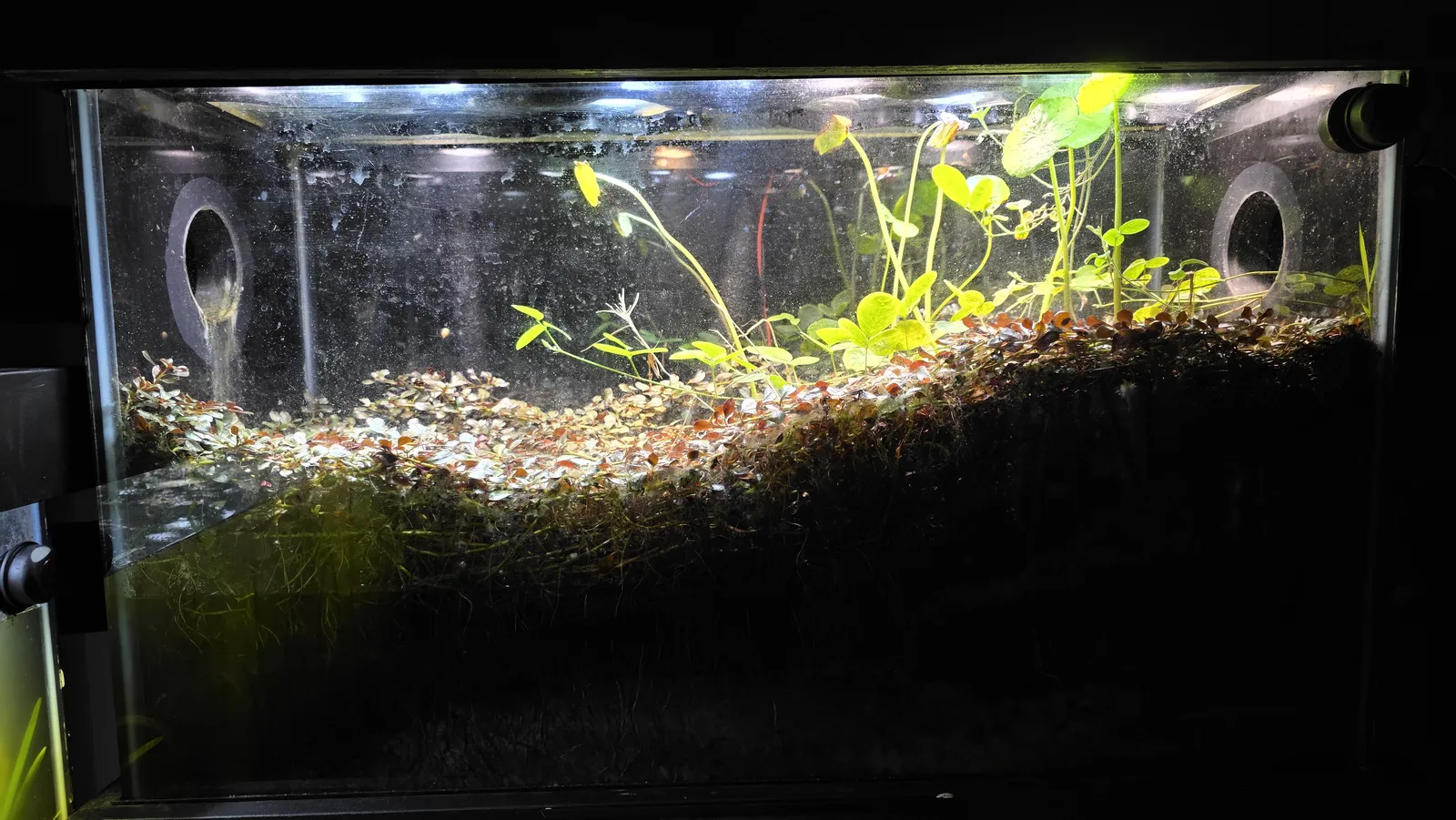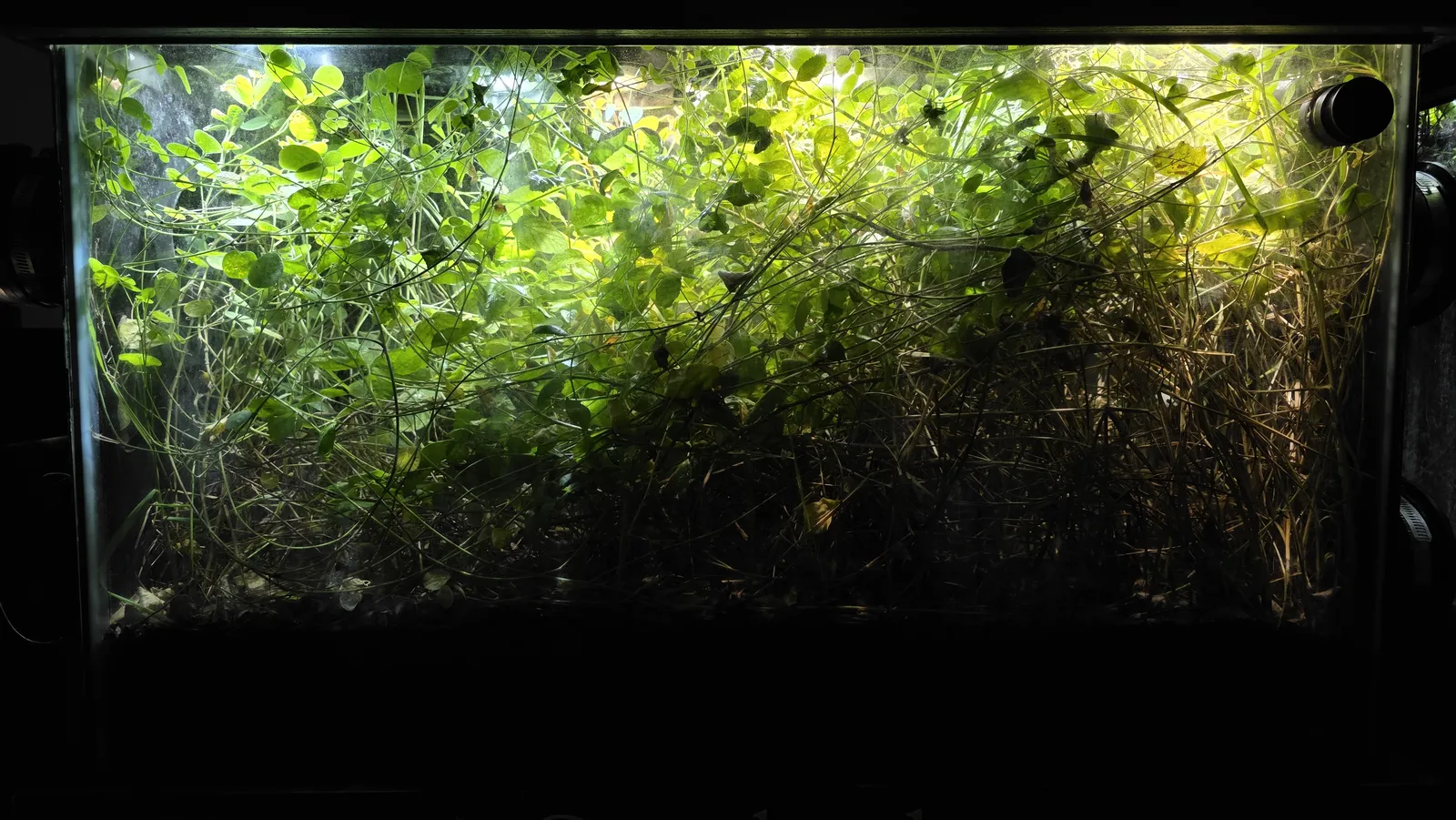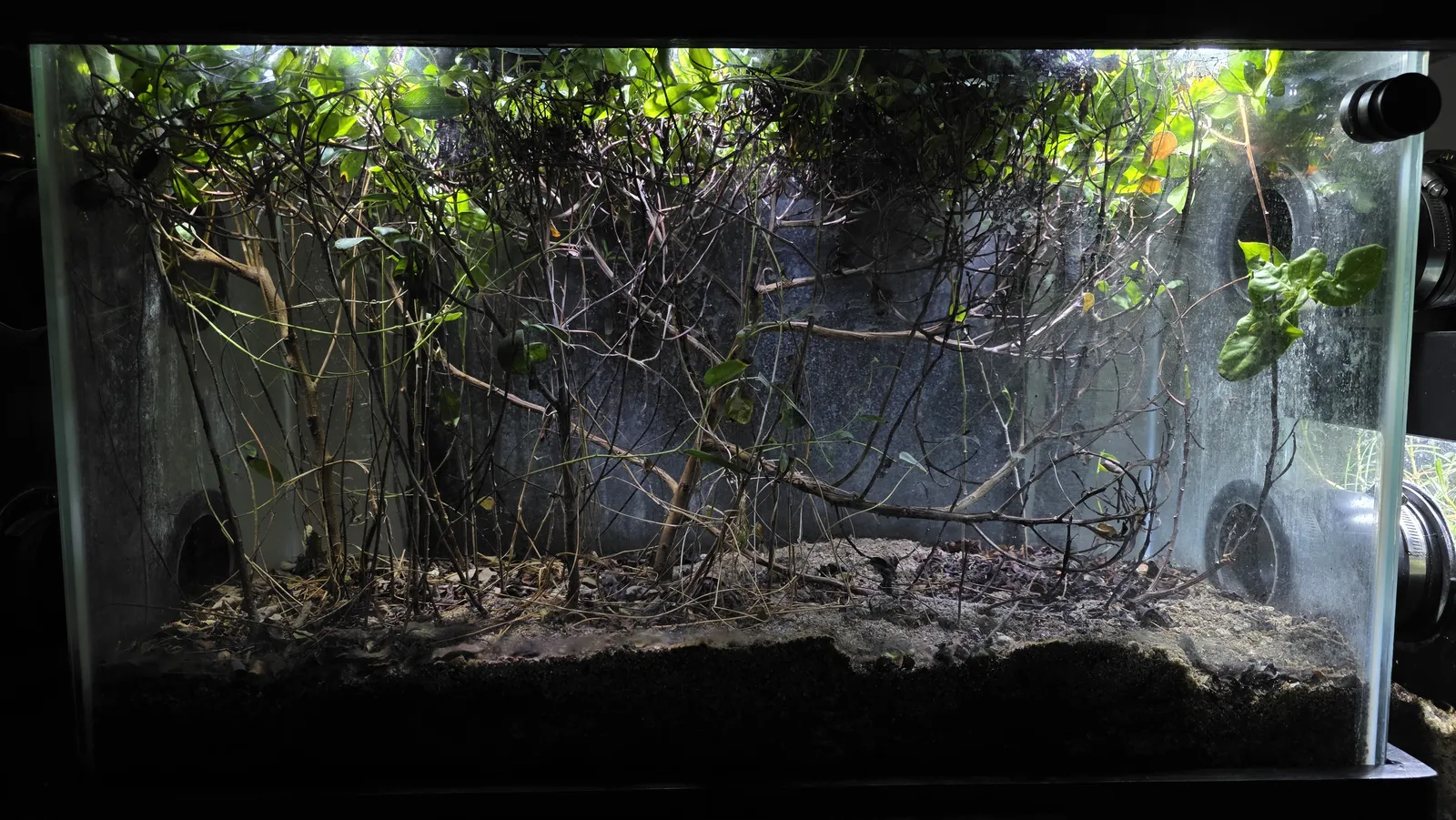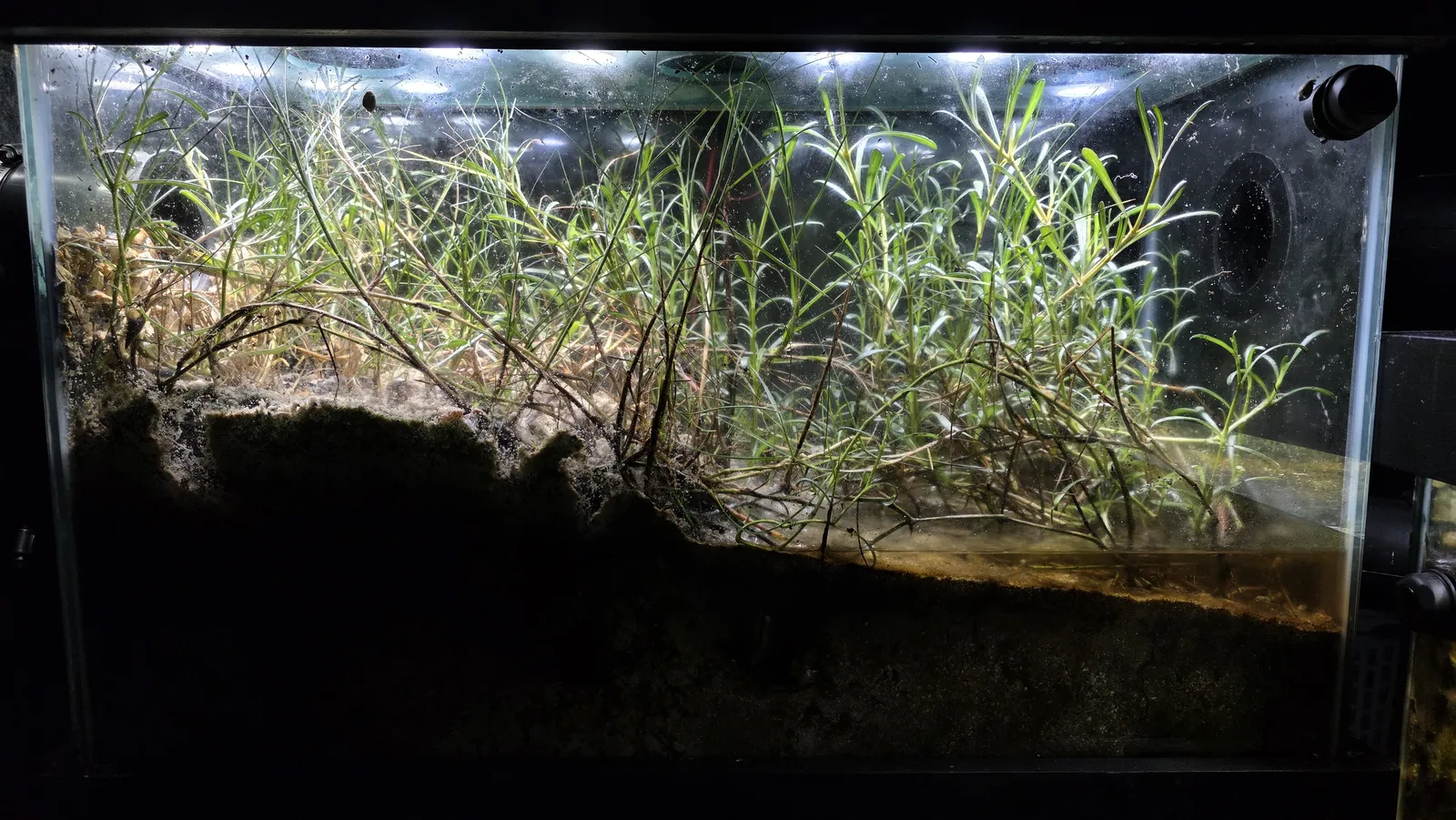
The miniBIOTA Biosphere
A connected living system of habitats, species, engineering, and observation records, built to make ecological change visible at human scale.
This biosphere section will fill in as more project-wide data is documented.
Temperature and humidity across the biomes, shown as live weather conditions.
Not reporting
Not reporting
Not reporting
Partial
Updated just now
Weather partly reporting
Partial
Updated just now
Not reporting right now
Partial
Weather partly reporting
Updated just now
Partial
Not reporting right now
Updated just now
Not reporting
Not reporting
Not reporting
Move from the macro-system into the specific habitats that make up the miniBIOTA biosphere.
Explore the six connected systems that regulate climate, water, light, motion, control, and enclosure inside the biosphere.
The biome light fixtures use standard 50-watt-equivalent 6000K home spotlights because they are inexpensive, focused, powerful, and individually replaceable. After years of constant use, failed bulbs can be swapped one at a time instead of replacing an entire lighting panel.
A 3D printer normally used for ecosystem parts was temporarily redirected to make QR-code bookmarks for Aquashella Orlando. The record marks public outreach preparation for the March 13-14 event rather than an ecology change inside the system.
With the chiller offline and the atmospheres venting, the project shifted into rebuild mode instead of stopping. The next phase focuses on stronger cloud reservoirs, rain distribution, upgraded lighting, spring 2026 organism additions, and improved species-card and condition tracking.
A burning-plastic smell led to the chiller, where a fuse had blown and the pump/compressor circuit would not restart. With the 220-side distribution relay box suspected, the immediate priority became venting the system to stabilize temperature and humidity while troubleshooting the failed cooling hardware.
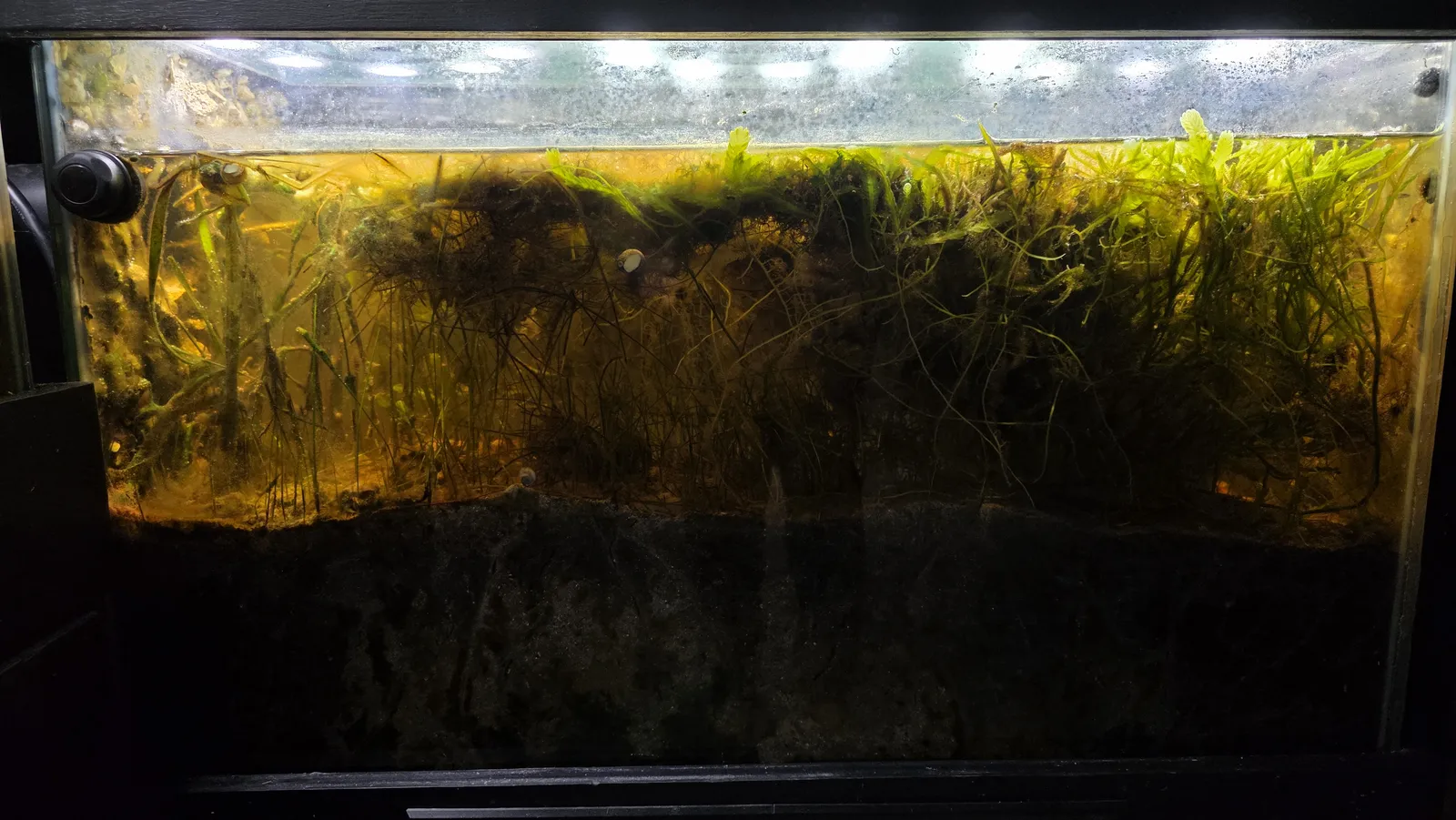
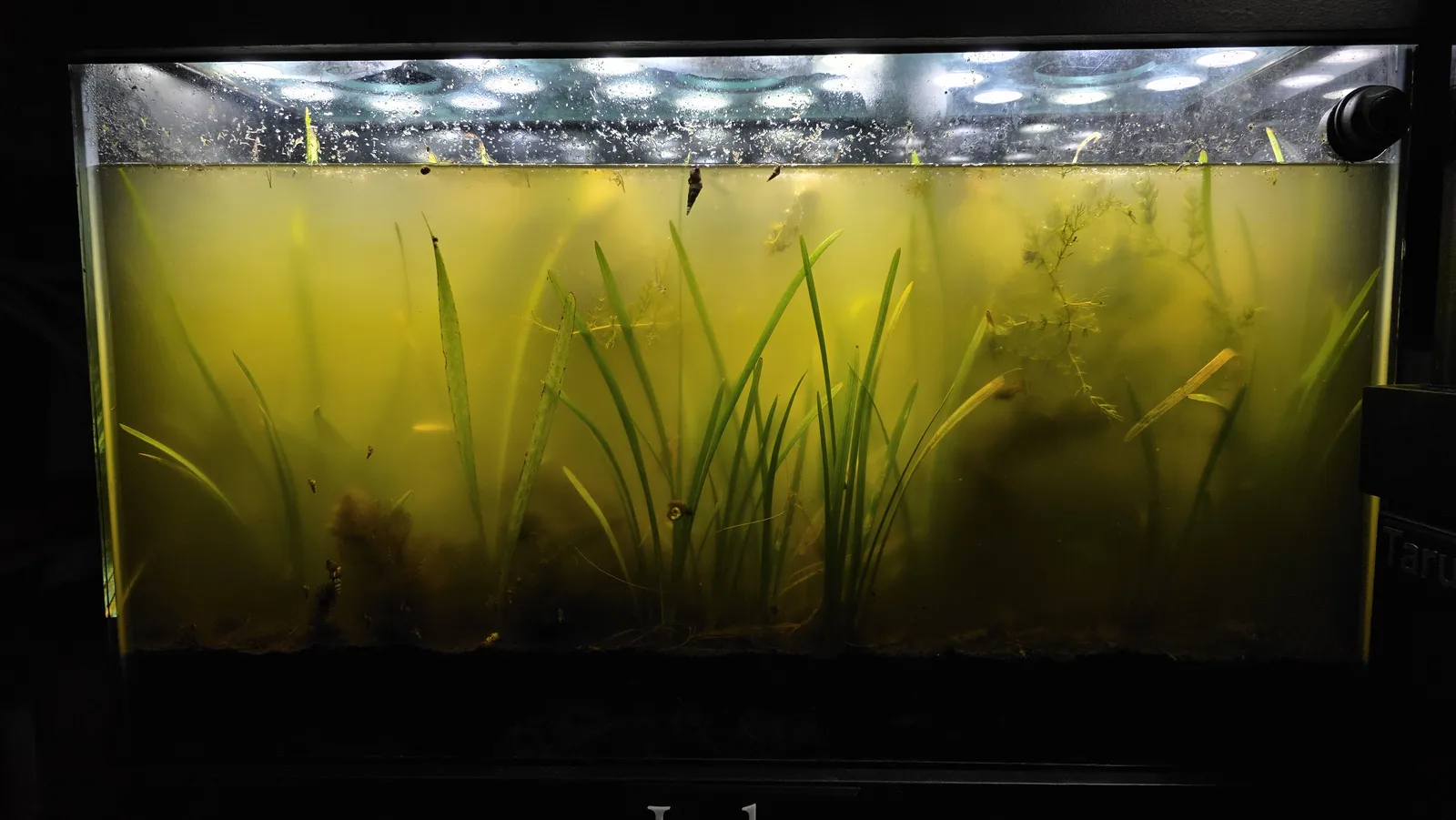
When the plant structure in the Freshwater Lake changed, the effects didn't stay in the lake. Because the biomes share air, water, and nutrients, a shift in one habitat shows up in the others. This longform entry tracks how a transition from macroalgae dominance toward tapegrass establishment changed the lake's nutrient cycling, and what that meant for connected biomes. The ghost shrimp in the seagrass meadow, thriving for over two years, became the reference point for whether the lake could finally support the same species under sealed conditions.
The wave and tide system was rebuilt after the temporary toggle-switch feedback design failed. A rotary encoder mounted to the belt now lets the controller track movement continuously, making the wave motion smoother, quieter, programmable, and stable after more than two months of operation.
Rain is still forming inside the system, but two older atmosphere builds are dropping water through vent openings instead of routing it through the rain manifold. The rusted first-generation bearings make this a cloud rebuild problem rather than a simple hose connection.
A Southern Lugworm seen in the coastal substrate helped reinterpret earlier gelatinous egg sacs that had once been suspected to belong to ragworms. The observation suggests the worm, or others like it, may have been present since the original local substrate was added more than two years earlier.
Tiny unidentified flies appeared on Tapegrass leaves above the waterline after river-edge plants were collected for the Freshwater Lake. Their role is still unknown: they may become spider prey, establish their own niche, or disappear as the sealed system filters accidental arrivals.
Unidentified flies were observed on tapegrass leaves.
Red House Spiders are reproducing throughout the terrestrial areas even though no new insects are being added and prey remains are rarely visible. Their success points to a hidden flow of small arthropods and micro-prey moving through the closed food web.
Florida woods cockroaches moved into the atmosphere tank after the system was sealed and began leaving waste where rainwater collects. The concern is mechanical: future rain events could carry particles into the rain lines and slowly clog the distribution system, so the fix needs to protect the plumbing without blocking organism movement.
Five days into the sealed test, land isopods stayed active and the newly added Tapegrass produced steady oxygen bubbles. Crayfish and snails also continued moving normally, giving the closure test its most important early signal: the system was still holding balance.
Slough Crayfish remains sealed-test animal-response context.
miniBIOTA was prepared for a week-long airtight closure test to see whether the new balance could hold oxygen without outside exchange. The test would run while the willow-to-tapegrass transition continued through rain, grazing, decomposition, and time.
As miniBIOTA approached full closure, the project paused to take stock of how land, water, air, organisms, and infrastructure had shaped each other. The closed phase would leave light and temperature as the main outside influences while air and water cycled internally.
In the final weeks before the Freshwater Lake was sealed into a closed biosphere, each major population had reached a working equilibrium. This longform entry documents the ecological baseline at the moment of closure: what had stabilized, what was still uncertain, and what it looked like for a freshwater system on the edge of becoming fully self-sustaining.
The wave system was repaired enough to run again, putting full closure back within reach. The next planned upgrade would replace limit switches with a rotary encoder so the wave motion could be programmed with position feedback.
The temporary wave system failed again after belt and switch problems, forcing the bubbler back onto the saltwater side. The failure delayed sealing the biosphere and reinforced the need for a more reliable redesigned wave system.
The rain system moved away from siphon logic because the reservoirs fill one drop at a time. A triangular tipping reservoir solved the problem by shifting its center of mass as it filled, letting one final drop trigger a smooth gravity rain event.
The working climate system removed humidity from the habitats, captured water in the atmosphere towers, and returned drier cooler air below. Clear glass confirmed that convection was doing the needed work, opening the path toward sensors, gas monitoring, and full closure.
As the new atmosphere system was being finished, humidity sat near 100% and created risk for some terrestrial insects. Fans were used to vent moisture while millipedes, hermit crabs, and Florida woods cockroaches remained active, making this a transitional stress test before the climate system could balance itself again.
3D printing continued to make miniBIOTA practical by producing light fixtures, tank connectors, rain-system parts, wave-system components, and clean electronics housings. The approach kept costs down and turned custom ecosystem ideas into usable hardware.
As miniBIOTA neared full closure, small 3D-printed ducts and PC fans were added to push air through the heat exchanger panels and speed glue curing. The airflow shortened a process that could have taken weeks, helping the atmosphere tanks move closer to installation and closed-system testing.
All four atmosphere tanks survived heat-exchanger removal and refurbishment, even though one old epoxy joint pulled shallow chips from the glass. With the new heat exchangers ready to glue on, miniBIOTA moved closer to closing the room connection.
Midge fly larvae collected from an outdoor rainwater bucket were introduced to the Freshwater Lake as a potential sediment-layer decomposer. Their red coloring points to hemoglobin adaptation for low-oxygen environments, which makes them a practical fit for a detritus dweller in a sealed system. This marks the first deliberate introduction of an invertebrate chosen specifically for its role in the lake's decomposition layer.
A large lubber grasshopper was considered for miniBIOTA because it was a charismatic herbivore, but its size and water needs made it a poor fit for the current system. The observation stayed outside the ecosystem rather than becoming an introduction.
The external wave and tide system kept saltwater moving without internal pumps or blades, but eight months of use revealed belt, mount, and noise problems. It remained useful at minimum operation while a phase-three redesign was planned.
miniBIOTA prepared for a closed and modular phase where air and water would be contained from the outside room. The next questions focused on gas balance, sensors, dew, lightning, nitrogen fixation, ozone, flying insects, and weekly public tracking on YouTube.
The heat exchanger finally reached the performance needed for closed-system climate control, transferring temperatures down to minus 30 degrees Celsius without dangerous pressure risk. The milestone allowed miniBIOTA to move toward sealed operation, condensation tracking, rain-system work, and biome rebalancing.
A male and female Southern Two-Striped Stick Bug were collected for miniBIOTA as possible herbivores. Their defensive spray made handling risky, but their plant-feeding behavior could add a new herbivore role if they adapted to the system.
A new Wi-Fi light controller added five channels, high current capacity, smooth 20 kHz dimming, and sensor integration. The controller can support sunrise-to-midday-to-twilight simulations while eventually coordinating light, temperature, humidity, pumps, and the heat exchanger.
A grizzled mantis and a larger green mantis were observed outside the system, but not introduced because miniBIOTA already had too much predator pressure. The record preserves the consideration point: mantises are fascinating, but even one could tip the balance in a small biosphere.
A 3D-printed magnetic glass cleaner was built from sealed magnets, silicone, and hook-and-loop pads to clean viewing glass with less disruption. The first test dramatically improved visibility, starting a durability test for whether the tool can work long term.
Water Spangles were browning under lights that were too strong, so temporary XL4016 modules were added to reduce voltage on the fixtures. The adjustment aimed to keep the plants healthy until a new lighting system could be built, while crayfish grazing remained an ongoing pressure.
Slough Crayfish remains grazing-pressure context.
The new atmosphere heat exchanger began working well enough to prove the climate-control concept. It still needed stronger cold transfer, insulation, and sensors, but the test showed miniBIOTA moving toward a closed biosphere with controlled weather patterns.
The new atmosphere heat exchanger was nearly ready to connect to the chiller. If the system could regulate air temperature and return condensed water as rain, miniBIOTA would be closer to sealing the tanks as a controlled closed biosphere.
An unidentified group of insects moved together in a tight line, froze at the same time, and then restarted in sync after one individual twitched. The behavior looked coordinated rather than random, making the observation a clear identification and behavior question.
A water treader attacked a cricket nymph that fell onto the water surface, then another water treader displaced it and took over the meal. The observation showed that even the freshwater surface had become an active predator zone.
Cricket remains prey context for water treader behavior.
Lakeshore/freshwater surface context for water treader predation.
The next engineering focus shifted to rebuilding atmosphere heat exchangers and connecting the chiller. Those systems would let miniBIOTA regulate upper and lower tank temperatures, drive weather, and eventually control seasonal conditions across the biosphere.
A Regal Jumping Spider found on the house was added to miniBIOTA even though predator pressure was already a concern. The spider immediately disappeared into the brush, entering a large habitat with springtails, isopods, and young roaches as possible prey.
A large Southern Lubber grasshopper found outside miniBIOTA was documented but not introduced because it was too large for the ecosystem. The record now routes to the Southern Lubber species entry while preserving that this was an outside observation, not a miniBIOTA introduction.
A female fiddler crab was observed carrying eggs after earlier courtship activity on the marine side. The timing increased pressure to restore the wave system, since the crabs were still holding on while water movement was not yet fully repaired.
Marine Shore context for fiddler crab reproduction.
Termites were added to the Lowland Meadow as a possible biological answer to accumulated dead grass. Because they can feed on cellulose and burrow underground, they became a candidate detritivore population that might reproduce quickly and help break down grass without hand-removal or risky fire-based disturbance.
A mass of worms or wormlike tentacles emerged while oxygen levels were low in miniBIOTA. The organism was not confidently identified from the footage, so the chronicle preserves the observation as an open identification question tied to low-oxygen behavior.
After the move, miniBIOTA was not fully assembled yet, but the new garage setup was taking shape. Temporary air conditioning was installed first to hold the room near 76 F, aeration was keeping the tanks stable, and the next step was reconnecting the wave system and linking the tanks back together.
Grasshoppers were reintroduced while the atmosphere tanks were still offline, so a temporary fan was added to push drier air into the biosphere. The test was designed to see whether excess humidity had been the missing factor behind earlier grasshopper failures.
The custom miniBIOTA light fixture was shown as a 3D-printed housing built around MR16 bulbs, snap connectors, and simple low-voltage wiring. The demonstration preserved the assembly method behind the modular lighting system used across the biosphere.
The lighting system used inexpensive 6000K MR16 bulbs in modular 3D-printed fixtures instead of conventional aquarium lights. The design made failed bulbs easy to replace, let fixtures be resized, and continued supporting Ludwigia, mangrove, grasses, and other plant growth.
Two days after duckweed was added, the floating plants had been completely eaten instead of spreading like they often do in aquariums. The result framed duckweed as a highly palatable food input for the freshwater food web rather than an immediate nuisance plant in miniBIOTA.
Freshwater Lake context: user confirmed duckweed was added to the lake biome and lakeshore.
Lakeshore context: user confirmed duckweed was added to the lake biome and lakeshore.
A small amount of duckweed collected from Orlando lakes was added as a possible competitor against the algae in the freshwater side. The trial began with uncertainty: the duckweed could either be eaten quickly or establish enough surface growth to change the plant balance.
Filamentous macroalgae remains competing producer context.
Freshwater Lake context: user confirmed duckweed was added to the lake biome and lakeshore.
Lakeshore context: user confirmed duckweed was added to the lake biome and lakeshore.
The marine wave system failure was traced to a slightly angled motor mount that shredded the belt. A redesigned adjustable mount got the system running again, but the outage caused at least one slipper snail to die after losing access to tidal water.
A shredded belt stopped the marine wave system after the belt began riding up against an edge. The failure forced a redesign around the motor mount and returned the tank to bubbler support until the wave system could be repaired.
miniBIOTA's next location was announced: a full garage dedicated to the ecosystem. The move would allow more tanks, more biomes, and future additions such as river, estuary, and possibly reef habitats within the Florida ecosystem concept.
The atmosphere tanks were identified as the next major closure priority because they prevent stale, saturated air and drive the internal rain cycle. The rebuilt system needs heat exchangers, cloud reservoirs, rain routing, and a chiller loop capable of condensing water back into the habitats.
The wave system ran overnight without the airstone, and the usual low-oxygen warning signs did not appear. Worms stayed in the sand instead of rising for oxygen, showing that the wave motion could keep the marine water oxygenated and move the project forward.
The wave-system stepper motor was overheating while holding position, so a fan-cooled housing was designed and tested around it. After running all day, the motor measured about 36 C, showing that the cooling assembly could keep the mechanism warm rather than dangerously hot for full-time operation.
Limestone in the biosphere was visibly chipping and breaking down without direct intervention. Heat, cold, salt, and internal weather patterns may have been driving a real weathering process inside the habitat, turning rock breakdown into another long-term ecosystem dynamic.
The biosphere was down to its last visible grasshopper, so humidity and temperature were measured directly. Daytime readings were moderate, but nighttime humidity reached about 93 percent, suggesting that overnight moisture may be one reason the grasshoppers were failing to persist.
The marine wave system began running with a basic sine-wave program, pushing and pulling water while keeping the mechanism outside the habitat. The motion was gentle, oxygenated the water, and showed that future tide-chart programming could build on the same system.
The wave system prototype moved onto a belt-driven linear drive powered by a stepper motor. The rough assembly was designed to pivot a pipe up and down, eventually allowing miniBIOTA to generate programmable wave conditions and follow a tide chart from outside the sealed habitat.
The earlier wave mechanism was retired in favor of a belt-driven stepper motor design that could be programmed with different wave patterns. Early tests showed the motor following a sine wave, opening the door to waves tuned for speed, period, and tank resonance.
The wave maker improved after the guide arm was redesigned with three bearings contacting the PVC pipe instead of plastic rubbing directly on it. The change reduced sticking and moved the mechanism closer to reliable operation, though more refinement was still needed.
With miniBIOTA established but carrying too much dead grass and detritus, 20 grasshoppers and 7 crickets were added to increase herbivory. The goal was to see whether a stronger insect layer could consume aging plant material and visibly transform the landscape over the following weeks.
This short announced that miniBIOTA updates would move more heavily onto YouTube, with both shorts and longer videos documenting the build in greater detail. It also captured a moment when the system was chemically balanced but visually stressed, with major changes ahead for the habitat and content workflow.
Green water returned after the sponge declined, while filamentous macroalgae disappeared from the grass blades. The shift suggested that available nutrients were moving into whichever algae layer could capture them without being eaten, revealing a balance between plankton, microalgae, and macroalgae.
The wave system was nearly abandoned because the original motor lacked torque and moved too quickly. A 12-volt window lift motor changed the direction, offering slower, stronger rotation that could drive the main gear and integrate with the linear actuator for tides.
The wave and tide system was running with basic controls, but the mechanism was too loud and only produced gentle waves. It could still become useful for slow tide movement across a day, while the released longform video documented the broader system.
The second wave and tide design worked but was noisy, so a linear actuator was added to move the mechanism in a more controllable way. The update showed the system moving toward programmable tide control while keeping all powered mechanics outside the ecosystem.
After heavy algae pressure, most of the sponge appeared lost, but a small colored section still suggested possible survival. The light period was reduced to slow algae growth, and the oysters on the other side still appeared to be doing fine while the system waited for better water movement.
The marine tank looked artificially different after a major manual algae removal. Although the mottled shore crab had been grazing algae, the sponge appeared overwhelmed, so algae was removed by hand to restore water flow around the sponge and try to keep it alive.
A rough 3D-printed prototype demonstrated the core wave and tide concept: a pipe would push and pull water to create waves, while the whole mechanism could move vertically to change tide level. The prototype was noisy and rough, but it proved the mechanical direction.
The ecosystem project was beginning a shift toward longform videos, which meant fewer shorts while the wave system and broader documentation continued. The update also introduced the OpenOcular smartphone-to-microscope adapter and the plan to use it for close-up observations.
A wave and tide system was being designed from scratch for the coastal marine ecosphere. The design needed to be gentle on plankton, strong enough to create realistic current, able to simulate tides, contain water, and remain repairable from outside the future closed system.
After sponges and oysters cleared the plankton, nutrients shifted into filamentous algae growing across the marine system. More shore crabs became the next proposed control layer because existing females were already eating the algae, but males were needed for a reproducing population.
A second jellyfish species appeared in the coastal ecosystem, perching with tentacles spread like a web while small plankton and a swimming worm moved near it. Its identity was still unknown, making this another unexpected marine diversity record.
A nighttime marine observation showed the sponge actively ejecting filtered water, tiny jellyfish in medusa stages using the current, and another round of porcelain crab zoea drifting through the system. The entry captures a dense nighttime food-web scene shaped by sponge-driven water movement.
After sponges and oysters cleared the plankton, dissolved nutrients became available to macroalgae growing over the seagrass. The algae bloom looked messy, but it created food and shelter for amphipods and isopods, setting up a possible trophic cascade into higher-level animals.
The wave system build advanced with a brace that kept the U-bend still so it would not add pressure to the glass or coupler. The flexible coupler remained the moving part, allowing a future actuator to raise and lower the chamber and push water in and out of the ecosystem.
A nighttime observation in the clearer saltwater system revealed a pipefish hunting through the grass and tiny zooplankton moving through the water. The plankton were identified as porcelain crab zoea, meaning the porcelain crabs were reproducing inside miniBIOTA.
A pistol shrimp expanded a simple burrow into a deeper tunnel network visible against the glass, even cutting through roots with its claw. Another pistol shrimp used shells as functional barricades around its home, apparently trying to keep porcelain crabs out.
A day and a half after the oysters were added, the water looked much clearer as the oysters filtered plankton and algae from the water column. Their waste also became a new food source for shrimp, creating a visible new connection in the food web while the wave and tide system was still unfinished.
Five oysters donated through a viewer connection were added to the marine ecosystem and began affecting the algae within the first two hours. The test asked whether five oysters could provide the right amount of filtration for the system before they were permanently attached in place.
A duplicate update recorded the same pause in wave and tide system work while OpenOcular was prepared for Maker Faire Orlando. The remaining build steps were the stabilizing frame and linear actuator for automated reservoir movement.
Work on the wave and tide system paused while OpenOcular was prepared for Maker Faire Orlando. The wave project still needed a stabilizing frame and linear actuator before the reservoir could be driven up and down automatically.
A squareback marsh crab escaped from the system during an atmosphere refurbishment and was found crawling on Josue's leg. The incident exposed a temporary escape path while the atmosphere tanks were being rebuilt, and the crab was returned to the habitat.
miniBIOTA 1 was supporting a thriving population of Common Atlantic Marginella snails, including a confirmed second generation. The appearance of baby marginellas showed that the system could sustain detritus- and meat-eating snails through reproduction, not just survival.
The saltwater ecosystem had been running without pumps or filters because the plankton layer was feeding baby shrimps and other life in the water column. A sponge became a candidate filter predator that could reduce excess plankton while also creating habitat and passing energy through the food web.
Condensation forming high on the atmosphere glass revealed the basic physics miniBIOTA would rely on for a closed water cycle. Warm humid air rose, cooled against the upper glass, and condensed there; once connected to the chiller, that same process could be used to drive rainfall without manually adding water.
The flat-backed millipede population remained strong after close to a month in the miniBIOTA 2 system, with no predators visibly reducing their numbers. The entry supports the idea that this detritivore group could persist long enough to help process dead plant matter.
A parasite was removed from a tiny shrimp using forceps and a dental scraper under the microscope. After the parasite was separated, the shrimp was returned to the ecosystem to continue living parasite-free.
The second wave and tide system update showed how water movement could be driven from outside the sealed ecosystem. The planned mechanism would move a chamber up and down to create waves, hold high tide, and lower the water again without disturbing the animals inside.
A possible shore crab pair was observed away from the fiddler crabs, with the female appearing to fan eggs. The species identity was still unresolved, but the egg-bearing female marked another reproductive event in the coastal system.
The early wave and tide concept used a moving reservoir that could raise and lower water to create both wave motion and tide effects. The design still needed refinement, but it established the basic direction: an external motorized mechanism that could move water rhythmically without placing powered equipment inside the habitat.
A new PETG rain system was installed on miniBIOTA 2, using glued channels, soaker hose, capped ends, and silicone tubing from the atmosphere tank. Once water ran through the cloud reservoirs and into the hoses, it fell back into the biome as rain.
The day after the clams were added, the water was already clearer, but mud crabs were harassing the clams and at least one clam was lost. Rooted substrate also prevented the clams from burrowing, making the addition useful but temporary while the system's balance was reassessed.
Twenty-three clams were added to miniBIOTA to test whether they could filter the plankton bloom and clear the water. A mud crab immediately tried to pry one open, confirming crab predation pressure and raising the likelihood that mud crabs would need removal for a more balanced system.
A nighttime flashlight check showed that the previously noticed plankton had developed into abundant baby shrimps in the mysis stage. The same observation also revealed a surprise baby pipefish hunting among copepods, adding a new hitchhiker predator to watch.
A Cocoa Beach estuary search for suitable clams did not produce the right bivalves for miniBIOTA, but it revealed horseshoe crabs, macroalgae, and other organisms from the local ecosystem. The entry records both the field context and the next potential stocking material.
miniBIOTA 2 had been running for more than two years, with crayfish, fish, snails, roaches, isopods, insects, and other arthropods cycling through multiple generations. The entry documents a stable closed-system food web sustained by light alone.
miniBIOTA 1 was holding steady, and baby Cerith snails were visible across the grass blades after earlier uncertainty about whether the snails were maturing. Along with Lightning Nerites, the young snails were grazing algae from surfaces and helping the tank stay clearer without pumps or filters.
Nerite snails are mentioned as grazing algae in the transcript.
A nighttime look into miniBIOTA revealed a shrimp carrying eggs and many tiny larval crustaceans moving through the water column. Their exact identity was still unknown, but the observation added a new reproductive signal to the marine system.
Hurricane Milton passed without taking power from the Orlando site, leaving miniBIOTA safe from the expected outage risk. With the immediate threat over, the next recovery step was to restock the tank with clams that could help clear the water.
Two solar panels were prepared as a backup power plan for the tank most vulnerable to oxygen loss during Hurricane Milton. The setup was meant to keep light reaching the system if grid power failed, while the other systems would have to endure darkness for as short a time as possible.
With Hurricane Milton approaching Orlando, miniBIOTA faced a serious power-loss risk. The aquatic system depended on light-driven oxygen production, and even a day without power could have pushed the water column toward ecological collapse.
Cloudy water was linked to microorganisms drawing down oxygen in the water column, especially at night when grasses were no longer producing oxygen. The entry identifies the bloom as both a visibility issue and a water-quality stressor.
The coastal system was still running, but cloudy water revealed a dense layer of microorganisms in the water column. A pistol shrimp was pregnant again, raising the possibility of another reproductive event, while the failed small clams pointed toward a future need for larger natural filter feeders.
The old drip-style rain system was replaced with a new 3D-printed rain delivery setup for testing. This entry records the first trial of that replacement as part of miniBIOTA's continuing water-cycle engineering work.
A custom 3D-printed LED light fixture was built to support the ecosystem while reducing reliance on less efficient lighting. The change was part of the broader effort to manage plant and algae growth without letting fast growth become a long-term imbalance.
A short visual entry preserved a lady crab feeding moment inside the coastal system. The record keeps the animal behavior in the public timeline even though the transcript itself captured mostly music rather than narration.
The miniBIOTA 1 revamp was interrupted when changing sand led to a tank-bottom failure and a major water release. The immediate focus shifted from rebuilding the habitat to cleaning up the flood and finding a way forward.
A new rain distribution design was tested as an alternative to the earlier approach. The goal was to find a way to move water across miniBIOTA's biomes more evenly and reliably before the atmosphere system became fully enclosed.
The high-power chiller was connected to miniBIOTA's atmosphere system for the first time. Only the cold side was online at this stage, but the connection made it possible to begin testing whether the atmospheres could function as designed.
Testing the chilled-water distribution reservoir exposed leaks in both the reservoir and the heat exchangers behind the habitats. The failure showed that the glue used on the exchanger assemblies was not strong enough, forcing a rebuild before the external cooling system could reliably support miniBIOTA's atmosphere.
The ecosystem's habitats were physically linked through separate pathways for air, surface movement, and underground soil connections. Those links allowed the habitats to behave less like isolated tanks and more like connected parts of one biosphere.
A 240-volt chiller capable of reaching about minus 30 degrees Celsius was connected for miniBIOTA's atmosphere system. The cold loop is meant to drive convection: cold air falls, warm humid air rises, water condenses into reservoir clouds, and later returns to the habitats as rain.
Additional plants and animals, including filamentous macroalgae and sponges, were added to increase biological opportunity inside miniBIOTA. The system looked chaotic, but the new diversity created more surfaces, niches, and food-web potential.
Day 21 of the marine ecosystem - life flourishing in the new year. Caulerpa prolifera covering ground quickly. Sand hoppers (lawn shrimps) colonizing the beach. New plants sprouting in coastal habitat. Spans Mangrove Forest, Marine Shore, Seagrass Meadow.
The original DIY chiller, built from a mini-fridge-style cooling loop and pump, showed that the atmosphere system could be cooled mechanically. Even though it was only an early version, it proved the direction needed for stronger climate control.
Day 5 - atmospheres removed, water evaporating. Mangrove Forest looks barren. Water topped off to replace evaporated loss. Hundreds of land amphipods (lawn shrimps), insects, and spiders hiding. Water traveled through substrate to the ocean carrying nutrients. Awaiting new chiller.
Day 4 - meeting the inhabitants: Daggerblade Grass Shrimp, Eelgrass Isopod, Long-armed Hermit Crab, Clingfish, Naked Goby, unknown snail. More still to discover. Spans marine side of system.
Day 3 after stocking - pan across Mangrove Forest, Marine Shore, and Seagrass Meadow showing thriving system. Unknown Mermaid's winecup visible.
A small Cladonema jelly became an early focal organism in the marine system. Its movement and visibility made it one of the first charismatic animals in the newly stocked coastal environment, helping anchor the second day of observation.
The marine environment reached its first day as a stocked miniBIOTA system. The entry serves as the opening marker for the coastal ecosystem's public timeline and the beginning of day-by-day observation.
A new biosphere build was underway, capturing an early formation stage before the system looked complete from the outside. This entry preserves the transition point where the structure and habitat plan were beginning to take shape.
The full atmosphere assembly was test-fitted with reservoir clouds, a rain manifold, and routing hoses. The open hose ends still needed sealing and perforation, but the layout showed how water could be directed back into the habitats as rainfall.
The newly built atmosphere clouds were tested for the first time, starting the proof-of-concept work for miniBIOTA's internal rainfall system. This entry marks the first live trial of the reservoir-cloud design before later tuning of leaks, flow, and rainfall behavior.
Testing showed that a single upper reservoir cloud could trigger the clouds below it when they were already full. The cascade effect demonstrated how different reservoir fill levels could create lighter rain or a heavier storm event inside the atmosphere system.
A chiller and heat exchanger prototype successfully moved cold water behind the habitat glass, proving that external cooling could transfer temperature into the sealed atmosphere. The test showed that chilled glass could drive condensation and support the internal water cycle miniBIOTA needs, making the next atmospheric build step possible.
miniBOITA began as a 29 gallon terrarium tank filled with soil from the nearby forest and my favorite fern, the rabbits foot fern. I would continue to add various bits of moss and insects to observe their interactions