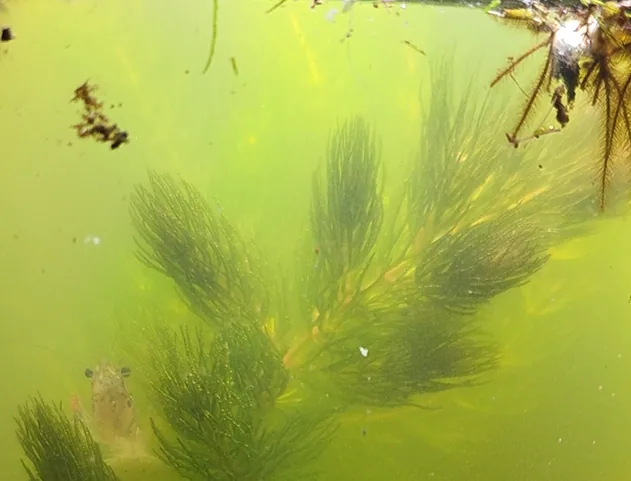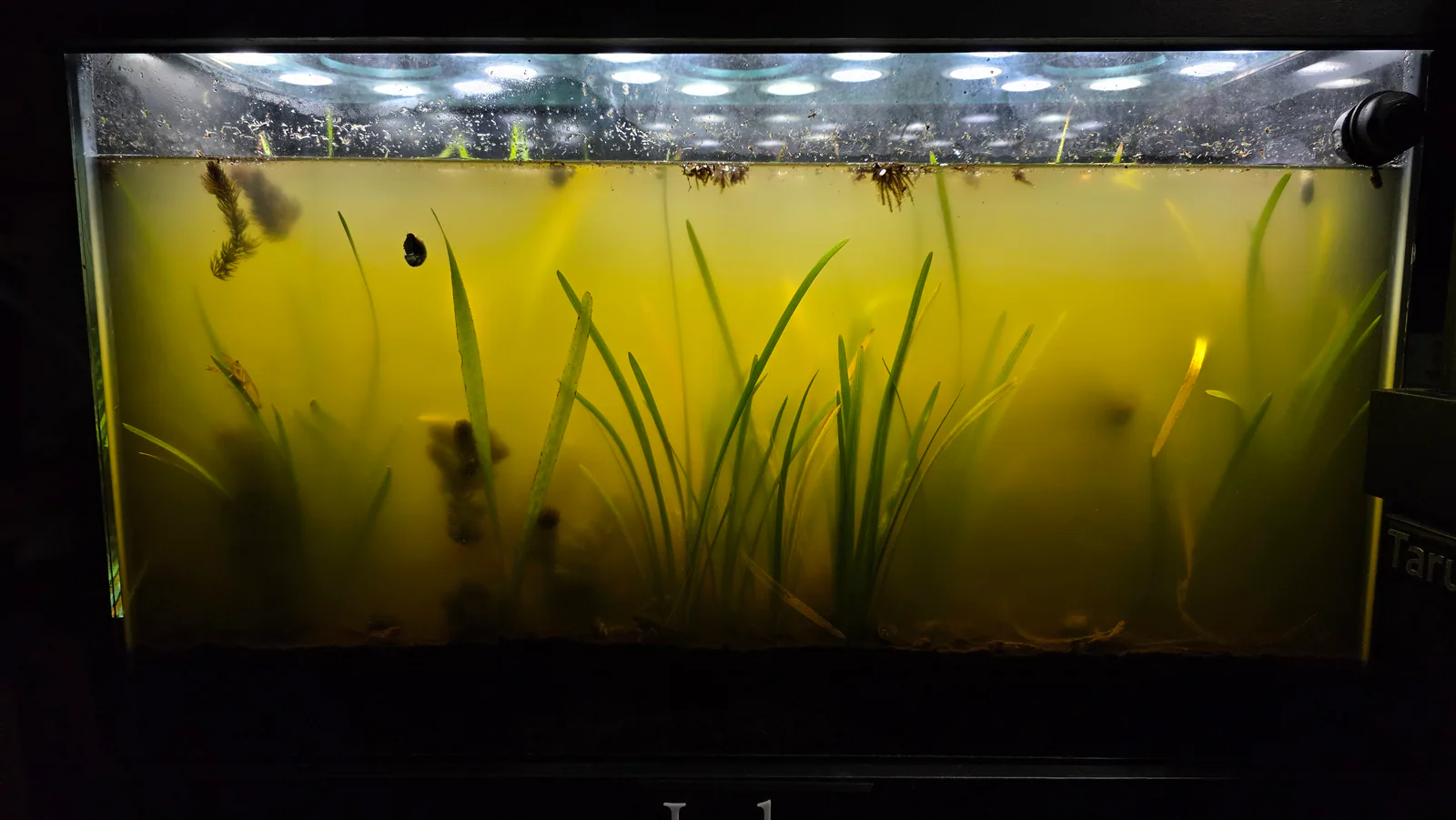
Ceratophyllum demersum

Hornwort

A rootless submerged plant that floats freely in the Freshwater Lake, absorbing nutrients directly through its dense whorled leaves, suppressing algae through chemical compounds it releases into the water, and providing shelter for invertebrates.

Visual Data Unavailable

Overview

A fully submerged aquatic plant (Ceratophyllum demersum) listed in the Freshwater Lake biome. Hornwort is rootless, free-floating, and native to Florida's freshwater systems. It is one of the most widely distributed aquatic plants in the world and a common component of freshwater aquaria. No dedicated observation file has been archived for this species; introduction date, source, and current status are all unknown.

Identity

  • Common name: Hornwort
  • Alternate names: Coontail, rigid hornwort, coon's tail
  • Scientific name: Ceratophyllum demersum
  • Identification confidence: Species level
  • Uncertainty label: Uncertain

Taxonomy

  • Kingdom: Plantae
  • Phylum: Tracheophyta
  • Class: Magnoliopsida
  • Order: Ceratophyllales
  • Family: Ceratophyllaceae
  • Genus: Ceratophyllum
  • Species: Ceratophyllum demersum

Natural History

Ceratophyllum demersum is one of the world's most widespread freshwater plants, found on every continent except Antarctica. In Florida it is native and common in lakes, ponds, slow-moving rivers, ditches, and canals. It tolerates a broad range of conditions and grows particularly well in warm, still or slow-moving water with moderate to high nutrient levels.

The most distinctive feature of Hornwort is the complete absence of roots. Unlike most aquatic plants, which anchor in substrate and absorb some nutrients through root systems, Ceratophyllum demersum is entirely rootless. It floats freely in the water column or rests loosely on the substrate and absorbs all water, carbon dioxide, and dissolved nutrients directly through the surface of its stems and whorled leaves. The leaves are stiff and forked, with small tooth-like projections along the margins that give the plant a rough, bristly texture and contribute to its common names ("coon's tail" from the bushy, feathery appearance; "hornwort" from the horned projections). Stems are branching and can extend one to three meters in well-lit, nutrient-rich conditions.

Hornwort is one of the faster-growing aquatic plants under suitable conditions. In warm water (22 to 28 degrees C) with adequate light and dissolved nutrients, it can add several centimeters of new stem growth per day, quickly establishing dense beds that exclude competing vegetation by shading and through chemical inhibition. Ceratophyllum demersum releases allelochemicals (polyphenolic compounds) into the water that inhibit the germination and growth of certain algae and competing aquatic plants. This allelopathic effect is well documented and considered one of the mechanisms by which Hornwort can rapidly dominate a still-water system.

Reproduction is almost entirely vegetative: stem fragments break off and establish new plants wherever they settle. Sexual reproduction produces small spiny nuts (achenes), but fragmentation is the primary means of spread in managed and enclosed systems. In a closed aquatic system with no surface outflow, fragments remain in the system and re-establish readily.

Hornwort tolerates a wide range of pH (6.0 to 9.0), temperatures (5 to 30 degrees C), and light conditions, including lower light where other submerged plants cannot grow. It is one of the few fully submerged plants that does not require a rooted substrate, making it particularly suited to bare-bottom aquarium environments and deep open-water zones.

Ecological Role

Ceratophyllum demersum functions as a primary producer, converting light, CO2, and dissolved nutrients into plant biomass. In freshwater systems, dense Hornwort growth provides structural habitat: the branching, bushy stems offer refuge and foraging surfaces for invertebrates, small fish, and snails while also producing oxygen through photosynthesis during daylight. At night, like all plants, it consumes oxygen through respiration.

The allelopathic properties of Hornwort make it ecologically unusual among aquatic plants. By releasing inhibitory compounds into the water column, dense Hornwort can reduce phytoplankton and filamentous algae populations, contributing to water clarity without direct grazing. In a closed system like miniBIOTA's Freshwater Lake, this effect could complement grazing by snails and microcrustaceans in reducing algal biomass.

Slough Crayfish were confirmed grazing heavily on Hornwort within one day of its June 30, 2026 introduction, climbing to the water surface to feed on it directly. This rapid grazing pressure means Hornwort's ability to function as either a nutrient sink or an allelopathic algae suppressor now depends on whether its growth rate can outpace crayfish consumption.

In miniBIOTA, Hornwort coexists in a lake that also has tapegrass (Vallisneria sp.). The two plants would compete for light, CO2, and dissolved nutrients. Tapegrass is rooted and prefers high light with a stable substrate; Hornwort is rootless and more shade-tolerant. In a well-lit tank, tapegrass is likely the dominant macrophyte, but Hornwort's ability to grow in the water column without substrate gives it access to zones tapegrass cannot occupy.

The bushy structure of Hornwort would also provide refuge for microcrustaceans such as water fleas and copepods, particularly in areas without tapegrass coverage. This complements the Lakeshore's vegetated margin as a refuge zone.

miniBIOTA Evidence

Introduction context: Unknown. No introduction record, source origin, date, or observation file has been archived for Hornwort. The species is commonly available in aquarium supply and could have been introduced as a plant addition at any point in the Freshwater Lake's history. Vegetative fragments could also have arrived with other aquatic plant material.

Observation timeline:

  • June 30, 2026: A section of hornwort introduced to the Freshwater Lake as part of a broader nutrient-reduction effort, alongside filamentous algae and a four-species duckweed trial. Introduced as fast-growing submerged plant biomass with the goal of absorbing dissolved nutrients from the water column. Slough Crayfish are expected to graze the hornwort; the strategy relies on plant growth rate exceeding consumption rate. No fish currently present in the lake. Light intensity briefly reduced following the introduction then restored to full the same day. Observation record, June 30, 2026.
  • July 1, 2026: One day after introduction, Slough Crayfish observed climbing to the water surface and concentrating heavily on hornwort, consuming large amounts of plant tissue alongside the filamentous algae growing intertwined with it. The observer predicts the introduced plants may again be eliminated before establishing. Video documented. Observation record, July 1, 2026.

Confirmed:

  • Hornwort introduced to the Freshwater Lake on June 30, 2026 as submerged nutrient-absorbing plant biomass.
  • Slough Crayfish confirmed grazing heavily on hornwort as of July 1, 2026, one day after introduction.

Inferred:

  • If growth rate exceeds consumption rate, hornwort functions simultaneously as a nutrient sink and a crayfish food source.
  • The absence of fish (compared to prior trials) may improve persistence odds.
  • Given the rate of consumption observed July 1, 2026, hornwort may be eliminated again before establishing (owner prediction; not yet confirmed).

Unknown:

  • Whether hornwort growth will outpace Slough Crayfish consumption under current conditions.
  • Whether the June 30, 2026 introduction will result in an established population.
  • Whether hornwort reaches sufficient density to produce allelopathic effects on the algal community.
  • How hornwort interacts competitively with tapegrass for light and nutrients if it establishes.