Vallisneria americana

Tapegrass

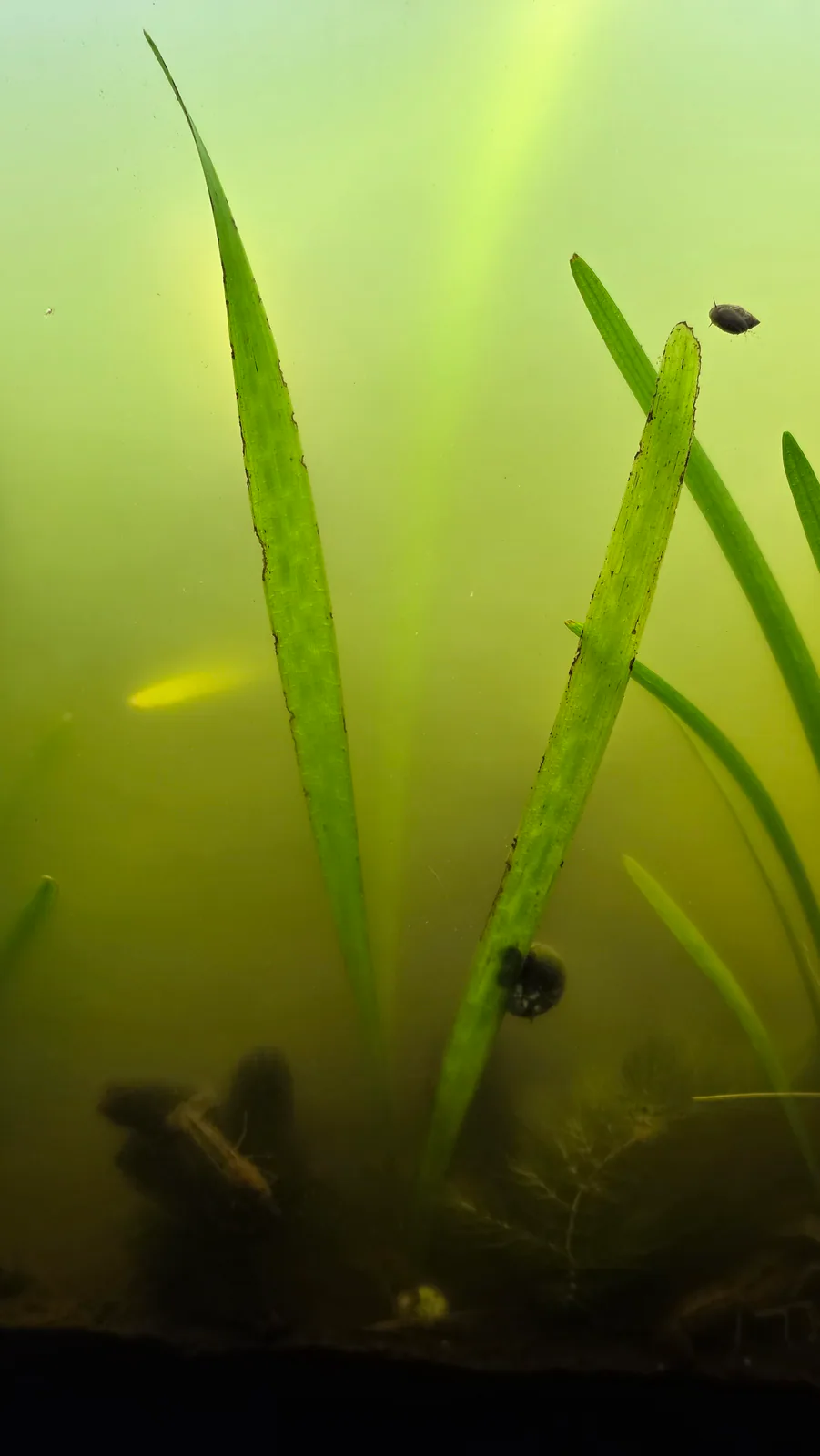
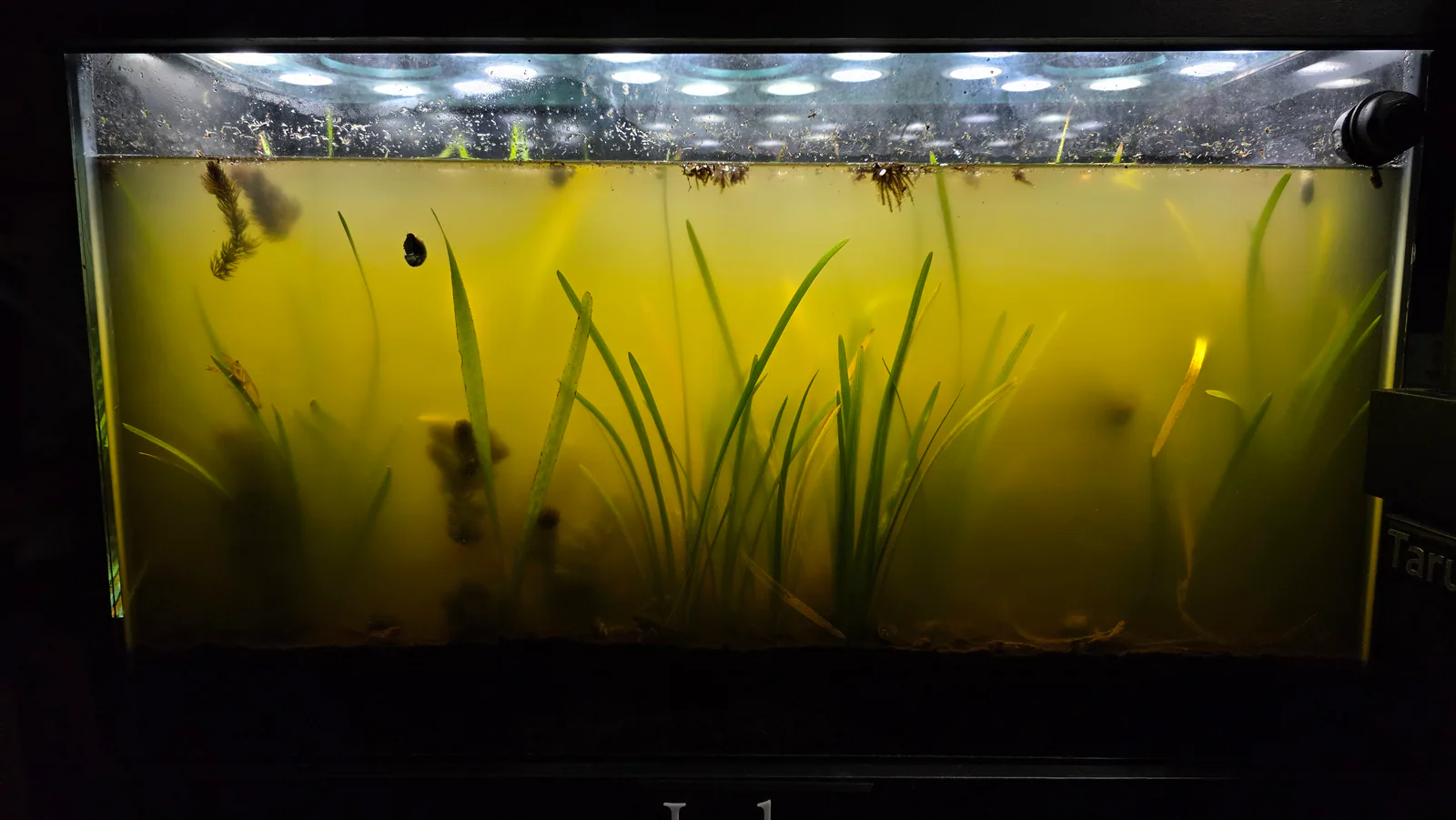
Rooted in the Freshwater Lake substrate, Tapegrass extends ribbon-like leaves through the water column, providing surfaces and shelter for small invertebrates and, during active growth, producing a continuous stream of oxygen bubbles from its leaf tips while older leaf tissue is grazed by crayfish.

Visual Data Unavailable

Overview

Tapegrass is a submerged freshwater plant rooted in the Freshwater Lake substrate, where it extends long ribbon-like leaves through the water column and provides surfaces and shelter for small invertebrates. It has been in the Freshwater Lake since June 2025, with a second addition of river-collected plants in January 2026. Its photosynthetic activity has been directly observed through continuous bubble streams rising from leaf tips, and its older leaf tissue is an active food source for Slough Crayfish.

Identity

  • Common name: Tapegrass
  • Alternate names: Eel grass, wild celery, tape grass, ribbon plant, American eelgrass, vallisneria, vallis, val, eelgrass
  • Scientific name: Vallisneria americana
  • Identification confidence: Species-level ID applied; consistent with the submerged freshwater ribbon plant common in Florida rivers and lakes
  • Uncertainty label: Confirmed

Taxonomy

  • Kingdom: Plantae
  • Division: Tracheophyta
  • Class: Liliopsida
  • Order: Alismatales
  • Family: Hydrocharitaceae
  • Genus: Vallisneria
  • Species: Vallisneria americana

Natural History

Vallisneria americana is a perennial submerged aquatic plant native to freshwater habitats throughout North America, common in Florida rivers, spring runs, lakes, and ponds. It grows from a basal rosette rooted in soft or sandy substrate, sending up long, ribbon-like leaves that reach from one to two centimeters wide and up to two meters long, extending through the water column toward the surface. It is one of the dominant submerged plants in Florida's clear, slow-to-moderate freshwater systems.

Tapegrass is a photoautotroph, absorbing dissolved inorganic carbon, nitrogen, and phosphorus through both its leaves and roots. Under bright light and warm water, it photosynthesizes vigorously, producing visible oxygen bubbles that rise from leaf surfaces and tips. It is adapted to moderate-to-high light environments with clear water and at least several hours of direct illumination daily.

The species is dioecious, with male and female flowers produced on separate plants. Male flowers release from short stems and float freely on the water surface. Female flowers are carried on long, coiled peduncles that unwind until the flower reaches the surface, where it is pollinated by drifting male flowers. Seeds and overwintering turions can develop, though vegetative spread through runners is the primary means of expansion in most established populations. Individual rosettes are perennial and can persist several years; runner-connected colonies persist indefinitely in stable conditions.

Tapegrass tolerates a wide range of freshwater conditions but grows best in clear, nutrient-rich water with a stable, soft substrate. In miniBIOTA it coexists with Ghost Shrimp, Slough Crayfish, Malaysian Trumpet Snails, Bladder Snails, Daphnia, and Moina in the Freshwater Lake.

Ecological Role

Tapegrass is the primary submerged structural plant in the Freshwater Lake. Its ribbon leaves create a three-dimensional habitat layer within the water column, providing surfaces for biofilm and periphyton, shelter for small invertebrates like Ghost Shrimp, and grazing substrate for snails and crayfish. During active photosynthesis, it contributes dissolved oxygen to the water column, observable as continuous bubble streams from its leaf tips.

By absorbing dissolved nutrients directly from the water through its leaf surfaces, Tapegrass competes with algae for inorganic nitrogen and phosphorus. This competition may have contributed to the reduction in free-floating algae observed in the Freshwater Lake after the June 2025 introduction, though the causal relationship was not confirmed.

Older Tapegrass tissue enters the detrital food web when crayfish graze on it. The May 2026 observation showed grazing focused specifically on older sections of the plant rather than new growth, suggesting the plant retains structural integrity under moderate grazing while older tissue turns over into the food web. Whether heavy grazing could threaten the current stand is not established; the May 2026 event followed a multi-week period with no observed grazing pressure.

miniBIOTA Evidence

Tapegrass has been part of the Freshwater Lake since June 2025. Additional river-collected plants were introduced in January 2026 when Creeping Primrose Willow was removed from the lake.

June 2025 (first introduction): Tapegrass and Hornwort were introduced to the Freshwater Lake on approximately June 12, 2025. Source not documented in observation files.

July 20, 2025: After June 14, algae disappeared from the Freshwater Lake. The observation noted this coincided with the introduction of Tapegrass and Hornwort, which may be outcompeting algae for nutrients and light or improving overall water quality. The causal connection was not confirmed. No media.

January 23, 2026: Tapegrass was collected from a local river to replace Creeping Primrose Willow in the lake biome. Video evidence: footage of river-edge collection.

January 24, 2026: Creeping Primrose Willow was removed from the Freshwater Lake. Approximately 12 Tapegrass individuals from the river collection were added. Hitchhiker snails too small to identify arrived on the plants. Video evidence: short clip of plants being added.

January 24, 2026: One of the hitchhiker snails was identified as the 5th aquatic snail species in the Freshwater Lake, alongside the Seminole Ramshorn, Freshwater Limpet, Bladder Snail, and Malaysian Trumpet Snail. Still too small to identify to species. Video evidence: very small unidentified snail feeding on glass; second individual feeding on the surface of the Tapegrass.

January 28, 2026: Tapegrass was producing a strong, steady stream of bubbles from the tip of a leaf. A Slough Crayfish was clinging to the leaf while the bubbles rose continuously through the water column. Active photosynthesis directly visible. Video evidence: Slough Crayfish holding Tapegrass leaf; continuous bubble stream.

May 24, 2026: A Slough Crayfish was observed actively consuming significant portions of Tapegrass, with feeding focused on older sections of the plant. The note recorded that Tapegrass had not experienced substantial grazing pressure for many weeks, possibly months. Continued observation was flagged to determine whether this becomes a broader pattern or remains limited to one individual. Video evidence.

Confirmed:

  • Presence in the Freshwater Lake from approximately June 12, 2025
  • Second introduction of river-collected plants January 24, 2026 (approximately 12 individuals)
  • Active photosynthesis: continuous bubble stream observed January 28, 2026 (video)
  • Use as habitat: Slough Crayfish clinging to leaves during photosynthesis (video)
  • Active grazing: Slough Crayfish consuming older leaf tissue, May 24, 2026 (video)
  • Tapegrass as vector for hitchhiker snails: January 24, 2026

Inferred:

  • Ongoing nutrient uptake from the water column, competing with algae
  • Providing shelter and substrate surfaces for Ghost Shrimp, snails, and other small invertebrates
  • Possible contribution to algae reduction observed after June 2025 introduction (correlation only)

Unknown:

  • Whether the current stand is from the original June 2025 introduction, the January 2026 addition, or both
  • Current stand size, density, and health
  • Whether sustained reproduction or runner-based spread has occurred
  • Whether the May 2026 crayfish grazing event represents a recurring pattern or an isolated incident
  • Whether the stand is growing, stable, or under increasing grazing pressure