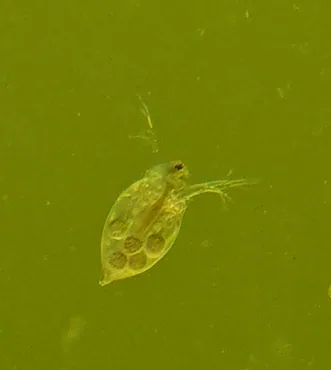
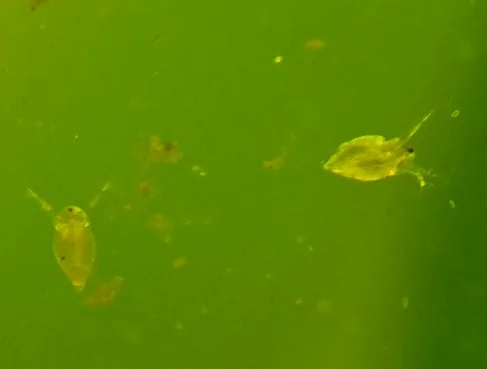
A Daphnia-type zooplankton population, later identified as Moina, has been present in the Freshwater Lake and Lakeshore since approximately September 2025. It was tracked at the time only as an unidentified ambient cladoceran population, without genus or species-level identification. A wild-collected trail-pool sample added May 1, 2026 supplemented this already-established population, and genus-level identification followed shortly after.
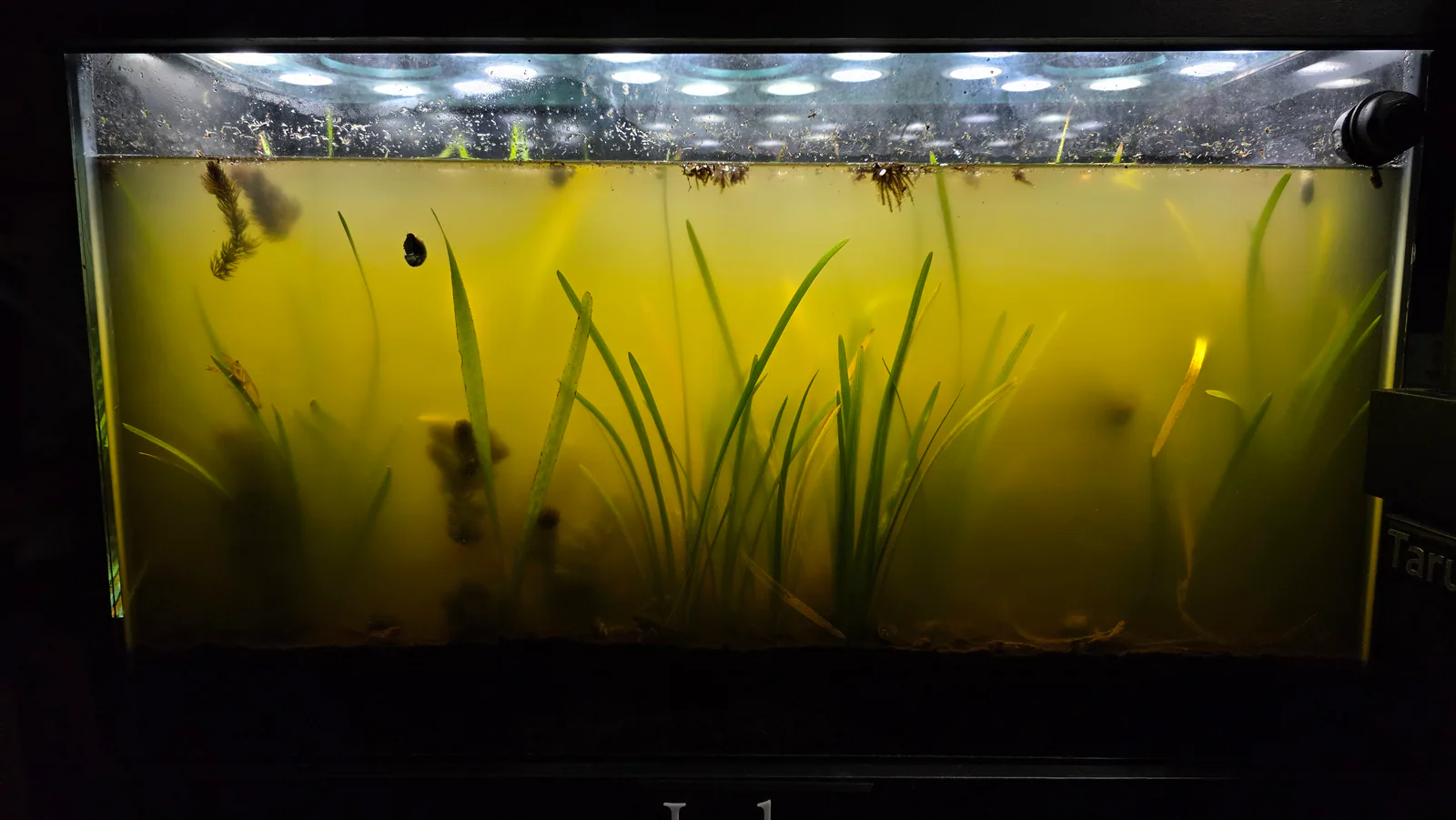
January 24, 2026: Lake biome murky hours after tapegrass addition. Very high abundance of microcrustaceans visible via flashlight, described as a "striking density darting rapidly in response to light." Crayfish visible climbing tapegrass leaves; Seminole Ramshorn Snails grazing. Video evidence.
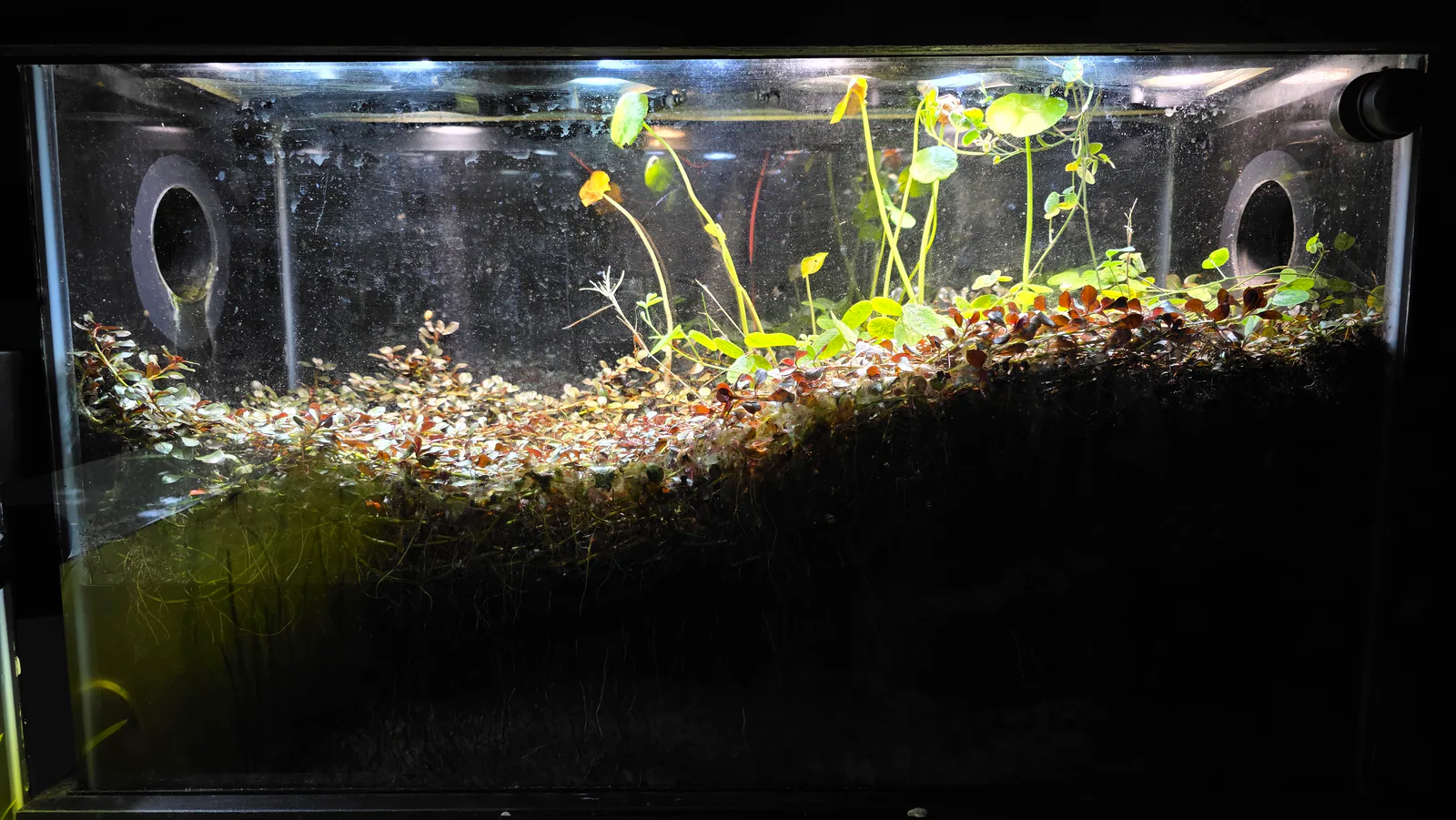
February 20, 2026: Pre-dawn flashlight observation at the Lakeshore underwater front glass edge showing a dense community actively darting through the water column, with amphipods feeding and small freshwater limpets on glass. Explicit contrast with the Freshwater Lake, which showed only copepods and small individuals, with no adult-sized individuals or amphipods. Predation pressure from Flagfish and Ghost Shrimp inferred as the limiting factor in the open lake. Video evidence.
February 21, 2026: Dense, thriving population documented in the Lakeshore biome where dense vegetation provides shelter. In the lake biome, the same organisms were present but sparse and mostly hidden, emerging when Slough Crayfish disturbed the substrate. Flagfish predation explicitly identified as the likely driver limiting lake biome density. Tapegrass establishment noted as potentially improving refuge availability over time.
May 1, 2026: Moina were added from a wild-collected trail-pool sample, supplementing the already-present population. The same day, very small individuals were observed in the water column, described as "a new wave of very small Moina," possibly representing recently hatched individuals. This interpretation is uncertain; the small individuals may have simply been the smaller members of the added cohort rather than in-system hatchlings. Video evidence shows numerous small Moina visible in the water column.
May 21, 2026: After weeks of observation, Josue reported being able to confidently distinguish the Moina population from a newly observed, smaller Daphnia-like species (later identified as Ceriodaphnia dubia). The Moina population was described as stable and established but not expanding as expected. Hundreds are present in the Freshwater Lake, with noticeably higher concentrations in sheltered Lakeshore vegetation among dense plants. On the glass in the morning after lights turn on, approximately a dozen individuals are commonly visible. They tend to remain hidden during the day and become much more active at night. No media.
June 17, 2026: During a general condition assessment of the Freshwater Lake, Moina were confirmed present. The population was described as modest and stable, not rapidly increasing. It was concluded that Moina (and copepods) have not expanded to the density needed to reduce the visible algae load. No media.
June 25, 2026: Moina confirmed in dense Lakeshore vegetation, consistent with the shelter-preference pattern observed since 2026. Observation paired with a concurrent Daphnia sp. sighting in the lower open water column; at the time the two were believed to be co-present, separate populations occupying distinct microhabitats. Video documented. Suspended green algae remains abundant. Elevated water temperature is proposed as limiting the ability of the microcrustacean layer to keep pace with algae growth.
August 7, 2026: Following review of older footage together with an outside identification consultation, Josue identified the longer-established larger daphniid population as Moina and confirmed it predates the April 8, 2026 Daphnia sp. introduction. This resolves the prior open question of whether the pre-2026 ambient population (previously tracked as an unidentified record) was superseded by later introductions: it was not superseded, and is the same Moina lineage tracked continuously since 2025. Sightings attributed to "Daphnia" in the Freshwater Lake between June and July 2026 are now understood to most likely reflect this Moina population (and/or Ceriodaphnia dubia) rather than the April 8, 2026 batch, which has not been seen since the day it was introduced.
Confirmed:
- Presence in the Freshwater Lake and Lakeshore since approximately September 2025, tracked at the time as an unidentified ambient zooplankton population
- Dense refuge population in the Lakeshore's submerged vegetation documented January-February 2026, with Flagfish predation suppressing open-lake numbers
- Wild-collected trail-pool sample added May 1, 2026, supplementing the already-present population
- Population estimated at hundreds, May 21, 2026; described as modest and stable on June 17, 2026
- Higher density in sheltered Lakeshore vegetation than open water
- Negatively phototactic behavior: active on glass in the morning, hidden during day, more active at night
- Confidently distinguished from Ceriodaphnia dubia by May 21, 2026
- Population insufficient to meaningfully reduce the Freshwater Lake algae load as of June 17, 2026
- Genus identification as Moina extended back to the pre-2026 population on August 7, 2026, based on footage review and an outside consultation
Inferred:
- Ongoing parthenogenetic reproduction since 2025; population persistence over many months is consistent with continuous reproduction in this genus
- Filter feeding on suspended algae and fine organic particles throughout the Freshwater Lake and Lakeshore
- Predation pressure or light avoidance as a likely factor constraining open-water density
- June-July 2026 "Daphnia" sightings in the Freshwater Lake most likely reflect this Moina population and/or Ceriodaphnia dubia rather than the separately introduced April 8, 2026 batch
Unknown:
- Exact source or arrival pathway of the pre-2026 population (possibly a hitchhiker with an early freshwater plant or substrate addition)
- Whether the May 1, 2026 small individuals represent in-system hatchlings or small members of the added cohort
- What ecological factor is limiting open-water density despite abundant food: predation, food quality, or system capacity
- Whether the population will expand to water-clearing densities or remain at the current modest, stable level
- Whether elevated water temperature is limiting Moina's ability to keep pace with algae growth