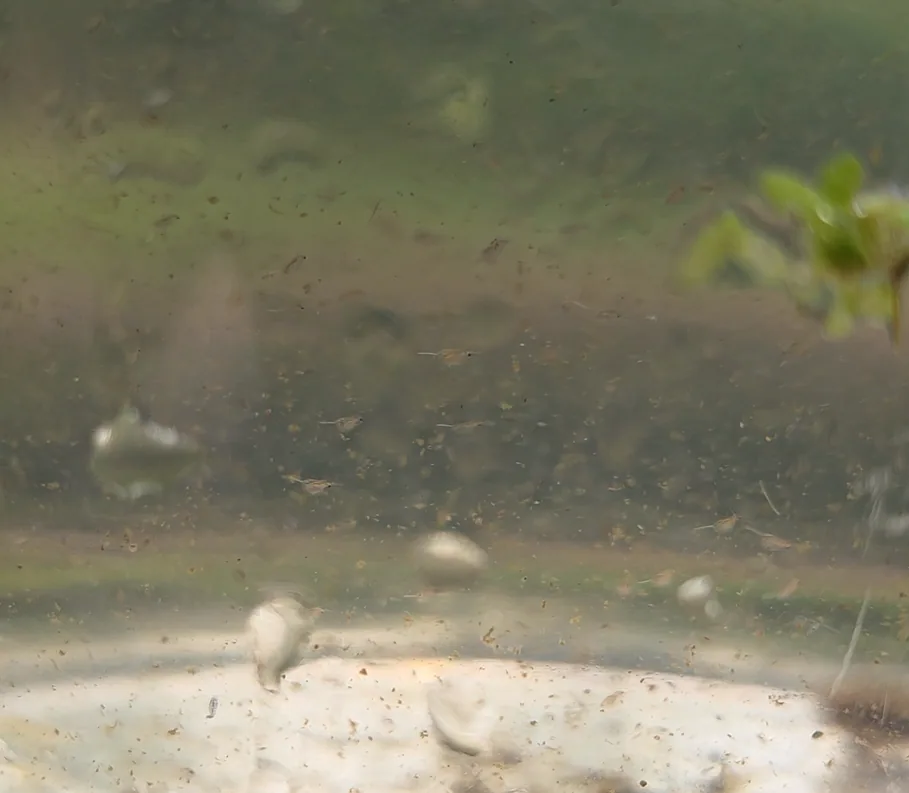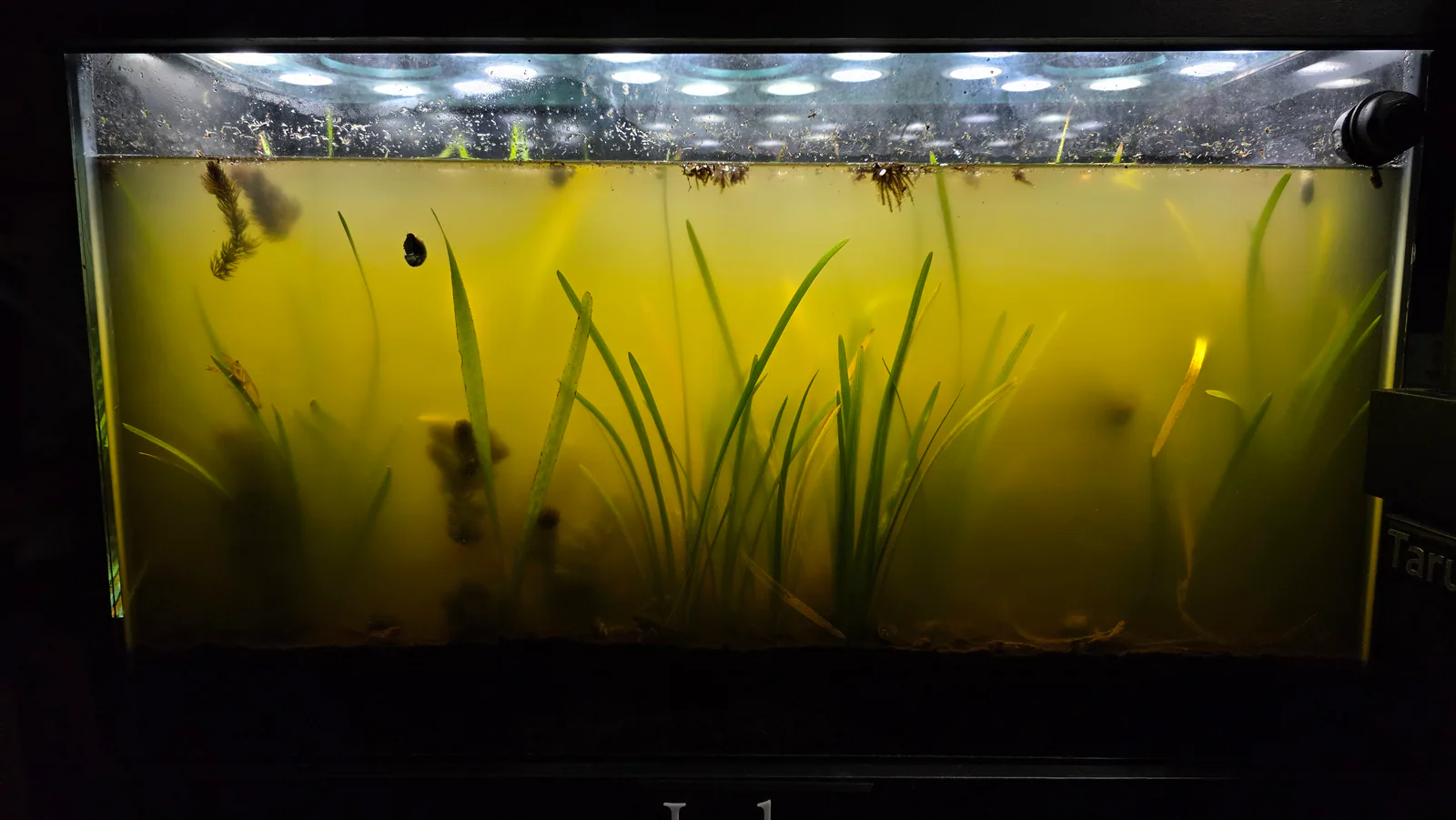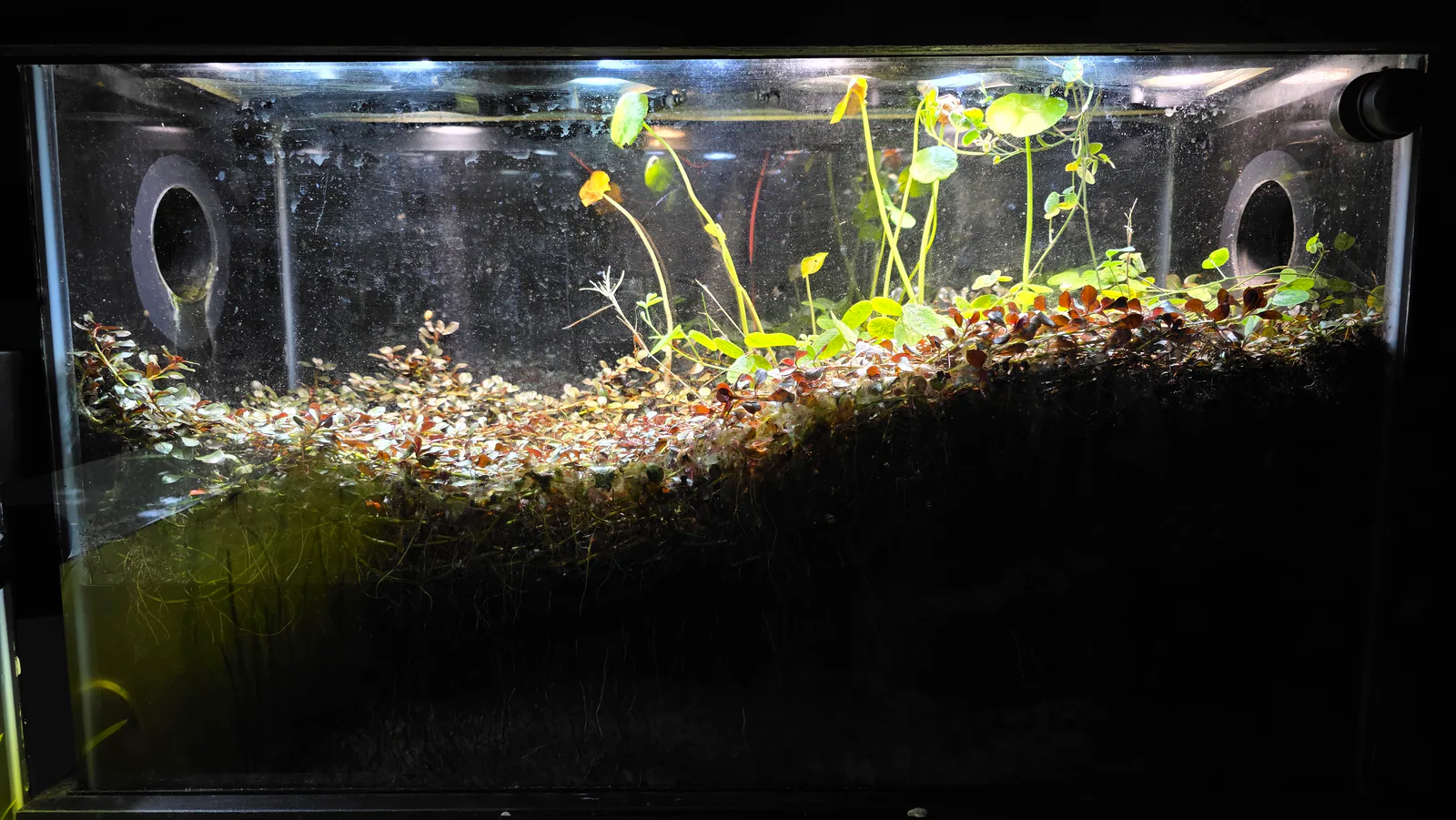
Daphnia sp. (unidentified)

Daphnia

Wild-collected from a Florida trail pool and introduced to the Freshwater Lake in April 2026, these tiny filter-feeding water fleas were still present five days later as the lake recorded its first visible clearing event after years of algae-clouded water.

Overview

Wild-collected from a Florida trail pool and introduced to the Freshwater Lake in April 2026, these tiny filter-feeding water fleas were still present five days later as the lake recorded its first visible clearing event after years of algae-clouded water. Species identity is tentatively Daphnia ambigua based on source notes but has not been confirmed.

Identity

  • Common name: Daphnia
  • Alternate names: Water flea, water fleas, pond flea, pond fleas
  • Scientific name: Daphnia sp. (unidentified)
  • Identification confidence: Genus-level; species identity unresolved
  • Uncertainty label: Observed

Taxonomy

  • Kingdom: Animalia
  • Phylum: Arthropoda
  • Class: Branchiopoda
  • Order: Diplostraca
  • Family: Daphniidae
  • Genus: Daphnia
  • Species: Unresolved

Natural History

Daphnia is one of the most recognizable genera of freshwater zooplankton, with over 100 described species distributed across lakes, ponds, and temporary wetlands worldwide. Their distinctive body shape, a translucent carapace enclosing the thoracic appendages, with a large compound eye and visible internal organs, makes them identifiable even to casual observers. The common name "water flea" reflects their jerky, hopping swimming motion.

Daphnia are filter feeders: they draw water through a filtering apparatus formed by thoracic legs and extract suspended algae, bacteria, and fine organic particles. A single adult can filter more than a liter of water per day, making dense Daphnia populations among the most effective natural water-clarifying agents in freshwater ecosystems. Populations can shift from algae-clouded to visibly clear water within days under favorable conditions.

Reproduction is typically parthenogenetic under stable conditions: females produce clutches of genetically identical daughters, enabling explosive population growth when food is abundant and conditions are favorable. Under environmental stress, crowding, food scarcity, temperature extremes, or drought, females produce males and switch to sexual reproduction, generating resting eggs enclosed in a protective saddle called an ephippium. Ephippia are resistant to desiccation and freezing and can remain dormant for years before hatching.

Daphnia ambigua is a widespread North American species found in warm, shallow temporary wetlands and ponds across the southeastern United States. It tolerates warmer water temperatures than Daphnia magna (the aquaculture standard), making it a more appropriate candidate for Florida's warmer enclosed freshwater systems.

Ecological Role

Daphnia function as a critical link between primary production and larger consumers in freshwater food webs. By filtering suspended algae and fine organic particles, they convert diffuse phytoplankton energy into accessible crustacean biomass available to fish, invertebrates, and predatory zooplankton. In a closed system like miniBIOTA, where nutrient and algae inputs are fixed, Daphnia grazing has direct implications for water clarity and algal control.

In miniBIOTA, the primary ecological role tested for Daphnia is water column filtration: the April 8, 2026 introduction was explicitly designed to evaluate whether Daphnia and ostracods could begin clearing the Freshwater Lake without fish predation. The April 13, 2026 clearing event, the first time the far end of the tank had been visible from the front in some time, occurred five days after the Daphnia introduction and one week after Flagfish removal. The observation attributes this to microcrustacean expansion; Daphnia and copepods together are implicated, with no single species isolated as the cause.

A critical complication is the Mesostoma ehrenbergii that arrived as a hitchhiker in the same April 8 introduction batch. Mesostoma is a predatory flatworm that preys specifically on crustacean zooplankton including Daphnia, copepods, and ostracods; it arrived with eggs attached and was expected to hatch offspring inside miniBIOTA. This introduced a predation pressure on the Daphnia population that may have contributed to any population decline after the initial observation window.

miniBIOTA Evidence

Introduction context: The ID 164 Daphnia node records a wild-collected introduction on April 8, 2026. This followed an earlier attempt with commercially sourced Daphnia magna, which was introduced April 5, 2026 from LRB Aquatics and was completely lost overnight by April 6 due to oxygen limitation and elevated water temperature (surface temperature measured at 83.6°F). The ID 164 introduction was a deliberate pivot to a more heat-tolerant, wild-adapted strain collected from a local trail-pool habitat. Source notes identify the collected species as "Daphnia ambigua."

Observation timeline:

  • April 8, 2026: Wild-collected organisms introduced to the Freshwater Lake: Daphnia ambigua (hundreds), ostracods (seed shrimp), a Water Scorpion (Ranatra sp.), planarians, and 6 lesser ramshorn snails (Anisus vorticulus). Mesostoma ehrenbergii also present as a hitchhiker, initially misidentified as a snail leech; corrected same day. Mesostoma confirmed as a Daphnia, copepod, and ostracod predator that arrived with eggs. Introduction video recorded.
  • April 9, 2026: First full day post-introduction. Daphnia confirmed present and swimming actively in the water column; close-up footage recorded. Aeration added overnight to prevent oxygen drop following the Daphnia magna oxygen crash three days earlier. Video evidence.
  • April 10, 2026: Second morning after introduction. Daphnia still present on glass and along tank surfaces. Numbers not yet large but persistent under continued aeration support.
  • April 11, 2026: First night without air pump. Living Daphnia confirmed present the following morning, observed on glass and grass blades and occasionally darting into the water column. "Oxygen availability under current conditions is not limiting their survival at this stage".
  • April 13, 2026: Lake beginning to clear for the first time in some time, visibility reaching the far end of the tank. "Daphnia still present." Clearing attributed to microcrustacean expansion following Flagfish removal; both Daphnia and copepods implicated as the clearing mechanism.
  • June 25, 2026: A substantial population of very small Daphnia confirmed present in the Freshwater Lake, concentrated in the lower half of the water column. Suspended green algae remains abundant throughout the tank with no sign of declining. Video documented. Population has persisted at least eleven weeks beyond the last prior confirmed sighting. Daphnia appear unable to keep pace with algae growth rate at current conditions; elevated water temperature is proposed as a limiting factor. Observation record, June 25, 2026.
  • July 2, 2026: Night observation found the Daphnia population considerably stronger than previously believed, with the majority concentrated in the dense vegetation of the Lakeshore biome rather than the open water of the Freshwater Lake. Daytime concealment among thick plant growth is proposed to explain earlier underestimation of abundance; at night, Daphnia emerge into the Lakeshore water column and actively feed. Video documented. Observation record, July 2, 2026.
  • July 10, 2026: Close-up footage at the moment the lights came on in the Freshwater Lake captured thousands of Daphnia in a coordinated downward migration toward the substrate, with Freshwater Amphipods simultaneously retreating into cover. The scale of the response is read as a second, independent line of evidence (alongside the July 2, 2026 Lakeshore finding) that the population is considerably larger than daytime open-water counts have suggested, with daytime scarcity attributed to a light-avoidance behavior rather than a true population limit. Video documented. Observation record, July 10, 2026.
  • July 10, 2026: Follow-up footage of the same lights-on event found that, alongside the downward substrate migration, a substantial portion of the population instead moved upward into the dense root systems of the floating plants introduced June 30, 2026. This is the first direct evidence that the floating plants are functioning as a second refuge zone for Daphnia, with the population now partitioning across the substrate, the Lakeshore vegetation, and the floating-plant roots. Video documented. Observation record, July 10, 2026.
  • July 15, 2026: Video documented a sharp, visible increase in large Daphnia moving through the hornwort growth within the Freshwater Lake itself, a zone previously used far less than the Lakeshore vegetation. The timing, coinciding with the July 4 and July 11, 2026 hornwort additions, is interpreted as evidence that habitat complexity supplied by the hornwort's dense structure, not food availability, had been the limiting factor on visible in-lake abundance. This is offered as a complementary interpretation alongside the existing June 25, 2026 temperature-limitation hypothesis, not a replacement for it. Video documented. Observation record, July 15, 2026.

Confirmed:

  • Introduction of hundreds of wild-collected Daphnia sp. on April 8, 2026
  • Active swimming confirmed on April 9, 2026; video evidence
  • Persistent presence on glass and plant surfaces April 10-11, 2026
  • Still present April 13, 2026 as lake began clearing
  • Introduced at the same time as Mesostoma ehrenbergii (crustacean predator, hitchhiker)
  • Survived three consecutive nights following introduction, including one without aeration support
  • Confirmed present June 25, 2026, concentrated in the lower half of the water column; video documented. Resolves prior open question about persistence beyond April 13, 2026.
  • Confirmed July 2, 2026 concentrated in dense Lakeshore vegetation, emerging into the water column and actively feeding at night; video documented. Population assessed as considerably stronger than previously believed.
  • Confirmed July 10, 2026 in a coordinated downward migration toward the substrate at lights-on, with Freshwater Amphipods retreating into cover simultaneously; video documented.
  • Confirmed July 10, 2026 using the root systems of the floating plants (introduced June 30, 2026) as a second refuge zone, partitioning the population between the substrate and the floating vegetation; video documented.
  • Confirmed July 15, 2026 in sharply greater visible abundance moving through the hornwort growth within the Freshwater Lake itself; video documented.

Inferred:

  • Filter-feeding on suspended algae and fine particles consistent with Daphnia genus biology
  • Contribution to the April 13 clearing event alongside copepods and other microcrustaceans; specific contribution not isolable
  • Predation by Mesostoma ehrenbergii offspring was a likely pressure on the Daphnia population in the weeks following introduction
  • Species identity as Daphnia ambigua probable based on source notes but unconfirmed
  • Daytime concealment within dense Lakeshore vegetation and a light-avoidance substrate migration likely explain why earlier, largely daytime and open-water-focused observations underestimated Daphnia abundance
  • Floating plant root structure is providing refuge and habitat complexity for Daphnia, independent of the plants' intended nutrient-uptake role
  • The hornwort's dense structure, established through the July 4 and July 11, 2026 additions, is providing a fourth zone of refuge and habitat complexity for Daphnia within the Freshwater Lake itself, following the same pattern already documented for the Lakeshore vegetation and floating-plant roots

Unknown:

  • Species identity within genus Daphnia
  • Whether reproduction occurred in the Freshwater Lake or Lakeshore
  • The relative contribution of Daphnia versus copepods and other microcrustaceans to the April 13 clearing event
  • Whether elevated water temperature is limiting Daphnia's ability to keep pace with algae growth in the Freshwater Lake (proposed June 25, 2026; unconfirmed)
  • Current population size and health trajectory, now that the population is understood to span the substrate, Lakeshore vegetation, floating-plant roots, and hornwort growth rather than the open Freshwater Lake water column alone
  • Whether this broader distribution changes the assessment of Daphnia grazing pressure on the Freshwater Lake's persistent algae bloom
  • Whether the July 10, 2026 lights-on migration is a recurring daily pattern or a one-time observed event
  • Whether the July 15, 2026 increase in visible hornwort-zone abundance reflects an actual population increase or a redistribution of the existing population into a newly available refuge