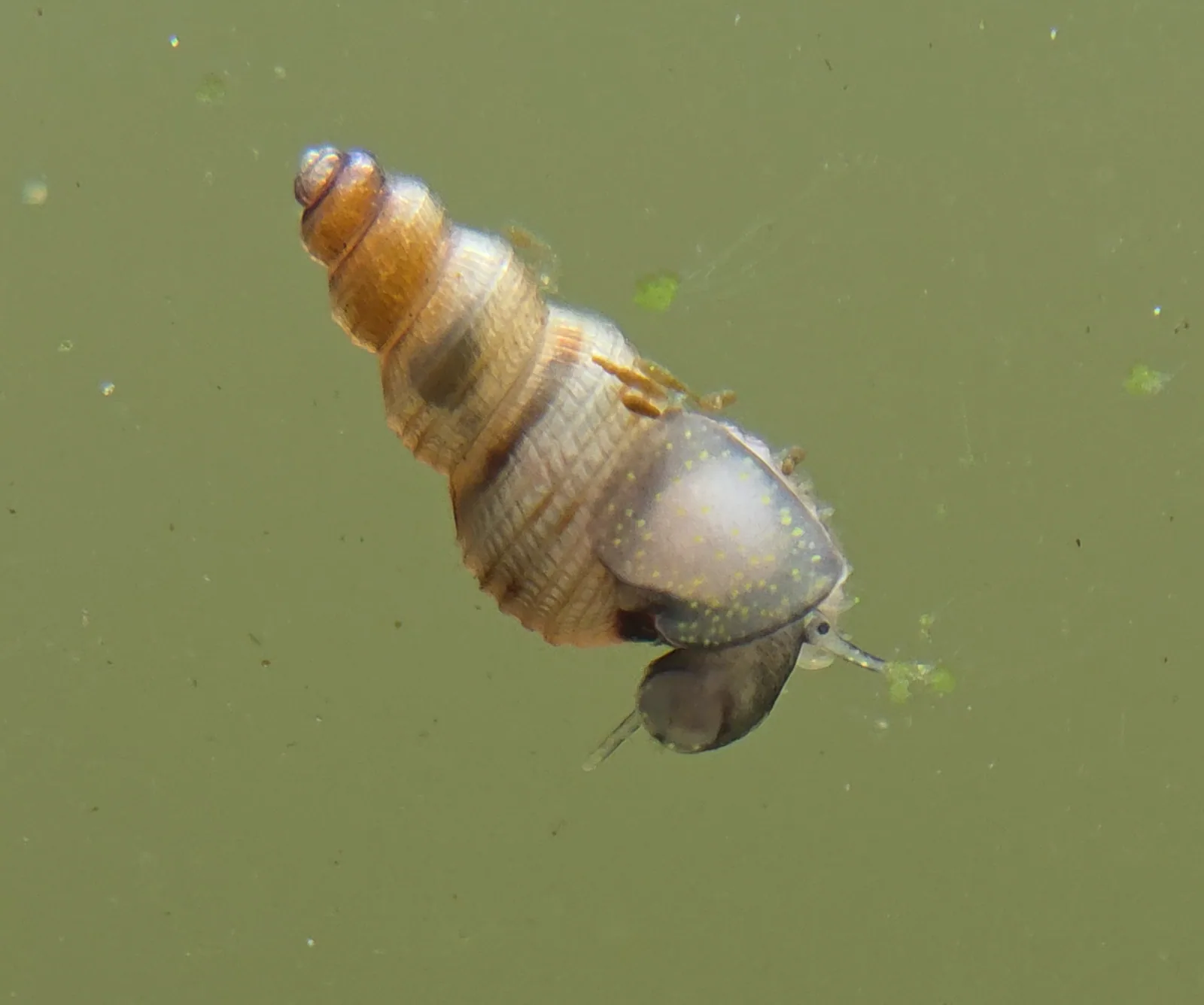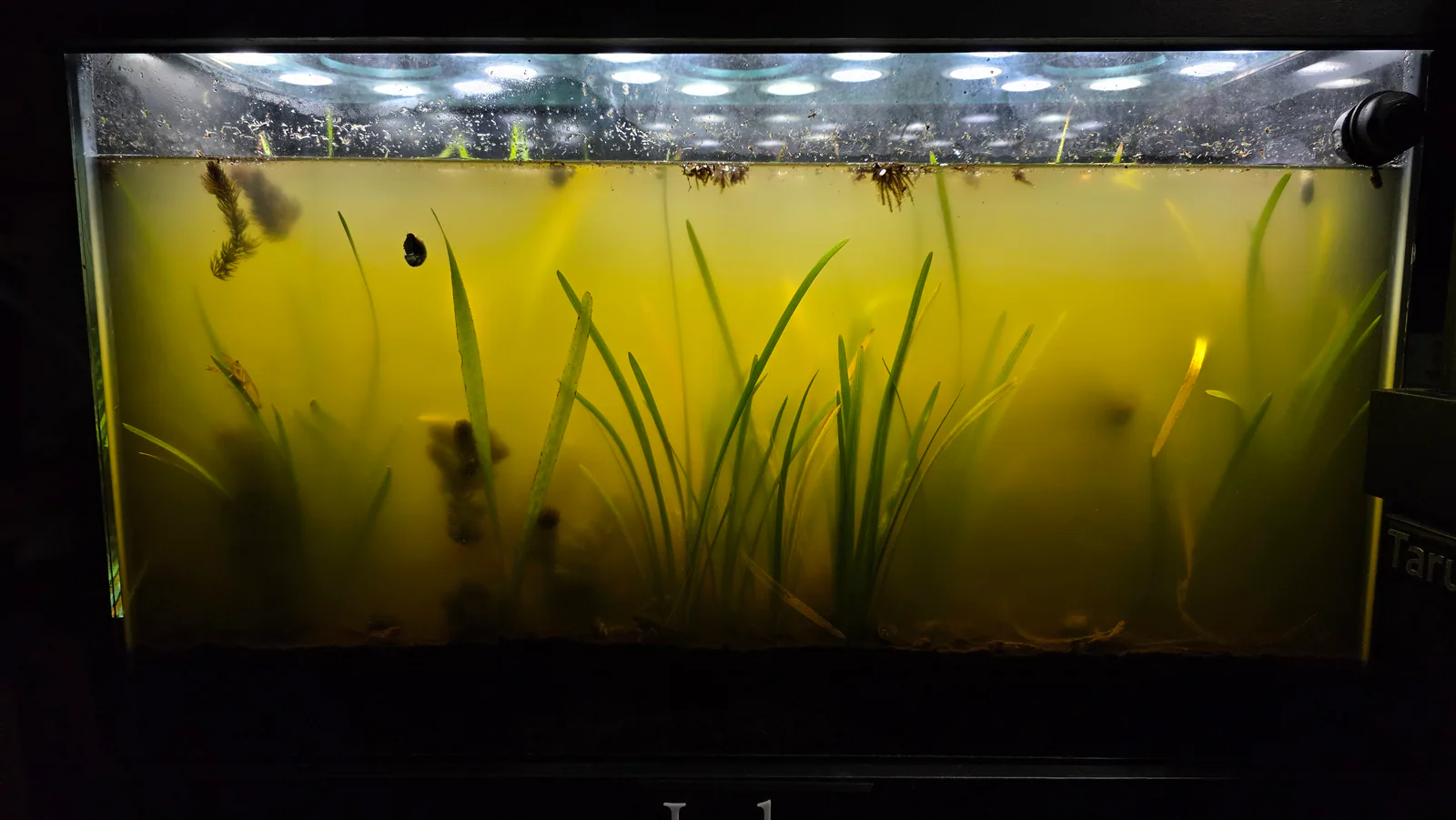
Melanoides tuberculata

Malaysian Trumpet Snail

A live-bearing freshwater snail that burrows into the Freshwater Lake substrate by day and grazes algae and biofilm at night, with hatchlings confirmed in April 2026 and juveniles consistently observed through May 2026.

Overview

Malaysian Trumpet Snails are small, conical burrowing snails established in the Freshwater Lake, where they spend daylight hours buried in the substrate and emerge at night to graze algae and biofilm. They are live-bearing and primarily reproduce without males. After an apparent population decline in winter 2025 to 2026, hatchlings appeared in April 2026 and juveniles were still visible and growing in May 2026, confirming ongoing reproduction in the closed system. On July 1, 2026, the highest number of individuals yet seen on the Freshwater Lake glass at one time was recorded, mostly juveniles climbing upward, a behavior raised as a possible early sign of developing oxygen stress in the biome.

Identity

  • Common name: Malaysian Trumpet Snail
  • Alternate names: MTS, trumpet snail, red-rimmed melania, malayan livebearing snail, burrowing snail, melanoides, malaysian burrowing snail, live-bearing snail
  • Scientific name: Melanoides tuberculata
  • Identification confidence: Species-level ID applied. Note: other conical snail species are present in the Freshwater Lake (Rasp Elimia); very small juveniles may be difficult to distinguish without close observation
  • Uncertainty label: Confirmed (adults and established population); Possible (ID of very small juveniles in absence of clear size or shell detail)

Taxonomy

  • Kingdom: Animalia
  • Phylum: Mollusca
  • Class: Gastropoda
  • Order: Caenogastropoda
  • Family: Thiaridae
  • Genus: Melanoides
  • Species: Melanoides tuberculata

Natural History

Melanoides tuberculata is a small conical freshwater snail native to Africa and southern Asia, now widely established in warm freshwater habitats worldwide including throughout Florida. Adults reach one to four centimeters in length, with a turret-shaped shell bearing a pointed apex and a tan or gray body with brown mottling. The species is a nocturnal burrower: during daylight it retreats into soft substrate, emerging at night to graze on algae, biofilm, and fine organic debris on hard surfaces and in the upper sediment layer.

Malaysian Trumpet Snails are primarily parthenogenetic: most populations consist almost entirely of females that give birth to live young without mating. The young are fully formed miniature snails at birth, with no free-swimming larval stage. This reproductive strategy allows populations to establish from a single individual and to maintain themselves without the need for male-female encounters. In aquarium and pond settings, populations can grow large under favorable conditions, though density in miniBIOTA has remained modest.

The species tolerates a wide range of water conditions and is considered highly adaptable in warm freshwater environments. Its burrowing activity aerates and mixes the upper substrate layer, functioning similarly to oligochaete worms in sediment bioturbation.

Ecological Role

Malaysian Trumpet Snails graze algae and biofilm from glass surfaces, plant stems, substrate, and hard surfaces throughout the Freshwater Lake. By processing this surface growth and depositing waste, they return organic material to the food web and contribute to surface cleaning in the closed system. Their nighttime burrowing mixes and aerates the upper substrate layer, disrupting anaerobic pockets and turning over fine organic particles.

In the Freshwater Lake, they occupy a portion of the grazer-detritivore niche alongside Bladder Snails, Daphnia, and Moina. Their burrowing behavior partially complements Bladder Snails, which graze primarily on exposed surfaces, while nighttime surface grazing introduces some niche overlap. At the low densities observed in miniBIOTA, their bioturbation and grazing contribution is modest but real.

Slough Crayfish are a potential predator of small juveniles in the Freshwater Lake. The April 2026 observation specifically noted that juveniles at hatchling size were vulnerable to crayfish predation, and that increasing plant density might provide shelter.

Surfacing and glass-climbing behavior in aquatic snails is a documented general response to declining dissolved oxygen, as it improves access to oxygen-richer water near the surface. On July 1, 2026, the highest number of Malaysian Trumpet Snails yet observed on the Freshwater Lake glass at one time, mostly juveniles climbing upward, raised a working hypothesis of developing oxygen stress, tentatively linked to reduced gas exchange and submerged-plant shading from the floating plants introduced June 30, 2026. This interpretation is not confirmed.

miniBIOTA Evidence

Malaysian Trumpet Snails were introduced to the Freshwater Lake in approximately July 2025 as part of a detritivore diversification batch. Population numbers appeared to decline through winter before juveniles reappeared in April 2026.

July 2025 (first introduction): Approximately 20 Malaysian Trumpet Snails were introduced to the Freshwater Lake alongside two Apple Snails and ten Rasp Elimia, described as diversifying the detritivore population and enhancing nutrient cycling. The species records the introduction date as July 9, 2025; the observation file is dated July 20, 2025. No media.

April 13, 2026: A very small conical snail was observed and filmed moving along surfaces in the lake. Described as resembling a juvenile MTS but with identity not yet confirmed due to other conical species present. The note recorded that MTS numbers had appeared to decline with no clearly observed breeding until this point, and that the individual would be monitored for growth. Vulnerability to crayfish predation at this size was flagged. Video evidence.

April 17, 2026: A hatchling emergence was observed, with four individuals counted on the front glass alone. The note described this as suggesting many more distributed throughout the habitat, and interpreted it as indicating a successful reproduction event. No media.

May 21, 2026: Juvenile Malaysian Trumpet Snails were consistently observed in the Freshwater Lake. Three individuals were spotted immediately upon checking. The note emphasized that this species has never been observed in particularly high densities in miniBIOTA, and that three visible juveniles was still significant. Both adults and juveniles were present, described as suggesting successful competition alongside other lake snail species. The species was described as stable and persistent with a new generation actively developing. No media.

June 20, 2026: Second-generation juveniles are noticeably larger, with many expected to reach adulthood within the next couple of months. The owner draws a contrast with the flagfish-present period, when young snails appeared far less likely to reach visible sizes. With the flagfish removed, juvenile MTS now appear to have a substantially better chance of surviving and developing. Ramshorn snail juveniles are not showing the same visible pattern on the glass, which may reflect habitat and visibility differences rather than poor recruitment. No media. Observation record, June 20, 2026.

July 1, 2026: The highest number of Malaysian Trumpet Snails yet observed on the Freshwater Lake glass at one time was recorded. Most visible individuals are juveniles, with many climbing upward along the glass. This behavior raised a working hypothesis of developing oxygen stress, tentatively linked to reduced surface gas exchange and submerged-plant shading from the floating plants introduced June 30, 2026. Not confirmed; system flagged for monitoring. Video documented. Observation record, July 1, 2026.

Confirmed:

  • Introduction of approximately 20 individuals, July 2025
  • Presence and persistence through at least May 2026
  • Hatchlings observed on front glass, April 17, 2026 (four visible)
  • Juveniles consistently present and visibly growing, May 21, 2026
  • Both adults and juveniles confirmed, May 21, 2026
  • Second-generation juveniles noticeably larger and growing toward adulthood, June 20, 2026; improved juvenile survival relative to flagfish-present conditions inferred from timing
  • Highest number of individuals yet observed on the Freshwater Lake glass at one time, mostly juveniles climbing upward, July 1, 2026

Inferred:

  • Ongoing nocturnal grazing on algae and biofilm throughout the Freshwater Lake
  • Daytime burrowing in the substrate layer
  • Ongoing reproduction; the species is live-bearing and parthenogenetic
  • Glass-climbing behavior observed July 1, 2026 is consistent with possible developing oxygen stress, tentatively linked to floating plant surface coverage introduced June 30, 2026 (not confirmed)

Unknown:

  • Whether the conical snail observed April 13 was MTS or another conical species
  • Current adult population size; the species is rarely seen in large numbers
  • Whether Slough Crayfish predation is significantly limiting juvenile recruitment
  • Whether the population remained stable or has grown since May 2026
  • Whether dissolved oxygen is actually declining in the Freshwater Lake, and whether floating plant coverage is a contributing cause