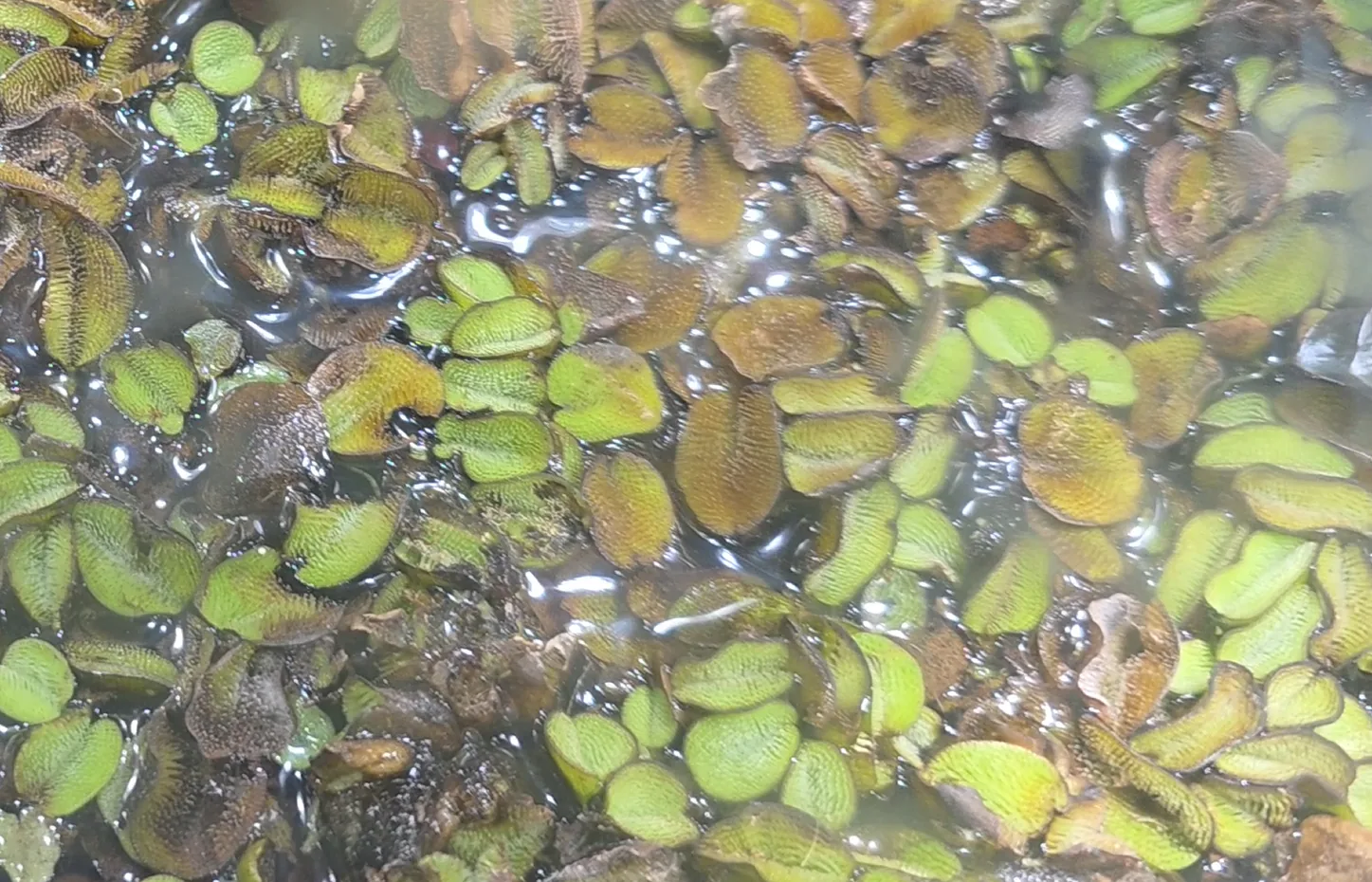
Salvinia minima

Water Spangles

Floating across the Freshwater Lake surface on paired fuzzy leaves, this small aquatic fern spreads to shade the water below and has displaced hair algae as it expanded, competing for light where its mat was densest.

Visual Data Unavailable

Overview

A small free-floating aquatic fern that entered the Freshwater Lake through plant trials of unknown start date. Its competition with hair algae was documented in September 2023, and it last appeared in structured records in October 2025. Introduction date and source are not recorded, and the current state of the population is unresolved.

Identity

  • Common name: Water Spangles
  • Alternate names: Salvinia, water fern, floating fern, small salvinia, floating moss (misidentified)
  • Scientific name: Salvinia minima
  • Identification confidence: Species level
  • Uncertainty label: Uncertain

Taxonomy

  • Kingdom: Plantae
  • Division: Pteridophyta
  • Class: Polypodiopsida
  • Order: Salviniales
  • Family: Salviniaceae
  • Genus: Salvinia
  • Species: Salvinia minima

Natural History

Salvinia minima is a free-floating aquatic fern native to South America, with its range centered on Brazil, Argentina, and Uruguay. It has naturalized broadly across the southeastern United States, including Florida, where it colonizes slow-moving freshwater habitats: ponds, ditches, lakes, canals, and marshes. It is not native to Florida but is widely established there.

The plant floats at the water surface through two paired oval leaves, typically 0.5 to 1.5 centimeters wide. These floating leaves are densely covered in short erect hairs that repel water and produce the species' characteristic fuzzy texture. A third leaf grows below the surface, finely divided into hair-like segments that stabilize the plant and assist with nutrient uptake from the water column. Despite resembling roots, this submerged structure is a modified frond; true ferns do not produce roots. The plant produces no seeds or flowers.

Salvinia minima reproduces almost entirely through vegetative fragmentation. Fronds bud new fronds directly, and fragments dispersed by water movement, animal contact, or physical disturbance can establish new mats wherever conditions permit. Under warm, nutrient-rich conditions with adequate light, colonies expand quickly and form surface mats that shade the water below.

In Florida, the species is broadly tolerant of water chemistry, growing across a pH range of roughly 6.0 to 8.0 and tolerating temperatures from approximately 10 to 35 degrees C. Growth is fastest between 22 and 28 degrees C, and the plant favors still to slow-moving water. Unlike its close relative Salvinia molesta (giant salvinia, a federally listed noxious weed), Salvinia minima is less aggressive and has not triggered equivalent regulatory concern in Florida, though it can reach nuisance coverage in nutrient-enriched systems.

Ecological Role

Salvinia minima functions as a primary producer, using photosynthesis to fix solar energy into plant biomass at the water surface. Dense mats intercept light before it reaches the water column below, reducing photosynthesis by submerged algae and other plants competing for the same resource. As fronds die and sink, they contribute organic matter to the detrital food web. The floating mat provides a physical surface that small invertebrates can use, and grazers consuming the fronds draw plant biomass directly into the animal food web.

In miniBIOTA, Water Spangles was one of several floating plants evaluated in the Freshwater Lake. By September 2023, its expanding mat coincided with visible decline in hair algae on the side of the lake with higher plant coverage, consistent with the expected light-competition mechanism. Slough Crayfish grazing on algae was also flagged in the same observation as a possible contributing factor, but was not confirmed as the primary driver of the algae decline.

The structured record indicates the plant subsequently faced grazing pressure and competition throughout its time in the system, briefly benefited from lighting adjustments at an undocumented point, and later lost ground to other freshwater plant dynamics. What specific competitors or conditions drove that outcome is not preserved in the observation record.

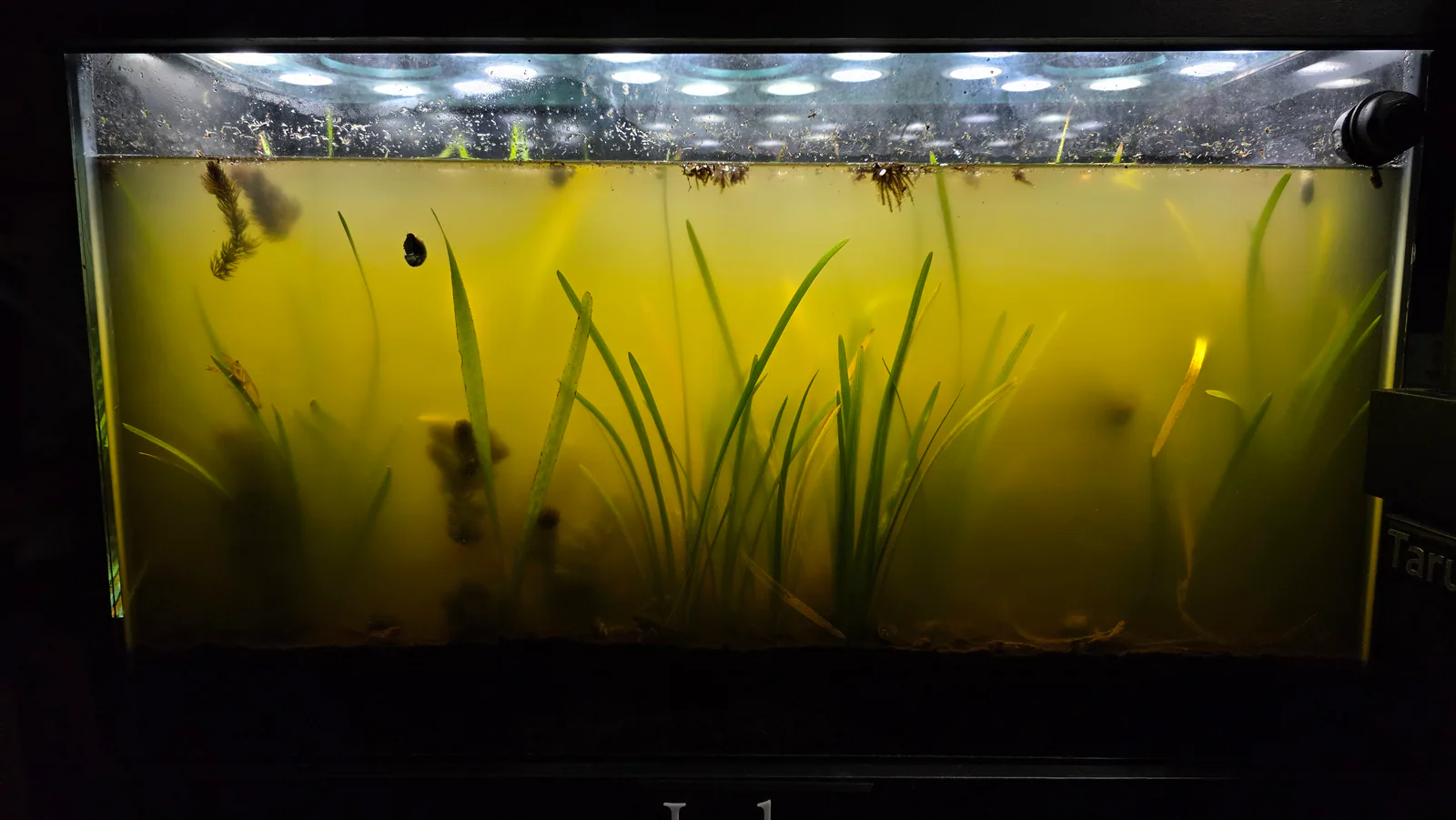
In a closed system, a dense floating mat can reduce gas exchange at the water surface and lower dissolved oxygen for submerged organisms, particularly in warm, low-flow conditions. That threshold was not documented in the observation records, but the risk is relevant to any future reintroduction into the Freshwater Lake. On July 1, 2026, one day after the June 30, 2026 reintroduction, rising numbers of juvenile Malaysian Trumpet Snails climbing the Freshwater Lake glass raised a working hypothesis that surface coverage from the newly introduced floating plants, including Water Spangles, may be reducing gas exchange and shading submerged vegetation; this remains unconfirmed. Slough Crayfish were also confirmed climbing to the surface and feeding on the duckweed and other floating plants from below the same day.

miniBIOTA Evidence

Introduction context: Water Spangles entered the Freshwater Lake through floating plant trials of unknown start date. Introduction method and source origin are not recorded. The species was previously misidentified as "floating moss" before the correct name was established; that earlier label is preserved in alternate names for provenance.

Observation timeline:

  • September 12, 2023: Water Spangles expanding across the lake surface; hair algae in visible decline on the side with higher plant coverage. Light blockage by the mat inferred as the primary driver. Slough Crayfish grazing on algae noted as a possible contributing factor, not confirmed.
  • October 6, 2025: Date last observed in structured records; no dedicated observation file is archived for this date. Population notes indicate the plant faced grazing pressure and competition, benefited briefly from lighting adjustments, and later lost ground to other freshwater plant dynamics.
  • June 30, 2026: Reintroduced to the Freshwater Lake as one of four floating plant species (alongside Valdivia Duckweed, Lesser Duckweed, and Dotted Duckweed). Prompted by persistent green water and a management decision to make one final attempt at using floating vegetation to reduce nutrients. No fish currently present to graze plants; surface access more limited compared to prior attempts. Framed as a final evaluation of floating vegetation's ability to shift nutrient dynamics. Video documented. Observation record, June 30, 2026.
  • July 1, 2026: One day after reintroduction, Slough Crayfish observed climbing to the water surface and hanging beneath the floating mat to feed on the duckweed and other floating plants from below. The observer predicts the introduced plants may again be eliminated before establishing. The same day, high numbers of juvenile Malaysian Trumpet Snails were observed climbing the Freshwater Lake glass, raising a working hypothesis that floating plant surface coverage may be reducing gas exchange and shading submerged vegetation; not confirmed. Video documented. Observation record, July 1, 2026.

Confirmed:

  • Presence as a floating plant in the Freshwater Lake (September 12, 2023, direct observation)
  • Active competition with hair algae through light blockage (September 12, 2023, consistent with the known mechanism)
  • Slough Crayfish confirmed feeding on the floating mat from below as of July 1, 2026, one day after reintroduction

Inferred:

  • Vegetative fragmentation as the primary means of colony expansion in the system
  • Grazing pressure from Slough Crayfish or lake snails as a contributor to population fluctuation
  • Intermittent rather than stable establishment in the lake
  • Floating plant surface coverage may be contributing to reduced gas exchange and submerged-plant shading in the Freshwater Lake (working hypothesis raised July 1, 2026, not confirmed)

Unknown:

  • Exact introduction date, method, and source
  • Current population size and status
  • Whether the plant persists in the system after October 2025
  • Whether crayfish grazing pressure observed July 1, 2026 will be sufficient to eliminate this reintroduction as it did prior trials
  • What specific event or condition drove the "lost ground" outcome described in the population notes
  • Whether floating plant surface coverage is measurably reducing dissolved oxygen in the Freshwater Lake