Bryophyta spp. (unidentified)

Moss

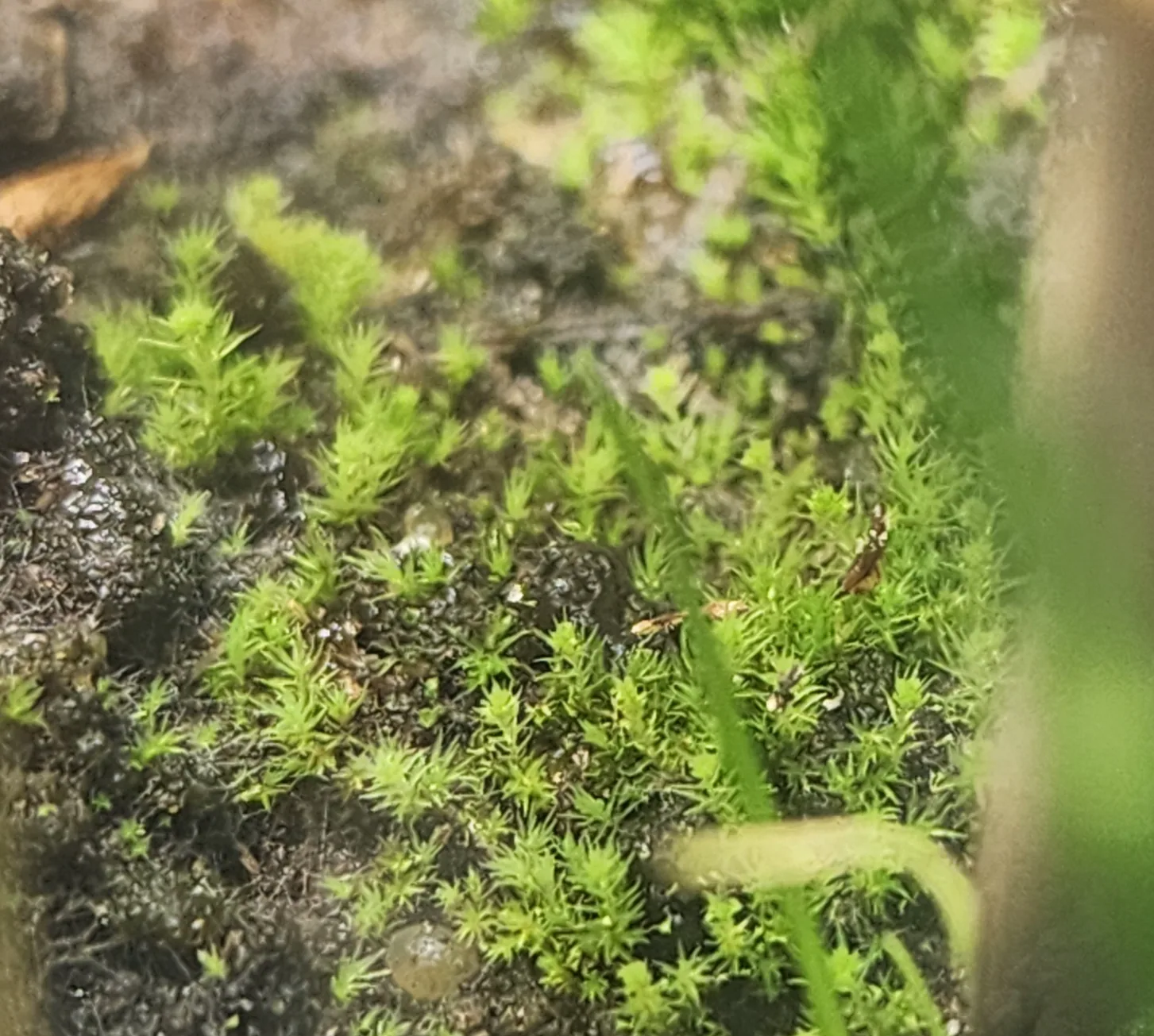
Appearing spontaneously around newly planted grass at the Lakeshore margin in August 2023, this soft ground-cover bryophyte is the only moss on record in miniBIOTA; genus is unidentified and no follow-up observation documents whether it persisted.

Visual Data Unavailable

Overview

Appearing spontaneously around newly planted grass at the Lakeshore margin in August 2023, this soft ground-cover bryophyte is the only moss on record in miniBIOTA; genus is unidentified and no follow-up observation documents whether it persisted.

Identity

  • Common name: Moss
  • Alternate names: Carpet moss, ground moss, cushion moss, sheet moss
  • Scientific name: Bryophyta spp. (unidentified)
  • Identification confidence: Division-level only; Bryophyta is confirmed as the correct division, but genus and species are unidentified
  • Uncertainty label: Unidentified

Taxonomy

  • Kingdom: Plantae
  • Phylum: Bryophyta
  • Class: (unidentified)
  • Order: (unidentified)
  • Family: (unidentified)
  • Genus: (unidentified)
  • Species: (unidentified)

Natural History

Bryophyta is the division encompassing true mosses, a large and ecologically diverse group of non-vascular land plants found across nearly all terrestrial environments. True mosses are distinguished from other bryophytes (hornworts and liverworts) by their leaf structure and life cycle. They lack true roots, using hairlike rhizoids only for anchorage, and absorb water and nutrients directly through their leaf surfaces. Mosses reproduce via spores released from elongated sporophyte capsules that rise above the leafy gametophyte body. They are highly adaptable, colonizing bare soil, rock, bark, and disturbed ground when moisture and light conditions are favorable.

In warm subtropical climates like Florida, mosses most commonly establish in shaded, moist, or periodically wet microhabitats where competition from faster-growing vascular plants is reduced. Many Florida mosses are opportunistic colonizers of disturbed or newly created substrates. They commonly appear as a secondary colonizer when soil is disturbed, bare ground is exposed, or moisture conditions improve. Dozens of moss genera are native to Florida, spanning both terrestrial and semiaquatic environments.

The specific genus of the moss recorded in miniBIOTA is unknown. Without detailed morphology or microscopy, it is not possible to narrow identification below the division level from the existing evidence.

Ecological Role

In general ecosystems, mosses contribute to soil development by accumulating organic material and retaining moisture at the ground surface. Their soft mats slow water runoff, keep substrate humid, and create microhabitat for small invertebrates such as springtails, mites, and nematodes. As they senesce, moss tissue enters the detrital layer and becomes available to detritivores. Mosses also provide a surface for biofilm and fungal development.

In miniBIOTA, the only documented record is the appearance of green moss at the Lakeshore margin in August 2023. The observation describes it emerging from around newly planted grass, consistent with opportunistic colonization of disturbed or freshly moist substrate. No feeding records, invertebrate associations, or ecological interactions involving the moss have been documented in miniBIOTA. The ecological role described here is based on general Bryophyta biology, not observed miniBIOTA events.

miniBIOTA Evidence

Moss was observed at the Lakeshore margin on August 27, 2023. The raw note reads: "Ground cracking around the lakeshore after adding UCF grass; appears to be awakening. Green moss beginning to emerge from around the grass." This is the only archived observation for this species. No introduction record exists; the moss self-colonized. No follow-up observation documents whether it persisted, spread, or disappeared after August 2023.

Introduction: Natural colonization; self-arrived. First and only archived observation August 27, 2023.

Observation timeline:

  • August 27, 2023: Green moss observed emerging from around newly planted grass at the Lakeshore margin; self-colonization inferred from context

Confirmed:

  • Moss (Bryophyta) present at the Lakeshore margin on August 27, 2023
  • Appeared in association with newly planted grass substrate
  • Self-colonized; not deliberately introduced

Inferred:

  • Colonization triggered by newly moist or disturbed substrate around the planted grass
  • Providing ground-level moisture retention and photoynthetic cover at the Lakeshore margin

Unknown:

  • Genus and species identity
  • Whether the population persisted after August 2023
  • Current extent or distribution in the biome
  • Whether the moss also occurs in the Lowland Meadow (species_to_biomes entry exists but no corresponding observation)