Domain - Eukaryota
Filamentous macroalgae
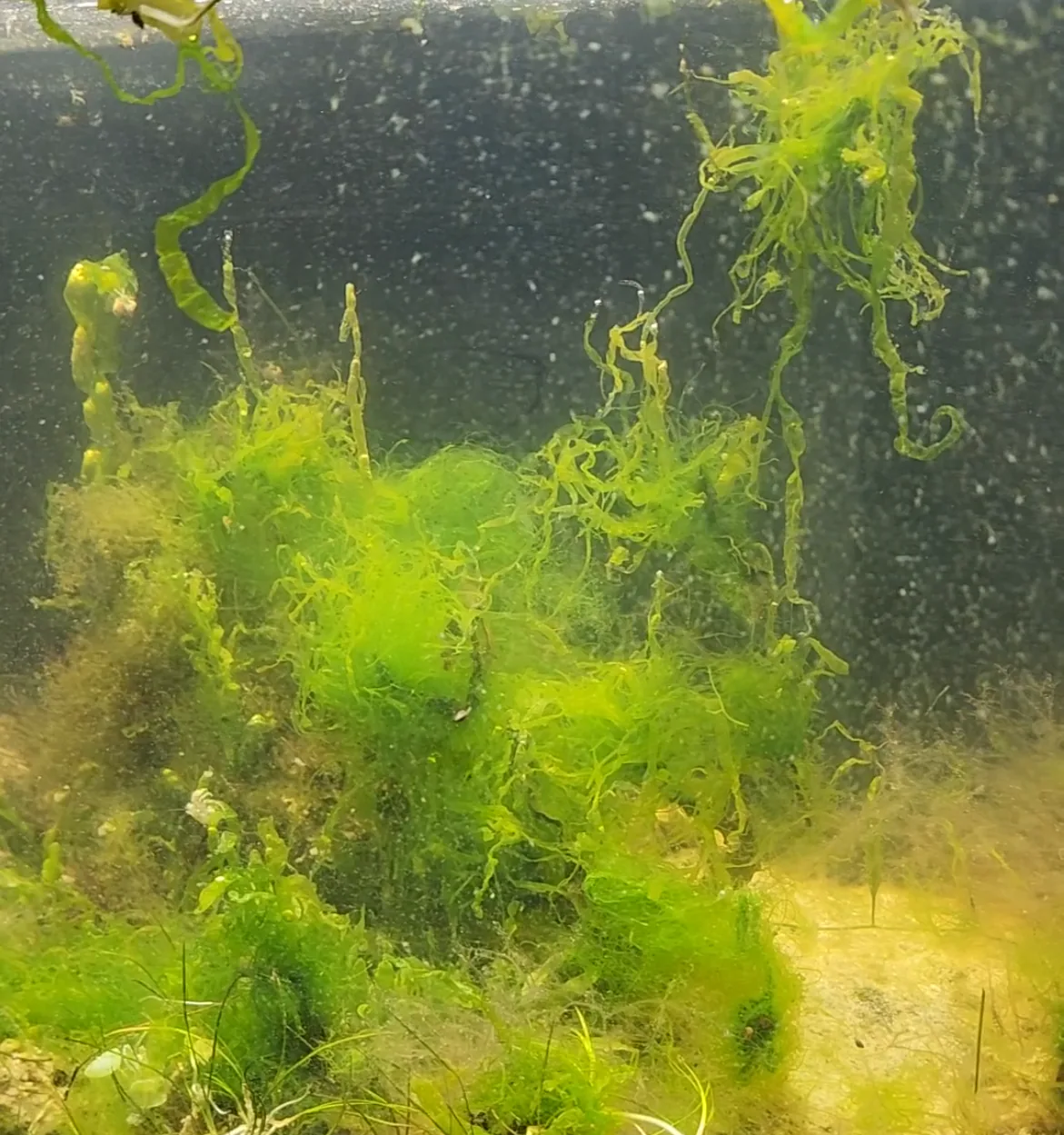
Threadlike macroalgae forming mats and tufts in the Seagrass Meadow, acting as both a photosynthetic producer and a visible problem-growth layer when nutrients run high.
Domain - Eukaryota
Threadlike macroalgae forming mats and tufts in the Seagrass Meadow, acting as both a photosynthetic producer and a visible problem-growth layer when nutrients run high.
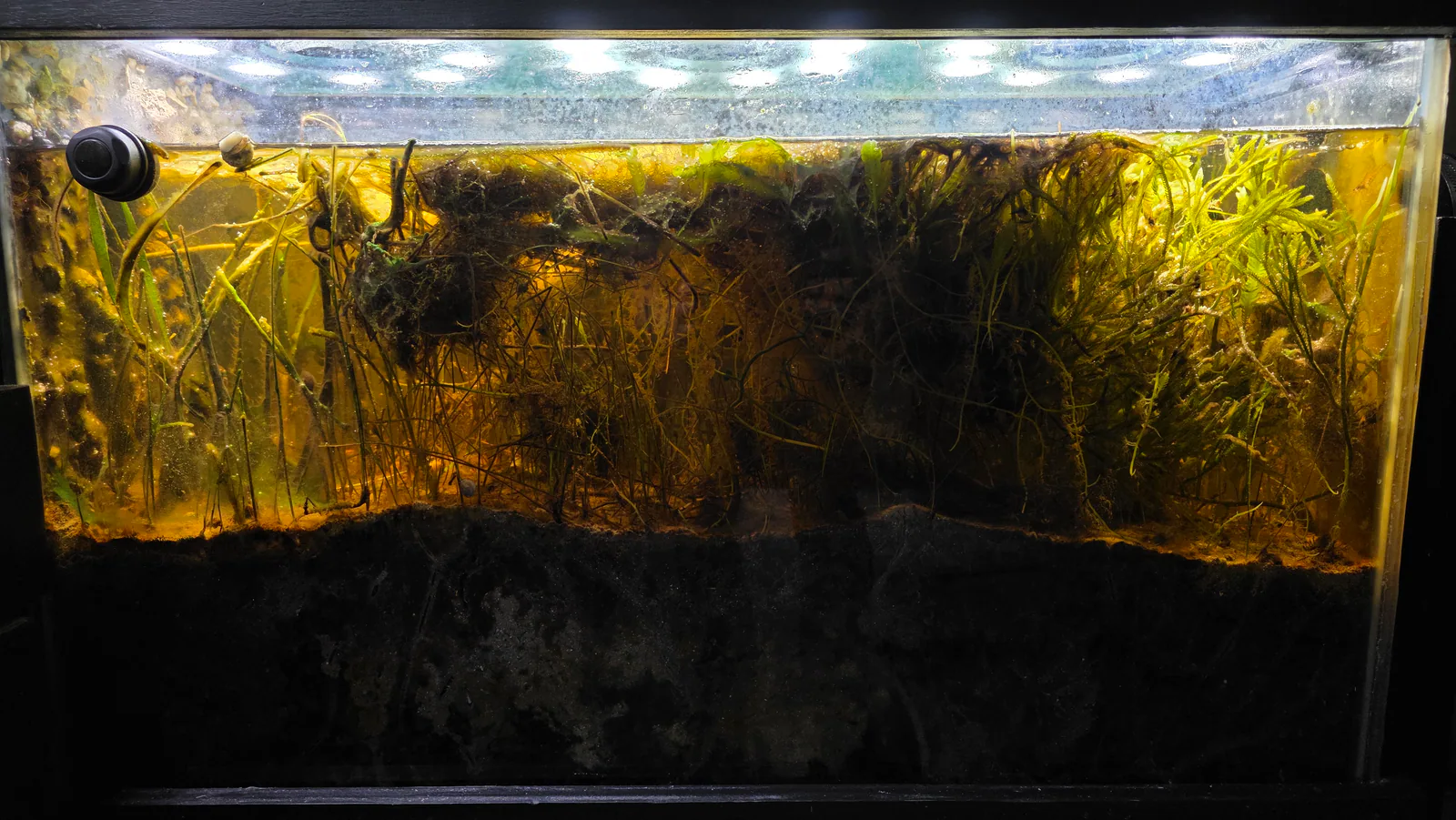
Filamentous macroalgae expanded across the Seagrass Meadow upper surface by late 2025 and has been part of the visible producer/problem-growth layer. Mottled Shore Crab (Pachygrapsus transversus) grazing was directly observed in early May 2026, which helps manage its abundance, though long-term population-level control and competition with shoalgrass remain under observation.
Absorbs dissolved inorganic nitrogen and phosphorus directly from the water column, converting solar energy into algal biomass. It serves as an abundant, highly accessible food source for generalist grazers like the Mottled Shore Crab, forming a key primary energy entry point in the Seagrass Meadow food web.
Extremely hardy and resilient. Capable of surviving broad shifts in salinity, dissolved oxygen, and nutrient loading. The primary physiological limits are the availability of dissolved inorganic carbon and the density of active grazers.
Exhibits a complex life history involving alternation of generations between haploid gametophytes and diploid sporophytes. Under active growth, it propagates primarily through vegetative fragmentation (where torn segments settle elsewhere and quickly regenerate), but it can rapidly release microscopic flagellated zoospores when environmental stress triggers a reproductive shift.
Functions as a powerful benthic nutrient filter in the Seagrass Meadow, rapidly absorbing excess nitrogen and phosphate from the water column. While it oxygenates the water during light cycles, excessive overgrowth can smother and block sunlight from slower-growing shoalgrass, and may create localized hypoxic pockets underneath thick mats at night when photosynthesis stops.
Follow this species across the habitats where it currently appears in the miniBIOTA biosphere.
This chronicle is connected here as related context. Open the primary chronicle for the full story.
Filamentous macroalgae remains oxygen-risk context.
Filamentous macroalgae remains freshwater producer context.
Filamentous macroalgae remains water-quality context.
This chronicle is connected here as related context. Open the primary chronicle for the full story.
Filamentous macroalgae remains seagrass condition context.
This chronicle is connected here as related context. Open the primary chronicle for the full story.
Filamentous macroalgae remains nutrient/water-clarity context.
Filamentous macroalgae remains water-quality context.
Filamentous macroalgae remains food source context.
Filamentous macroalgae remains competing producer context.
A dozen wild freshwater shrimp, including four pregnant females, were added to the Freshwater Lake after years without shrimp. The goal was to test whether the lake now had enough food and water-column life to support them, while added lake water might also bring in zooplankton for a stronger food web.
This chronicle is connected here as related context. Open the primary chronicle for the full story.
A sample from the suspended green algae in the Freshwater Lake was checked under the OpenOcular microscope adapter. The cells were photosynthetic and actively motile, with a tentative comparison to Chlamydomonas, but the identity remained open for expert review.
This chronicle is connected here as related context. Open the primary chronicle for the full story.
The Seagrass Meadow receives the wave and tide function it had been missing. Because no powered mechanical devices can operate inside the closed habitat, the solution uses external motion to move a PVC chamber and push water in and out of the biome. This entry marks a key engineering response to the meadow's oxygen, nutrient, and algae-pressure problems: recreating coastal movement without violating the sealed-system rule.
This chronicle is connected here as related context. Open the primary chronicle for the full story.
The land and mangrove areas remained fairly stable, but the marine side became cloudy again after filamentous algae was physically removed from the grass. With the sponge failing and oyster condition uncertain, the next focus shifted toward improving water flow before restocking for balance.
This chronicle is connected here as related context. Open the primary chronicle for the full story.
Turbo snails were added to reduce algae overgrowth, but progress was slower than expected and possible snail eggs appeared on the glass. At the same time, the sponge was growing steadily, adding a new branch and showing that it was still feeding despite clearer water.
With algae running out of control, turbo snails were added as fast grazers to consume filamentous algae. The expectation was that their waste would release nutrients back into the water, feeding plankton that could then be filtered by oysters and sponges, creating a more complete producer-consumer loop.
This chronicle is connected here as related context. Open the primary chronicle for the full story.
Warm water was causing biodiversity loss in the ecosphere, and added snails were not doing well under the conditions. The entry identifies temperature stress as a major constraint that needed correction before the system could recover diversity.
miniBIOTA 1 was scheduled for an update after the earlier habitat crash. The coastal side was expected to remain mostly stable, while the beach side needed revision as part of the recovery and rebuild plan.
This chronicle is connected here as related context. Open the primary chronicle for the full story.