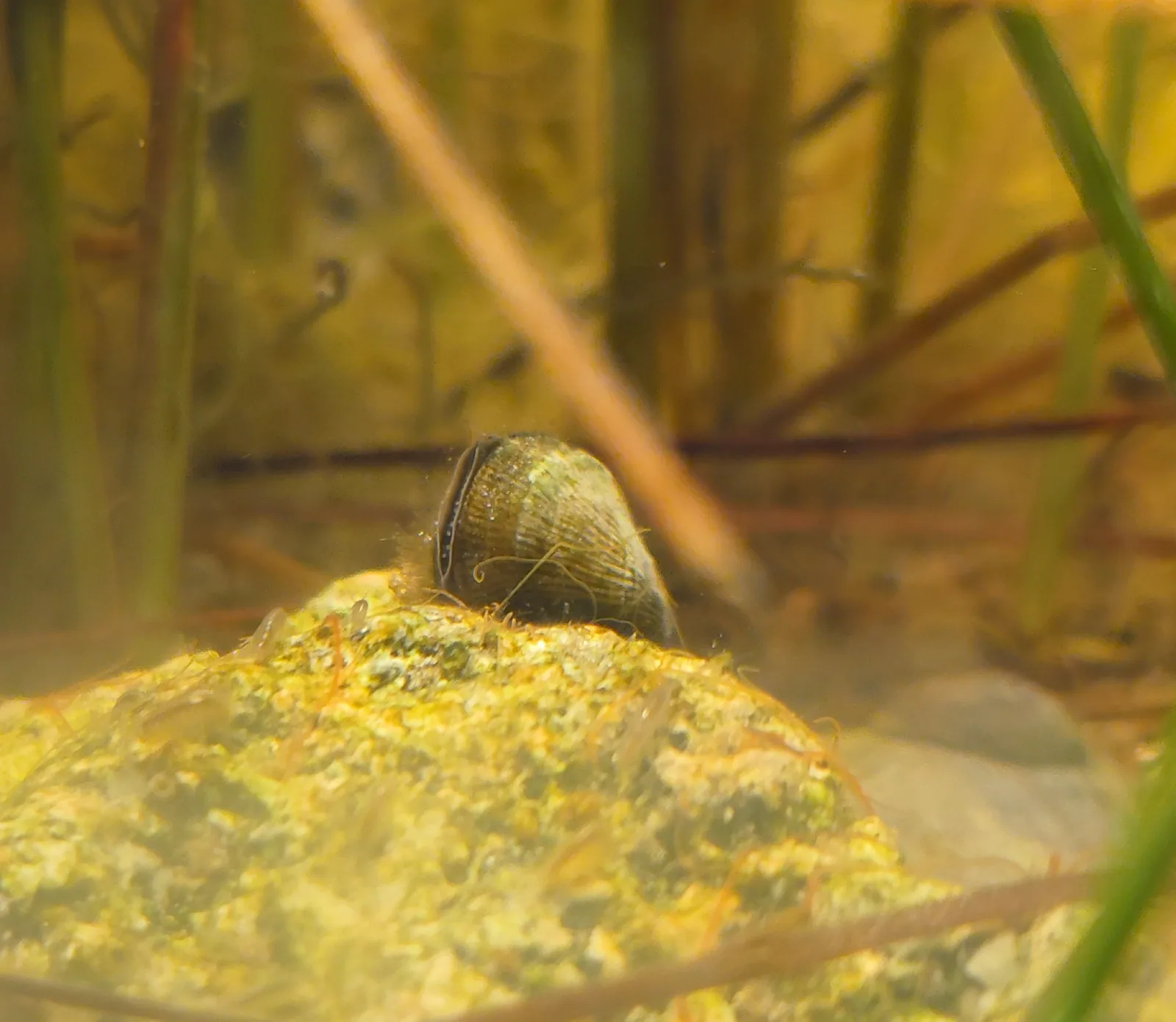
Brachidontes exustus

Scorched Mussel

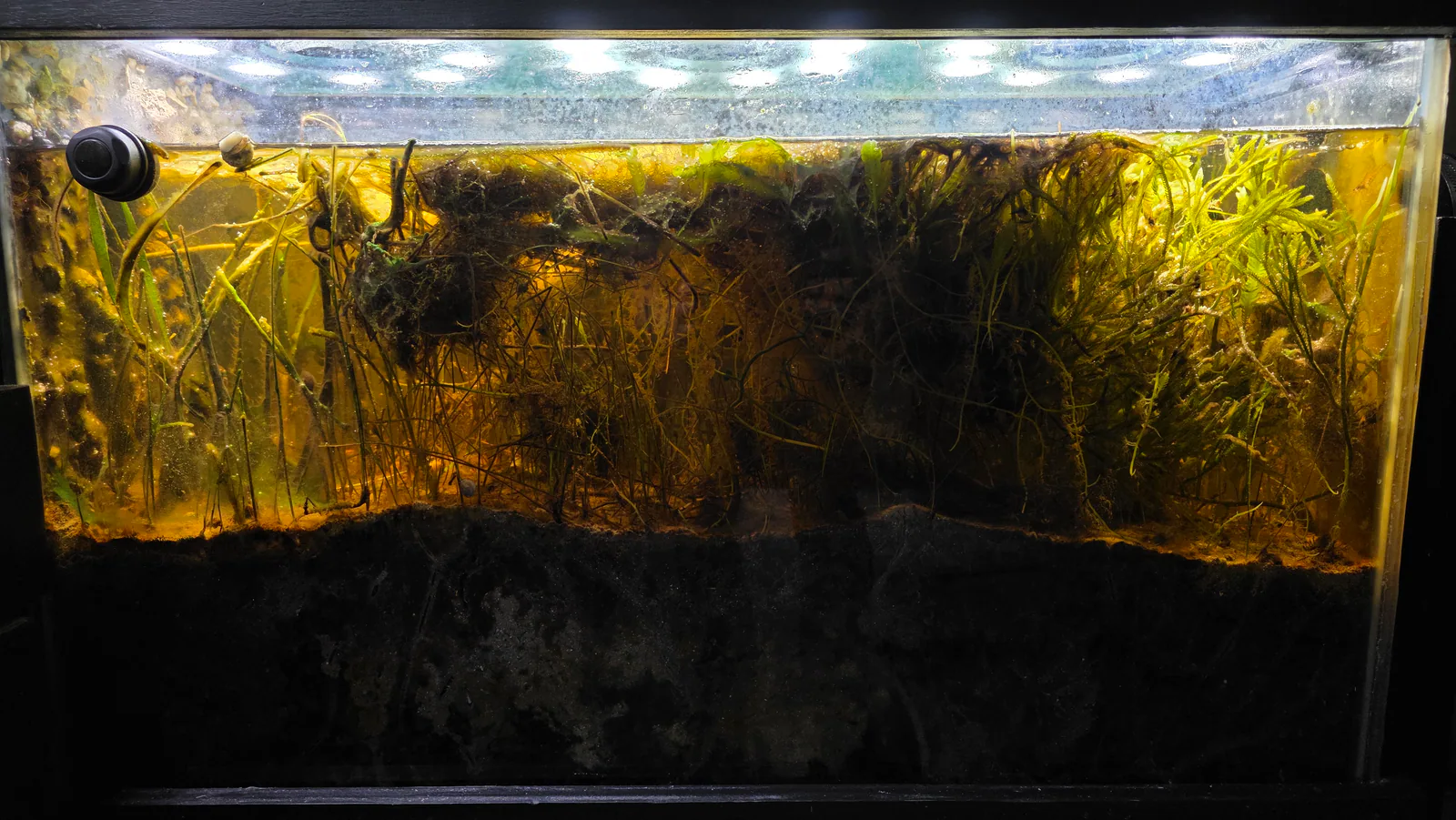
Found on hard surfaces in the Seagrass Meadow, this small ribbed bivalve filters suspended phytoplankton and fine particles from the water column, persisting as a filter feeder after eastern oysters failed in the same biome.

Visual Data Unavailable

Overview

The Scorched Mussel (Brachidontes exustus) is a small ribbed bivalve filter feeder present in the miniBIOTA Seagrass Meadow. A founding population was in the system before February 2026 and persisted after the eastern oyster population failed; by February 20, 2026, three individuals were confirmed, noted as more persistent than expected. On April 22, 2026, three additional wild-collected individuals from a brackish tidal ditch in Spring Hill, FL were drip-acclimated to marine salinity and introduced to the Seagrass Meadow. No feeding, reproduction, or post-April population count has been confirmed. Population status is Uncertain.

Identity

  • Common name: Scorched Mussel
  • Alternate names: charcoal mussel, brachidontes, small mussel, ribbed mussel (misidentified), burnt mussel, scorched ribbed mussel
  • Scientific name: Brachidontes exustus
  • Identification confidence: Confirmed
  • Uncertainty label: Confirmed, uncertain establishment

Taxonomy

  • Kingdom: Animalia
  • Phylum: Mollusca
  • Class: Bivalvia
  • Order: Mytilida
  • Family: Mytilidae
  • Genus: Brachidontes
  • Species: exustus

Natural History

Range and Florida Relevance

Brachidontes exustus is distributed from the Gulf of Mexico and Caribbean coast northward along the Atlantic seaboard to North Carolina. It is among the most abundant small mussels on Florida's rocky, shell, and hard-substrate intertidal shorelines, mangrove roots, seawalls, and marina pilings. It commonly occurs in brackish to full marine water, making it highly relevant to Florida's coastal habitats and well suited to the Seagrass Meadow's saltwater conditions. The April 2026 collection from a Spring Hill tidal ditch confirms that local Florida populations of this species tolerate the brackish end of its salinity range.

Habitat

Brachidontes exustus attaches to hard surfaces using byssal threads, forming clusters on rock, shell, mangrove root, and other firm substrates in the intertidal to shallow subtidal zone. It can tolerate periodic emersion and variable salinity. In miniBIOTA, the mussels occupy hard surfaces within the Seagrass Meadow, where they filter the water column from a fixed attachment point. No specific microhabitat use within the biome has been documented beyond hard-surface attachment.

Diet

Brachidontes exustus is a filter feeder. It draws water through its gills using cilia, capturing phytoplankton, suspended microbes, bacteria, and fine organic particles. Filtered particles are transported to the mouth for digestion; water is expelled through the exhalant siphon. In miniBIOTA, no direct feeding observations have been made; diet is inferred entirely from species biology and bivalve filter-feeder classification.

Reproduction

Brachidontes exustus reproduces by broadcast spawning: males and females release gametes into the water column, where fertilization occurs. Developing larvae spend a planktonic phase before settling and attaching to hard substrate as juvenile mussels. Spawning can occur multiple times per year under favorable conditions. In miniBIOTA, no reproduction has been confirmed. Successful recruitment would require spawning, larval survival in the water column, and successful settlement onto available hard substrate.

Tolerance Ranges

Brachidontes exustus is notably tolerant of salinity variation, occurring in habitats from brackish tidal ditches to full marine water. The April 2026 collection from a Spring Hill, FL tidal ditch and the subsequent drip acclimation from brackish to marine conditions demonstrates this range. It is also tolerant of warm subtropical temperatures and periodic low dissolved oxygen typical of intertidal zones. Formal tolerance measurements for temperature, pH, salinity drift, dissolved oxygen, and flow have not been taken in miniBIOTA.

Ecological Role

The Scorched Mussel provides water-column filtration in the Seagrass Meadow, capturing suspended phytoplankton and fine particles and converting them into attached bivalve biomass. This role removes particles from the water column and deposits filtered material as feces and pseudofeces at the sediment surface, potentially contributing to local nutrient cycling. In this context, the Scorched Mussel partially fills the filter-feeding role previously held by eastern oysters, which failed in the Seagrass Meadow.

The February 20, 2026 observation noted that the mussels appeared to be outcompeting Depressed Slippersnails for hard-surface attachment space. This is an observer-level interpretation from a single observation and has not been confirmed through systematic comparison.

No other ecological interactions have been documented in miniBIOTA. The Scorched Mussel's filter-feeding role and its possible competition with Depressed Slippersnails are the two ecological patterns currently on record.

miniBIOTA Evidence

Introduction Context

An original population of Scorched Mussels was present in the Seagrass Meadow before February 2026; no introduction date, method, or source is recorded for that founding group. The population survived the decline of the eastern oyster population and was noted as persisting more successfully than expected. On April 22, 2026, three additional individuals were collected from a brackish tidal ditch in Spring Hill, FL, drip-acclimated from brackish to marine salinity using a syringe method alongside amphipods, and introduced to the Seagrass Meadow. Video footage was recorded of the drip-acclimation process.

Observation Timeline

  • February 20, 2026: Third mussel confirmed in the Seagrass Meadow; only two had been seen approximately one month earlier. Observer noted the mussels have persisted and established more successfully than expected given oyster failure. Observer also noted the mussels appeared to be outcompeting Depressed Slippersnails in the biome. Video evidence of three mussels including the newly confirmed third individual.
  • April 22, 2026: Drip acclimation of 3 Scorched Mussels collected from a brackish tidal ditch in Spring Hill, FL, for introduction into the Seagrass Meadow. Syringe drip method used to gradually shift salinity from brackish to marine. Video footage of the acclimation process.

What Is Confirmed

  • At least two Scorched Mussels were present in the Seagrass Meadow by approximately January 2026, with a third confirmed by February 20, 2026.
  • The founding population persisted after the eastern oyster population failed.
  • Three additional individuals were collected from a Spring Hill, FL tidal ditch and introduced on April 22, 2026 following drip acclimation.
  • The species identity is confirmed as Brachidontes exustus.

What Is Inferred

  • The mussels may be outcompeting Depressed Slippersnails for hard-surface attachment space; this was observed once and has not been verified since.
  • The founding population likely arrived before January 2026 and persisted through the oyster failure event; the exact arrival date and origin are unknown.

What Remains Unknown

  • The current population count after the April 22, 2026 introduction.
  • Whether the introduced April 2026 individuals survived and are still present.
  • Whether any reproduction has occurred in miniBIOTA.
  • The origin, introduction method, and arrival date of the original founding population.
  • Whether the mussels have any measurable effect on water clarity or nutrient cycling in the Seagrass Meadow.
  • Whether the Depressed Slippersnail competition dynamic persists.