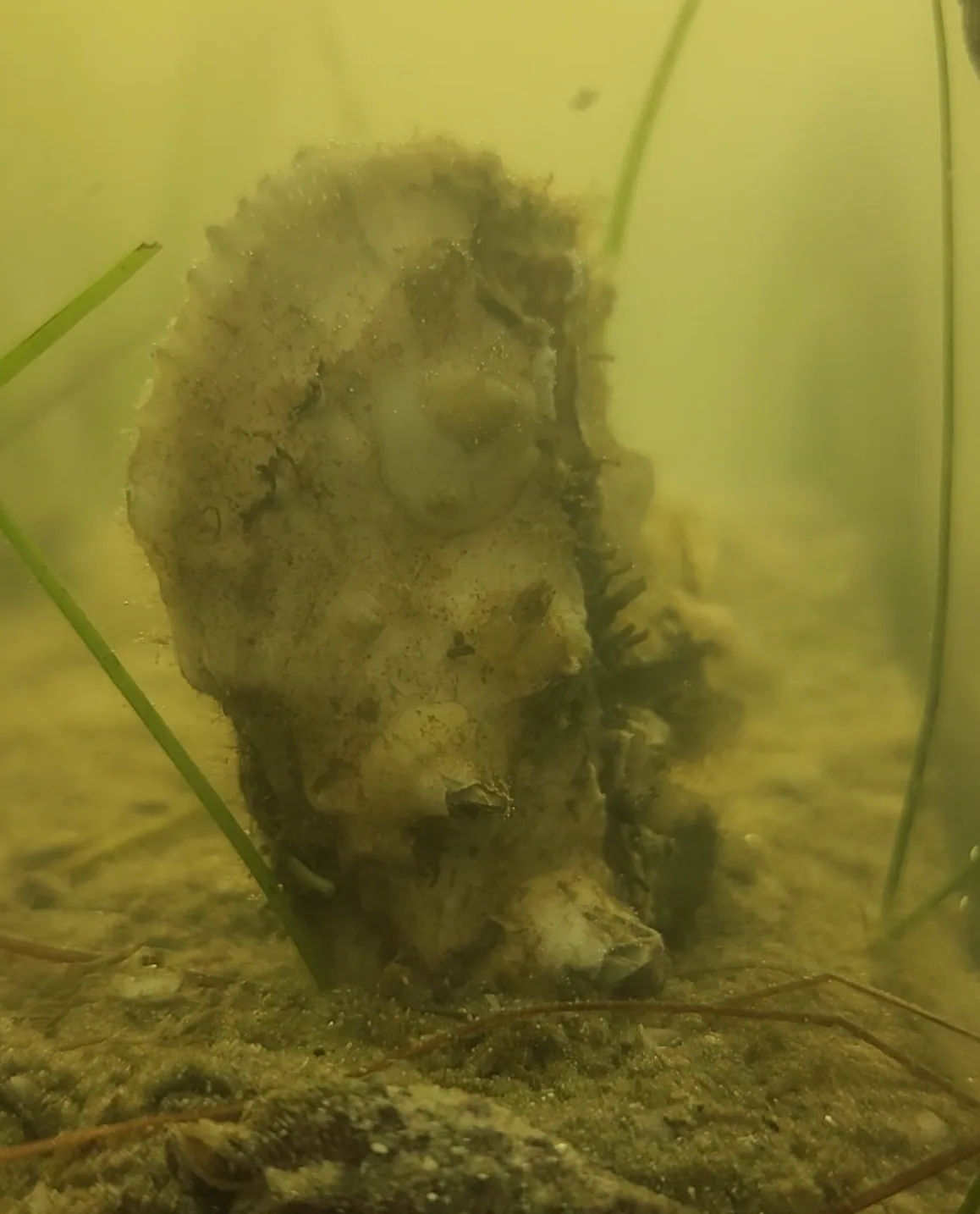
Crassostrea virginica
Eastern oyster
A reef-building bivalve that once served as a major Seagrass Meadow filter feeder, pulling suspended algae, microbes, and fine particles from the water while creating hard structure for other small marine life.
Crassostrea virginica
A reef-building bivalve that once served as a major Seagrass Meadow filter feeder, pulling suspended algae, microbes, and fine particles from the water while creating hard structure for other small marine life.
Oysters were introduced as a water-clearing filter-feeder layer, later serving mostly as historical context for mussels, barnacles, sponge balance, and water-column clarity. The reviewed evidence does not support a current stable oyster population claim.
Trophic classification is Primary Consumer. Food-web role: Filter-feeding plankton consumer. Feeding method: Filter feeder of phytoplankton. Dietary inputs: Phytoplankton, suspended microbes, and fine organic particles
This section will expand as more information is documented for this species.
Follow this species across the habitats where it currently appears in the miniBIOTA biosphere.
Oysters are origin context for the mussel hitchhikers.
This chronicle is connected here as related context. Open the primary chronicle for the full story.
Eastern oysters remain filter-feeder competition context.
This chronicle is connected here as related context. Open the primary chronicle for the full story.
A new sponge that had acclimated for a week showed short-term success, with open oscula and a visible current of filtered water. Porcelain crabs and a fiddler crab used it as habitat, while the sponge added another biological filter for the smallest suspended particles.
With the water clearer than it had been in a long time, the oysters made it possible to see more organisms and test the wave and tide system manually. The entry connects biological filtration to the next engineering check inside the marine habitat.
This chronicle is connected here as related context. Open the primary chronicle for the full story.
After an earlier sponge declined and had to be removed, oysters and a few small clams became the next candidates for controlling free-living plankton. The plan was cautious because too many filter feeders or a failed addition could quickly destabilize the ecosystem.