Amphibalanus amphitrite

Striped Acorn Barnacle

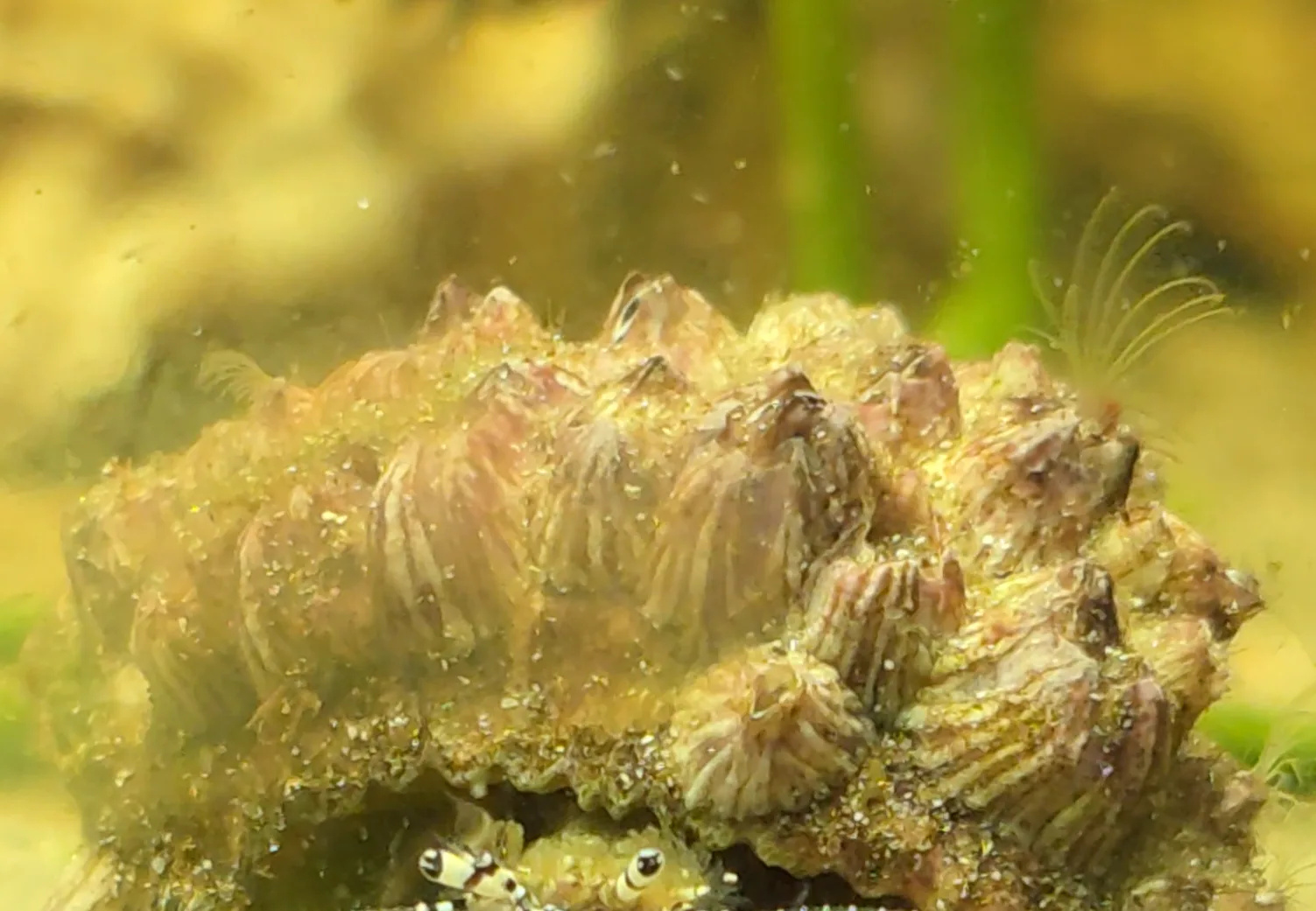
Arriving as silent stowaways cemented to the shells of introduced hermit crabs, these filter-feeding barnacles extend feathery cirri into the water column to capture suspended food, marking the second barnacle species to enter miniBIOTA's saltwater realm.

Visual Data Unavailable

Overview

Striped Acorn Barnacles (Amphibalanus amphitrite) arrived in miniBIOTA on June 12, 2026 as passive hitchhikers attached to the shells of Hairy Hermit Crabs and Long-claw Hermit Crabs collected from the Tampa Bay coast. Their count is unknown; individuals were already cemented to the gastropod shells when the hermit crabs were collected. This is the second barnacle species in miniBIOTA, distinct from the self-recruited Bay Barnacle (Amphibalanus improvisus).

Identity

  • Common name: Striped Acorn Barnacle
  • Alternate names: striped barnacle, banded barnacle, Amphibalanus amphitrite
  • Scientific name: Amphibalanus amphitrite
  • Identification confidence: Confirmed. Identified by Josue during intake, June 18, 2026.
  • Uncertainty label: Confirmed. Species ID is solid; survival on introduced shells, count, and long-term fate are all unresolved.

Taxonomy

  • Kingdom: Animalia
  • Phylum: Arthropoda
  • Class: Thecostraca
  • Subclass: Cirripedia
  • Order: Sessilia
  • Family: Balanidae
  • Genus: Amphibalanus
  • Species: A. amphitrite

Natural History

Range and Florida Relevance

Amphibalanus amphitrite is one of the most widely distributed barnacles on Earth, having been transported globally through hull fouling on ships. It is native to the Indo-Pacific but is now established in virtually every warm coastal marine region, including the Gulf of Mexico and Florida's coastal waters. It is among the most studied barnacle species in the world, frequently used in marine fouling research. In Florida, it is extremely common on dock pilings, boat hulls, oyster clusters, crab trap buoys, and any other hard surface regularly submerged in warm saltwater.

Habitat

Amphibalanus amphitrite is a sessile fouling organism that attaches permanently to hard surfaces by larval settlement and cement. It occurs on any hard substrate in the intertidal to shallow subtidal zone: rock, shell, metal, plastic, wood, and in this case, gastropod shells occupied by hermit crabs. In miniBIOTA, individuals arrived pre-attached to shells. Whether they will spread to other hard surfaces (glass, rock, oyster cluster) depends on whether any individuals reproduce and release larvae that settle in the system.

Diet

Amphibalanus amphitrite is a suspension filter feeder. Like all acorn barnacles, it extends feathery cirri through the opercular plates to sweep suspended particles from the water column: phytoplankton, bacteria, fine detritus, and organic matter. Feeding is passive and continuous when the opercular plates are open.

Reproduction

Amphibalanus amphitrite is hermaphroditic but requires cross-fertilization between adjacent individuals. Internal fertilization produces eggs brooded in the mantle cavity before nauplius larvae are released into the water column. Larvae pass through several naupliar stages before metamorphosing into a cypris larva that settles on hard substrate. Settlement is strongly gregarious: cypris larvae are chemically attracted to surfaces where conspecifics are already present. The number of individuals that arrived in miniBIOTA is unknown; if multiple individuals arrived on the same shells, cross-fertilization could be possible.

Tolerance Ranges

Amphibalanus amphitrite is broadly tolerant of salinity variation and temperature, consistent with its global range and fouling lifestyle. It tolerates salinities from brackish to full marine and a wide temperature range spanning subtropical to tropical conditions. Specific tolerance measurements for miniBIOTA have not been taken.

Ecological Role

Striped Acorn Barnacle provides water-column filtration in the saltwater biomes, removing suspended phytoplankton and fine particles from the water column and returning material as feces to the substrate below. In miniBIOTA, this role is shared with the Bay Barnacle (A. improvisus), Depressed Slippersnail, Scorched Mussel, and eastern oyster.

The Striped Acorn Barnacle is notably the first marine species to arrive attached to another living animal (the introduced hermit crabs) rather than to substrate. This passive transport mode is ecologically common in the wild but is new to miniBIOTA's documented arrivals. Whether the barnacles remain on the hermit crab shells, detach as the hermit crabs exchange shells, or spread to fixed substrate depends on the dynamics of shell exchange events.

miniBIOTA Evidence

Arrival

Striped Acorn Barnacles arrived in miniBIOTA on June 12, 2026 as hitchhikers on the shells of Hairy Hermit Crabs and Long-claw Hermit Crabs collected from the Tampa Bay coast. Count unknown; individuals were observed cemented to shells at time of introduction.

Observation Timeline

  • June 12, 2026: Striped Acorn Barnacles confirmed attached to hermit crab shells at time of collection and introduction. Count unknown. Identity confirmed by Josue during intake, June 18, 2026. Distinct from Bay Barnacle (A. improvisus)..

What Is Confirmed

  • Striped Acorn Barnacle (Amphibalanus amphitrite) is present in miniBIOTA as of June 12, 2026.
  • Arrived attached to gastropod shells occupied by introduced hermit crabs from the Tampa Bay coast.
  • Count is unknown; multiple shells were barnacle-bearing.
  • Distinct species from Bay Barnacle (Amphibalanus improvisus).

What Is Inferred

  • Filter-feeding role consistent with Balanidae family biology.
  • Barnacles on hermit crab shells may be dislodged or transferred when hermit crabs exchange shells.

What Remains Unknown

  • Exact count of Striped Acorn Barnacle individuals.
  • Whether individuals are still alive after introduction.
  • Whether any spread to fixed hard substrate in the saltwater biomes.
  • Whether reproduction is possible with the number of individuals present.
  • Whether the species will interact with Bay Barnacle (A. improvisus).