Unknown species

Cyanobacteria

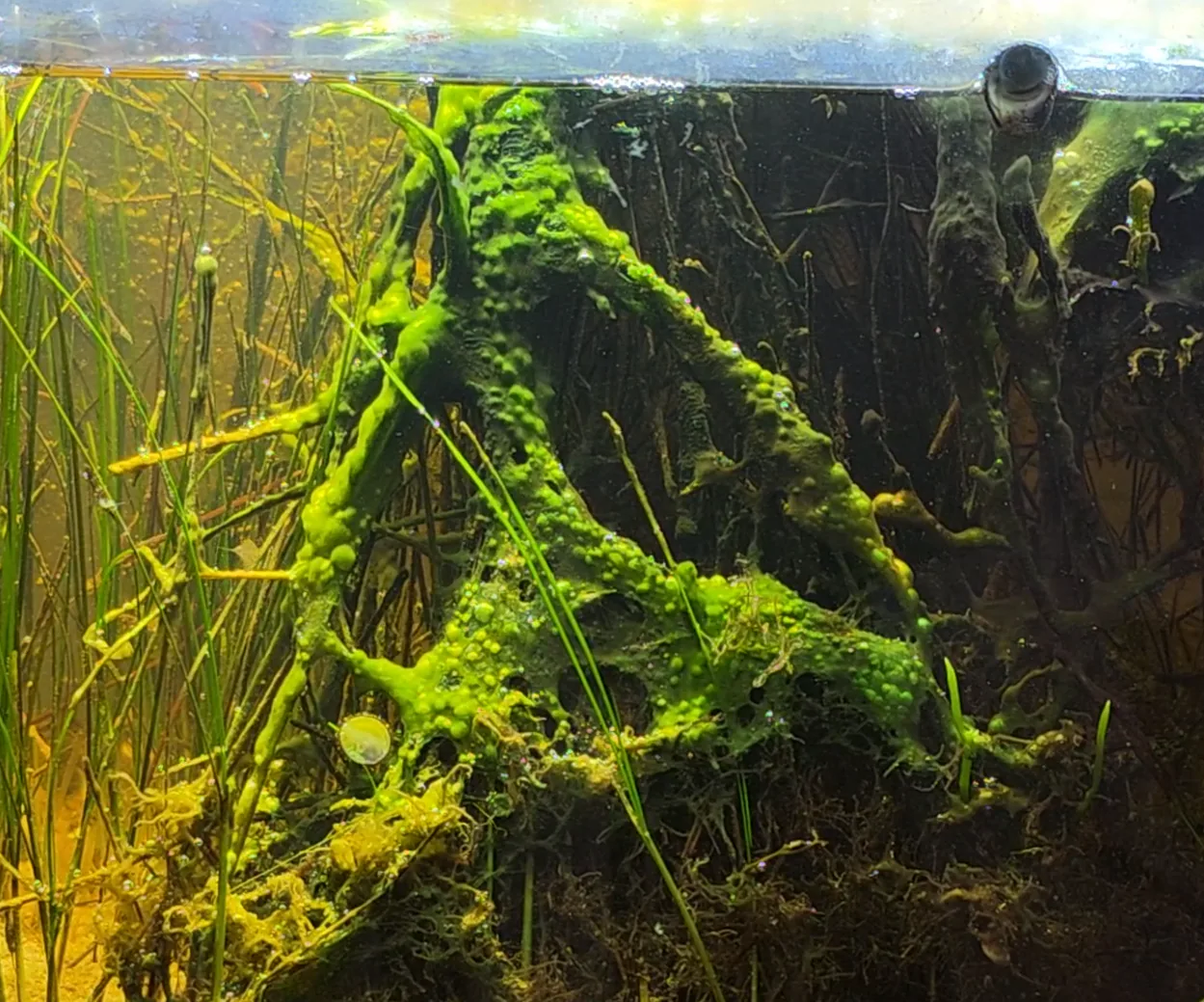
Spreading as a visible blue-green film across the substrate and glass of the Seagrass Meadow, this photosynthetic microbial growth colonized the system after sand-turning disturbance declined and is grazed by the Mottled Shore Crab and targeted by the June 2026 Mud Crab introduction.

Overview

This record tracks a visible cyanobacterial surface growth community in the Seagrass Meadow. The exact genus and species are unresolved; the growth is described as cyanobacterial based on visual appearance and context but has not been microscopically confirmed. The growth is not Nostoc (per direct user clarification). Transient cyanobacteria-like appearances occurred at various points in the system's earlier history; persistent surface growth established in November 2025. Mottled Shore Crab is documented as a grazer reducing the cyanobacterial extent. Mud Crabs were added to the Seagrass Meadow in June 2026 partly to disrupt the growth through sediment disturbance. Population status is Uncertain.

Identity

  • Common name: Cyanobacteria
  • Alternate names: blue-green algae, blue green algae, cyano, BGA, pond scum, slime algae
  • Scientific name: Unknown species (phylum Cyanobacteria)
  • Identification confidence: Unknown; identified visually as cyanobacterial surface growth; genus and species are unresolved; confirmed not Nostoc
  • Uncertainty label: Unknown

Taxonomy

  • Kingdom: Bacteria
  • Phylum: Cyanobacteria (also Cyanophyta in older classifications)
  • Class: (unresolved)
  • Order: (unresolved)
  • Family: (unresolved)
  • Genus: Unknown
  • Species: Unknown

Natural History

What Cyanobacteria Are

Cyanobacteria are photosynthetic prokaryotes, bacteria that photosynthesize. Despite being commonly called "blue-green algae," they are bacteria, not algae; they share no evolutionary relationship with true algae. Cyanobacteria were among the first photosynthetic organisms on Earth and played a key role in oxygenating the early atmosphere. They are found in virtually every aquatic and terrestrial environment.

Cyanobacteria grow as unicellular, colonial, or filamentous forms, often producing visible mats, films, or clumps on substrate and glass surfaces. Blue-green coloration is typical, though brown, black, or olive-green growth is also possible depending on species and light conditions. Filamentous forms can fragment and colonize new surfaces; colonial forms can spread horizontally across substrate.

Why Cyanobacteria Colonize Closed Systems

In aquatic systems, cyanobacteria opportunistically colonize substrate surfaces when conditions favor them: adequate light, available dissolved nutrients (particularly phosphorus and nitrogen), and reduced physical disturbance. In natural settings, bioturbation, the physical mixing of substrate by burrowing animals and detritivores, limits cyanobacterial mat development by continuously disrupting the surface layer. When bioturbation is reduced, cyanobacteria can establish and spread more readily.

In marine aquariums and closed systems, cyanobacterial surface growth is common and is typically associated with elevated nutrients, reduced water circulation over the substrate, and insufficient grazing or bioturbation pressure.

Nitrogen Fixation

Some cyanobacterial genera (notably Anabaena and Trichodesmium) fix dissolved atmospheric nitrogen into biologically available forms, adding nitrogen to the system from the air. Whether the miniBIOTA cyanobacterial growth includes nitrogen-fixing taxa is unknown.

Toxin Potential

Some cyanobacterial genera produce toxins (cyanotoxins) that can harm animals, particularly through ingestion or skin contact. Not all cyanobacteria produce toxins, and even toxin-producing genera do not produce toxins under all conditions. Whether the miniBIOTA growth produces toxins is unknown. No toxicity events have been documented.

Habitat

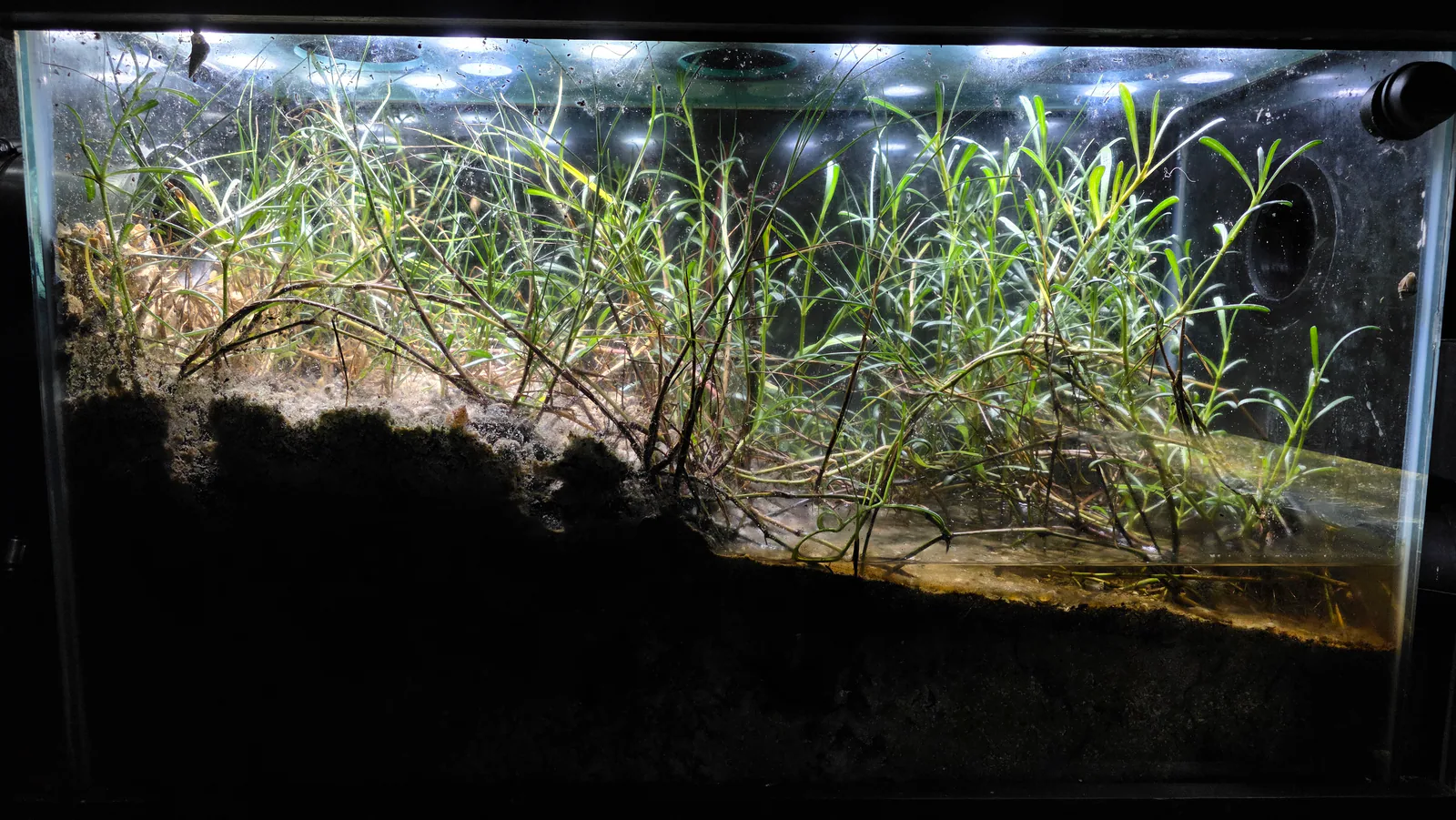
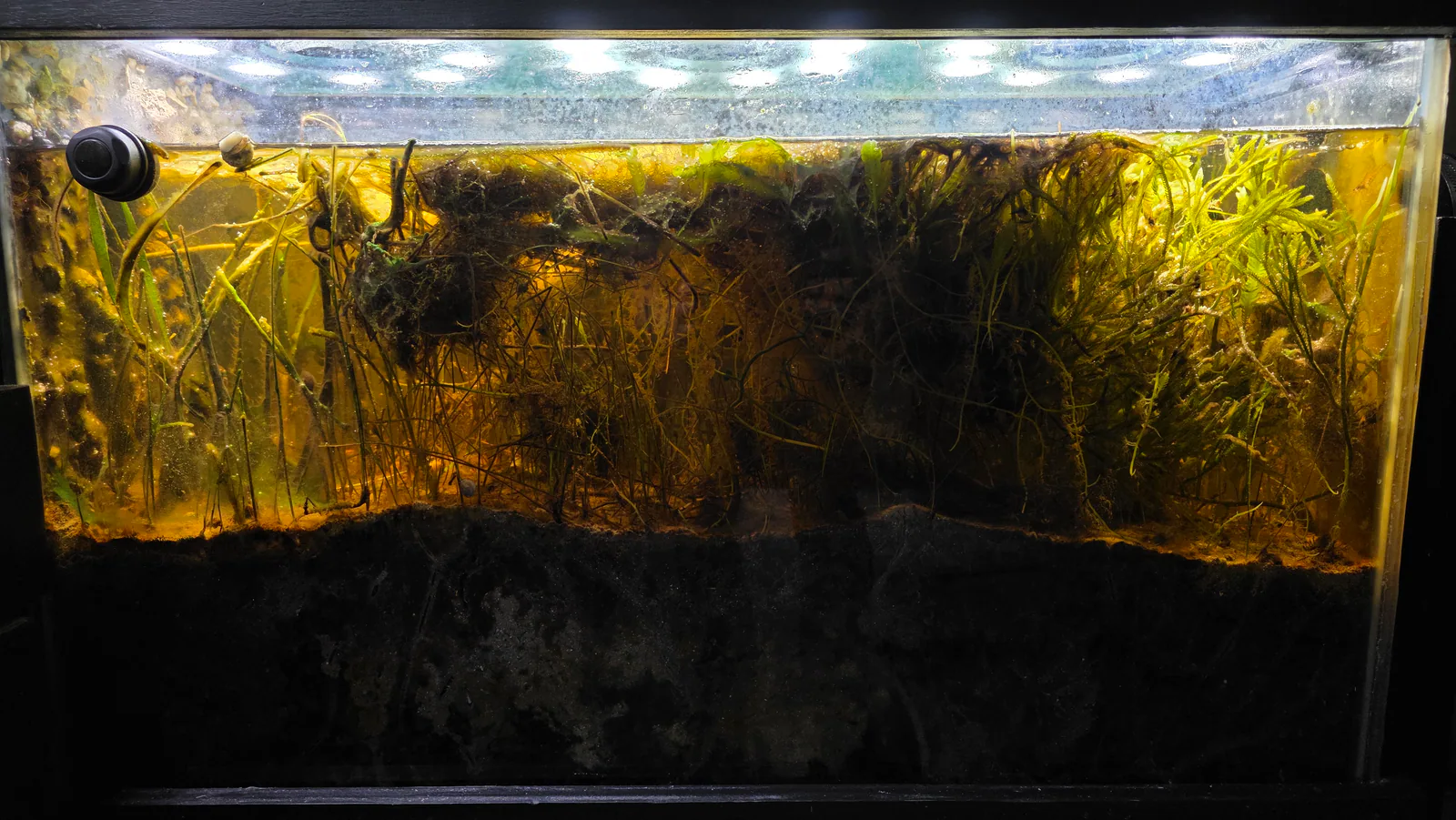
The miniBIOTA cyanobacteria occupy substrate surfaces and potentially vertical surfaces within the Seagrass Meadow. The growth forms a visible blue-green film or mat across sand and hard surfaces. Transient surface growth appeared at various earlier points; persistent, prolific growth established in November 2025 and continued through mid-2026.

Ecological Role

Cyanobacteria function as photosynthetic producers in the Seagrass Meadow, converting light and dissolved nutrients into microbial biomass. As a surface mat, the growth contributes to the base of the food web and can be consumed by generalist grazers.

The growth also represents a succession dynamic: in the absence of adequate bioturbation (sand-turning by detritivores), cyanobacterial mats can spread and outcompete other producers for substrate. The mat layer can shade underlying substrate, alter local oxygen dynamics, and influence which other organisms can establish.

Mottled Shore Crab has been documented grazing directly in the cyanobacteria and macroalgae clump, with the cyanobacterial extent notably reduced following the crab's activity (March 26, 2026). This is the only confirmed predator or grazer of this growth on record in miniBIOTA.

Mud Crabs were added to the Seagrass Meadow on June 4, 2026, partly with the intention that their digging and foraging behavior might disrupt cyanobacterial surface growth through increased sediment disturbance. Whether this intervention reduced the growth is not yet documented.

miniBIOTA Evidence

Origin

Cyanobacteria were not intentionally introduced to miniBIOTA. The growth colonized the Seagrass Meadow spontaneously. No introduction date, source, or method is on record. Transient cyanobacteria-like appearances occurred at various earlier points but did not persist; the growth became a persistent ecological feature of the Seagrass Meadow starting in November 2025.

Observation Timeline

  • November 2025: Cyanobacteria-like surface growth established as a persistent presence in the Seagrass Meadow. Earlier transient appearances occurred at various points but did not persist. No dedicated observation file for the November 2025 onset is on record; date is based on owner recollection.
  • March 26, 2026: Mottled Shore Crab observed actively grazing in a large macroalgae and cyanobacteria clump at the far end of the Seagrass Meadow. Cyanobacterial extent notably reduced; crab appeared to be directly controlling or reducing the growth. Video documented.
  • June 4, 2026: Timeline review documented: cyanobacteria became prolific in the Seagrass Meadow. A hypothesis was noted that reduced sand-turning disturbance after Common Atlantic Marginella removal may have contributed to cyanobacterial growth; the exact relationship is unresolved. The persistent growth onset (November 2025) is over a year after Marginella removal (2024), which weakens the timing correlation originally proposed. As of June 4, 2026, Josue had attempted to locate additional Marginellas for reintroduction but was unable to find any.
  • June 4, 2026: Mud Crabs collected and introduced to the Seagrass Meadow, partly because their digging and foraging behavior may help disrupt the widespread cyanobacterial growth. Outcome not yet documented.
  • June 10, 2026: Last observed date on record prior to June 14.
  • June 14, 2026: Cyanobacteria observed visually less established and beginning to break apart following stronger wave system settings implemented June 13, 2026. The biome overall described as noticeably healthier. Specific mechanism (wave disturbance vs. grazing) not confirmed; both are plausible given concurrent hermit crab grazing activity. No video.
  • June 18, 2026: Cyanobacteria retreat has advanced since June 14. The mat is now fragmented into smaller, discrete clumps and is no longer a continuous surface sheet. Owner describes the growth as clearly losing dominance in the biome. Two drivers attributed: hermit crab physical disruption and grazing (Long-claw Hermit Crabs and others confirmed active June 18), and sustained stronger wave currents from the June 13 wave system reprogramming. Video documented.

What Is Confirmed

  • Visible cyanobacterial surface growth present in the Seagrass Meadow as of mid-2026.
  • Transient cyanobacteria-like growth occurred at various earlier periods; persistent surface growth established in the Seagrass Meadow in November 2025.
  • Mottled Shore Crab observed grazing in the cyanobacteria clump on March 26, 2026; cyanobacterial extent reduced after crab activity (video).
  • Mud Crabs introduced June 4, 2026 with cyanobacteria disruption as one stated goal.
  • On June 14, 2026, cyanobacteria visually less established and beginning to break apart following stronger wave settings implemented June 13, 2026; hermit crab grazing also active simultaneously.
  • On June 18, 2026, cyanobacteria fragmented into smaller, discrete clumps and no longer a continuous surface mat; described as clearly losing dominance in the biome. Two attributed drivers: hermit crab disruption and grazing, and sustained stronger wave currents (video).

What Is Inferred

  • The timing correlation between Common Atlantic Marginella removal and cyanobacterial expansion suggests a possible connection through reduced sand-turning disturbance, but this is a hypothesis, not a confirmed cause.
  • The reduction in cyanobacterial extent following Mottled Shore Crab grazing suggests the crab provides meaningful top-down control on the growth.
  • Bioturbation by Mud Crabs may reduce surface stability that favors cyanobacterial mat development, but no post-introduction observation has confirmed this.

What Remains Unknown

  • Genus, species, and toxin-production potential of the growth.
  • Whether the growth will continue to decline following the June 2026 hermit crab introduction and wave system strengthening, or whether it will stabilize or rebound.
  • Whether Mud Crab bioturbation is contributing to the decline in addition to hermit crab activity and wave currents.
  • Whether Common Atlantic Marginella reintroduction would further reduce or prevent reestablishment.
  • Whether nitrogen fixation is occurring and what impact that has on the system's nutrient dynamics.