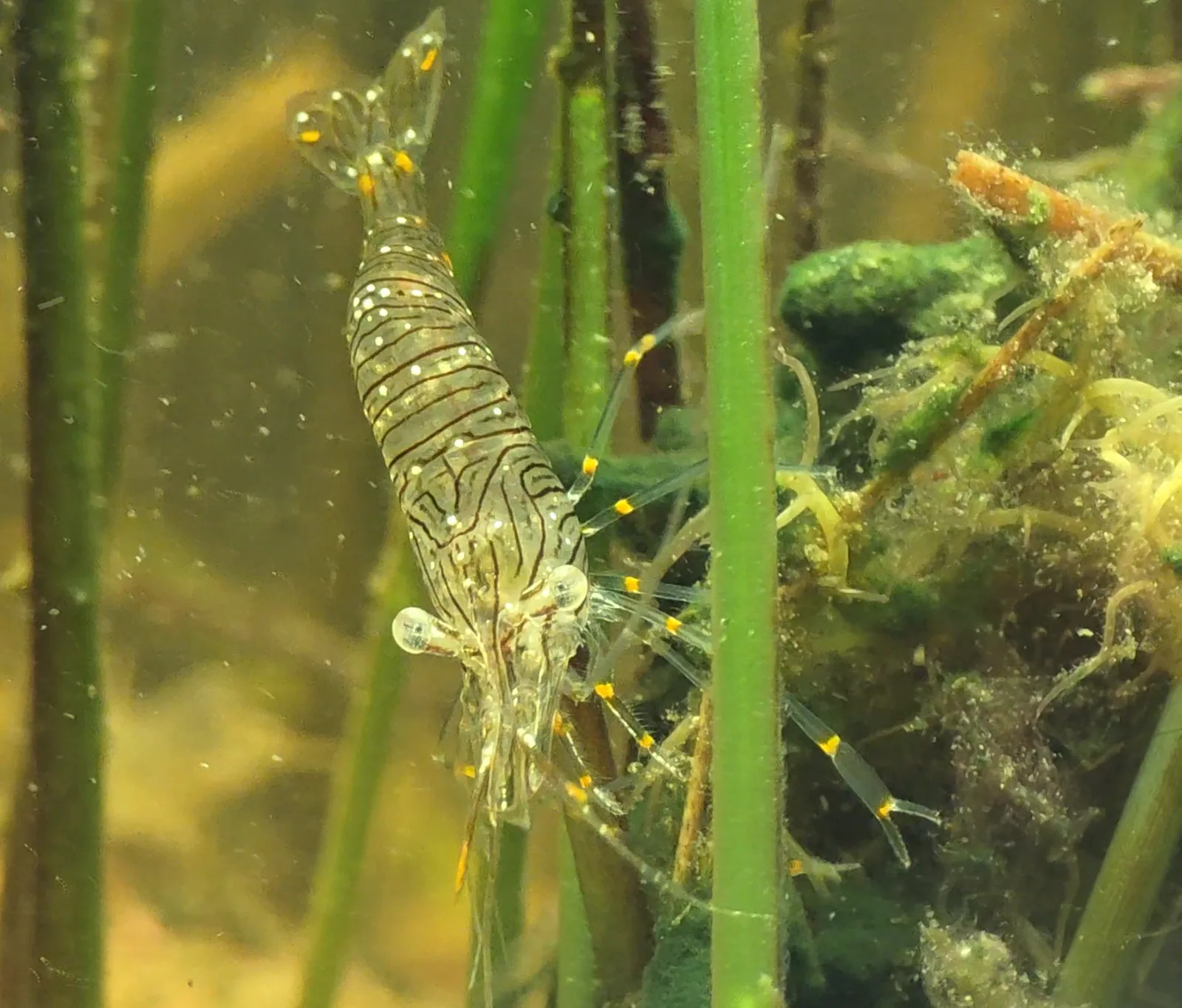
Palaemon floridanus

Florida Glass Shrimp

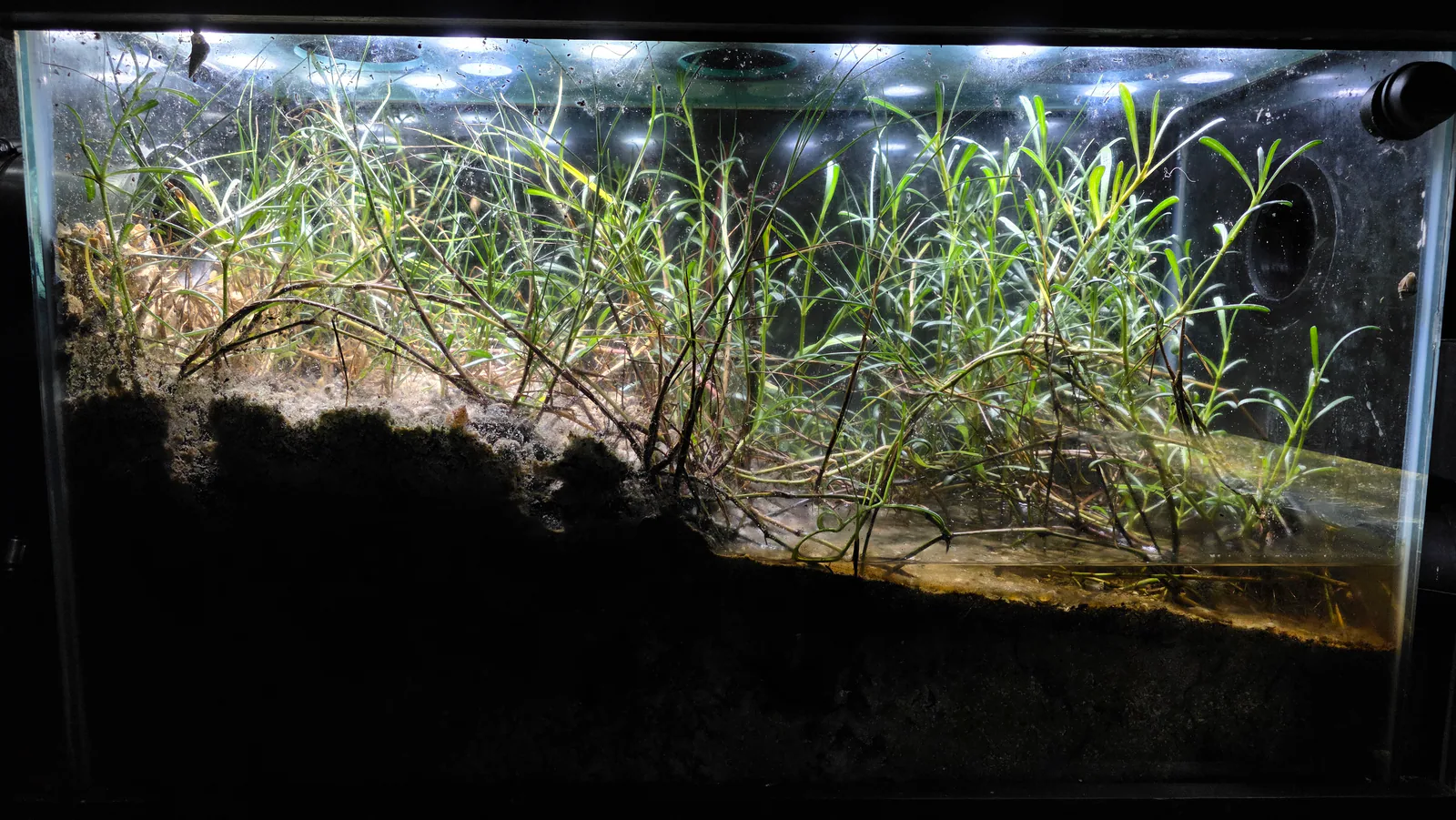
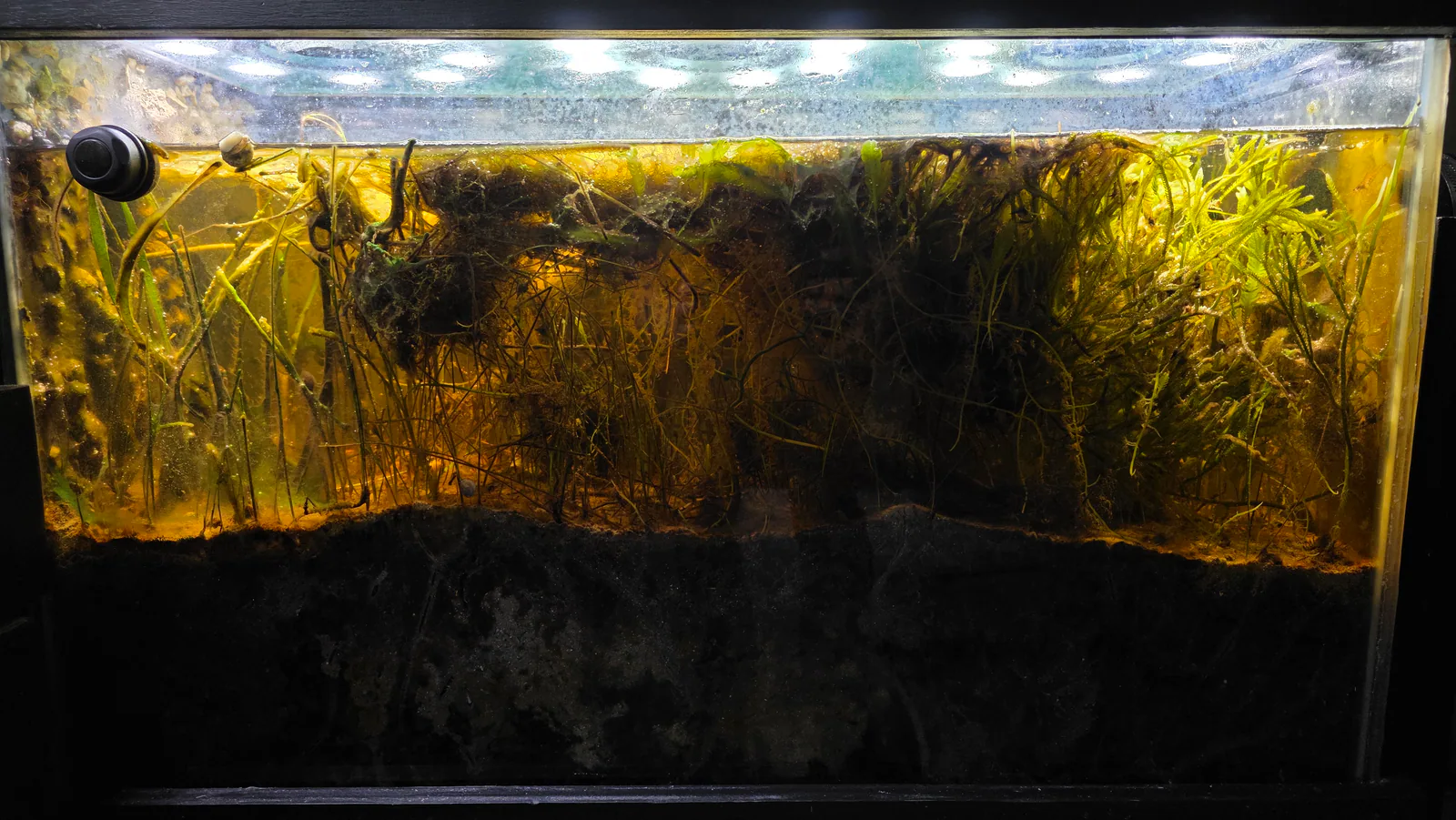
Introduced in a group of 75 from the Tampa Bay coast to strengthen the saltwater shrimp layer, this nearly transparent marine shrimp grazes algae and scavenges organic matter across the Seagrass Meadow and Marine Shore.

Overview

Seventy-five Florida Glass Shrimp (Palaemon floridanus) were collected from the Tampa Bay coast and introduced to miniBIOTA's Marine Shore and Seagrass Meadow on June 12, 2026. Introduced as a deliberate shrimp population supplement to support a stronger shrimp layer than the struggling Daggerblade Grass Shrimp, this is the largest single introduction of any shrimp species in miniBIOTA to date.

Identity

  • Common name: Florida Glass Shrimp
  • Alternate names: glass shrimp, Florida shrimp, palaemon shrimp
  • Scientific name: Palaemon floridanus
  • Identification confidence: Confirmed. Identified by Josue from the June 12, 2026 Tampa Bay collection.
  • Uncertainty label: Confirmed. Species ID is solid; establishment and long-term population trajectory in miniBIOTA are unresolved.
  • Disambiguation note: Three Palaemon-family shrimp are present in miniBIOTA records. Ghost Shrimp (Palaemon paludosus) is a freshwater species in the Freshwater Lake biome. Daggerblade Grass Shrimp (Palaemon pugio) is an existing saltwater species in the Seagrass Meadow, currently at approximately 5 adults with failed larval recruitment. Florida Glass Shrimp (Palaemon floridanus) is a new marine species introduced June 12, 2026.

Taxonomy

  • Kingdom: Animalia
  • Phylum: Arthropoda
  • Class: Malacostraca
  • Order: Decapoda
  • Family: Palaemonidae
  • Genus: Palaemon
  • Species: P. floridanus

Natural History

Range and Florida Relevance

Palaemon floridanus is native to shallow coastal marine and estuarine habitats of the southeastern United States and the Gulf of Mexico, with Florida as a core part of its range. It is found in seagrass beds, mangrove edges, tidal creeks, and shallow sandy substrates along Florida's coastal and estuarine shores, including Tampa Bay. It is the larger and more robustly built of the common Florida Palaemon species and is frequently encountered in nearshore saltwater collections.

Habitat

Florida Glass Shrimp inhabit shallow marine and estuarine environments with submerged vegetation, sandy substrate, and abundant surface structure. They are semi-pelagic, capable of swimming short distances but spending most of their time near the substrate and associated with seagrass blades, algae mats, and submerged debris. Their nearly transparent bodies provide camouflage in open-water backgrounds. In miniBIOTA, they were introduced to the Marine Shore and Seagrass Meadow.

Diet

Palaemon floridanus is an omnivorous scavenger and grazer. It feeds on algae and biofilm scraped from surfaces, processes detritus and fine organic particles, and scavenges dead animal matter when available. Behavior is broadly similar to other Palaemon species.

Reproduction

Females carry eggs attached to the pleopods beneath the abdomen until hatching. Larvae pass through zoea and mysis stages before settling. In a closed system, mysis larval survival depends on available fine suspended food particles, which has been the limiting factor for Daggerblade Grass Shrimp larvae in miniBIOTA. Whether P. floridanus larvae will survive past the mysis stage is unknown.

Tolerance Ranges

Palaemon floridanus tolerates a range of salinities from brackish to full marine, consistent with its estuarine range. It is adapted to Florida's coastal temperature range. Specific tolerance measurements for miniBIOTA conditions have not been taken.

Ecological Role

Florida Glass Shrimp serve as generalist omnivores and scavengers in the marine saltwater biomes, grazing surfaces and processing detritus similarly to Daggerblade Grass Shrimp but potentially at a higher population density given the larger introduction size. With 75 individuals introduced at once, they represent a substantially larger immediate contribution to the shrimp grazer and scavenger layer than the Daggerblade Grass Shrimp population has ever achieved.

As the larger of the two Palaemon species in the saltwater realm, there is potential for ecological overlap and competitive interaction with Daggerblade Grass Shrimp, but no interaction has been observed.

miniBIOTA Evidence

Introduction

Seventy-five Florida Glass Shrimp were collected from the Tampa Bay coast and introduced to miniBIOTA's Marine Shore and Seagrass Meadow on June 12, 2026, as a deliberate shrimp population supplement.

Observation Timeline

  • June 12, 2026: 75 individuals collected from Tampa Bay coast and introduced to Marine Shore and Seagrass Meadow. Introduced to supplement the struggling Daggerblade Grass Shrimp population.
  • June 13, 2026: Species identity formally confirmed as Palaemon floridanus by Josue, supported by morphological characteristics and known presence of the species at the Tampa Bay collection site. Short video clips on record; first media for this species in miniBIOTA. Many individuals observed burying in the substrate immediately after introduction, a typical acclimation and refuge response in Palaemon shrimp. Population appears to include a roughly even distribution of males and females across approximately 75 individuals. On the same morning, the shrimp population appeared unusually lethargic, interpreted as a stress response to low dissolved oxygen following the large overnight biomass increase from the June 12 introduction. Wave system programming was modified on June 13 in response. Mortality from this event was not confirmed until a July 2, 2026 follow-up: see below.
  • June 19, 2026: Florida Glass Shrimp observed crouching directly against algae-covered surfaces to feed, a posture distinct from the upright picking posture of Daggerblade Grass Shrimp. Many individuals showed visibly full digestive tracts through their transparent bodies, confirming active feeding and food availability in the Seagrass Meadow. Some females remain buried in the substrate; whether this reflects continued acclimation, resting, or brooding is not established. Video documented. Observation record, June 19, 2026.
  • June 27, 2026: A concurrent substantial decline in Eelgrass Isopods and Marine Scuds was observed in the Seagrass Meadow on this date. Florida Glass Shrimp predation is one of two competing explanations for the decline; no direct predation event on Eelgrass Isopods or Marine Scuds was observed. The timing correlation remains the basis for the hypothesis. Observation record, June 27, 2026. The original note described the shrimp "population" as having "increased significantly," clarified July 2, 2026 to mean the Seagrass Meadow's overall shrimp presence grew because Florida Glass Shrimp is a newly added species alongside Daggerblade Grass Shrimp, not that Florida Glass Shrimp's own numbers grew since introduction.
  • July 2, 2026: A follow-up conversation with the owner confirmed approximately 3 Florida Glass Shrimp died the morning of June 13, 2026; carcasses were consumed by tankmates within hours, so the owner considers 3 a likely conservative undercount of total mortality from that event. The same conversation produced a current population estimate of approximately 50 individuals, down from the 75 introduced, and clarified that the June 27, 2026 "increased significantly" wording referred to the shrimp guild overall, not Florida Glass Shrimp specifically. The owner states a precise census is not practically obtainable given the species' swimming speed and the amount of hiding structure available; the estimate is a rounded impression, not a count. Observation record, July 2, 2026.

What Is Confirmed

  • 75 individuals introduced June 12, 2026.
  • Species identity confirmed as Palaemon floridanus by Josue on June 13, 2026; supported by morphology and known Tampa Bay collection locality.
  • Introduced to Marine Shore and Seagrass Meadow.
  • Introduction was deliberate and intended to strengthen the shrimp layer.
  • Many individuals buried in the substrate immediately after introduction; substrate burial is an expected acclimation response in Palaemon shrimp.
  • Population includes a roughly even sex ratio across approximately 75 individuals.
  • Video documented June 13, 2026; first media for this species in miniBIOTA.
  • Crouching feeding posture documented June 19, 2026: individuals crouch directly against algae-covered surfaces to feed, distinct from Daggerblade Grass Shrimp's upright picking posture. Full digestive tracts visible through transparent bodies. Video documented.
  • Approximately 3 individuals died the morning of June 13, 2026, following the low-oxygen stress event; carcasses were consumed by tankmates within hours (confirmed via follow-up, July 2, 2026).

What Is Inferred

  • Ecological role as omnivorous scavengers and algae grazers consistent with Palaemonidae family biology.
  • Potential ecological overlap with Daggerblade Grass Shrimp (P. pugio) given similar habitat and trophic niche.
  • Current population is approximately 50 individuals as of July 2, 2026, per owner estimate; not a verified count.

What Remains Unknown

  • The precise current population; a direct count is not practically obtainable given swimming speed and available hiding places.
  • Whether larvae will survive past the mysis stage in miniBIOTA's closed system.
  • How Florida Glass Shrimp and Daggerblade Grass Shrimp will interact.
  • Whether the species will establish a self-sustaining population.
  • How long the substrate burial acclimation response lasts and when individuals begin foraging openly.
  • Whether Florida Glass Shrimp are predating Eelgrass Isopods or Marine Scuds in the Seagrass Meadow; timing correlation with observed declines exists but no direct predation event has been observed.
  • What accounts for the full gap between 75 introduced and an estimated ~50 remaining beyond the ~3 confirmed June 13 deaths.