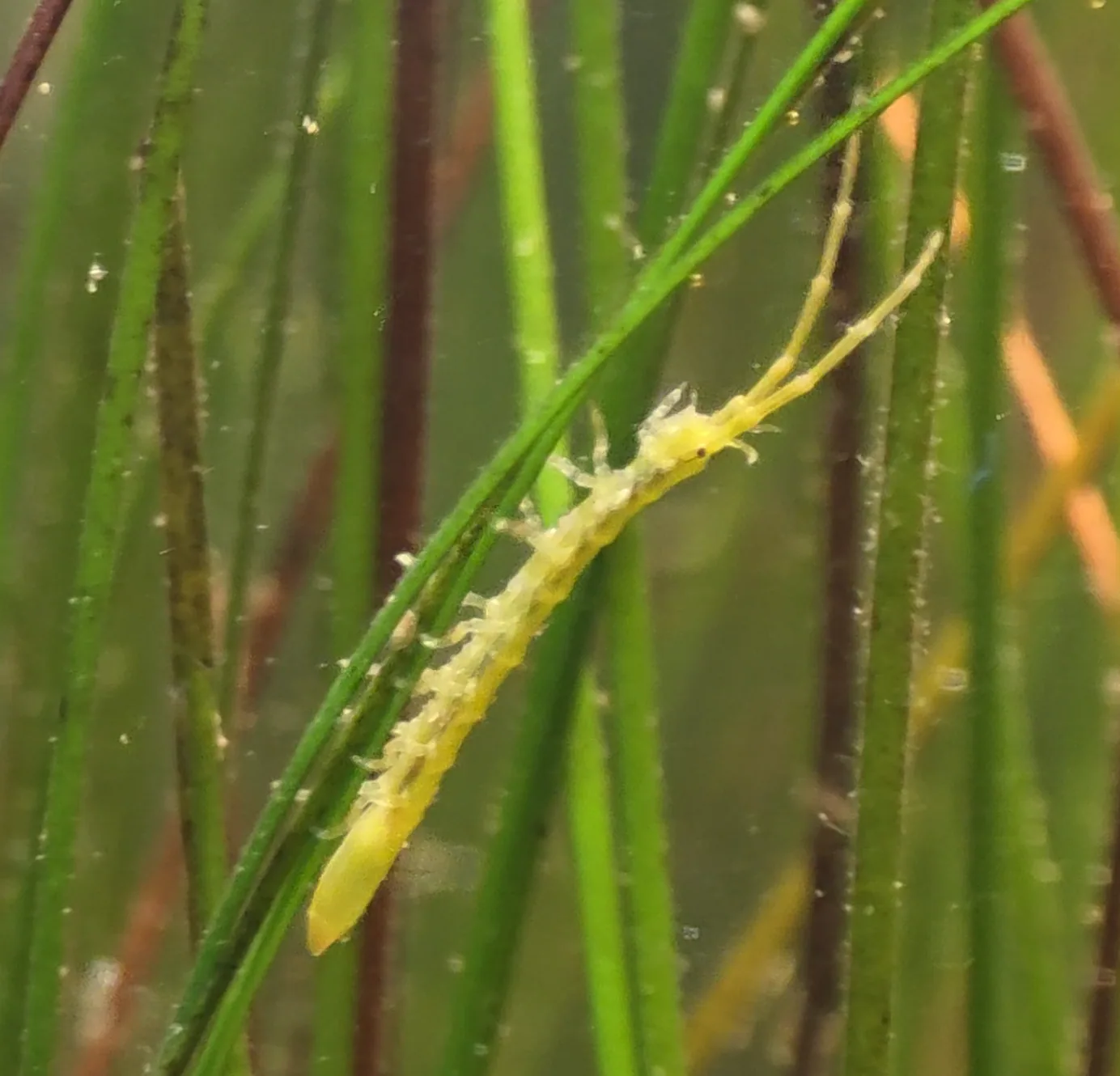
Erichsonella attenuata

Eelgrass Isopod

Clinging to seagrass blades in the Seagrass Meadow with a slender, camouflaged body, this small isopod grazes epiphytic algae from leaf surfaces and has been directly observed as prey for the Sea Anemone, linking the clean-up crew to the invertebrate predators of the seagrass community.

Overview

The Eelgrass Isopod (Erichsonella attenuata) is a small seagrass-associated isopod recorded in miniBIOTA's Seagrass Meadow, introduced alongside shoal grass plantings as part of the initial marine community seeding. Species-level identification is assessed as Possible; the name Erichsonella attenuata reflects the existing miniBIOTA record and is consistent with a common seagrass-associated isopod of Florida coastal waters, but has not been formally confirmed. Two predation and food-web events are on record: the Sea Anemone was confirmed consuming a live Eelgrass Isopod on March 21, 2026 (video), and two dead isopods were observed being scavenged by Daggerblade Grass Shrimp on June 10, 2026 (video). Population status is Uncertain; at least one individual is on record.

Identity

  • Common name: Eelgrass Isopod
  • Alternate names: isopod, seagrass isopod, marine isopod, eelgrass slater, erichsonella
  • Scientific name: Erichsonella attenuata
  • Identification confidence: Possible; tracked as Erichsonella attenuata in miniBIOTA records; species-level confirmation not formally documented
  • Uncertainty label: Possible

Taxonomy

  • Kingdom: Animalia
  • Phylum: Arthropoda
  • Class: Malacostraca
  • Order: Isopoda
  • Family: Idoteidae
  • Genus: Erichsonella
  • Species: attenuata

Natural History

Range and Florida Relevance

Erichsonella attenuata is native to shallow coastal marine and estuarine habitats along the Atlantic coast of North America and the Gulf of Mexico, including Florida. It is a characteristic species of seagrass beds, particularly those dominated by shoal grass (Halodule wrightii) and turtle grass (Thalassia testudinum). The species is common in Florida's shallow coastal waters from the Panhandle through Tampa Bay and the Atlantic coast. It belongs to family Idoteidae, a group of isopods well-adapted to clinging to and feeding on aquatic vegetation.

Body Form and Camouflage

Eelgrass Isopods are slender, flattened, and elongated, a body form adapted to life among seagrass blades. The body closely mimics the color and shape of seagrass leaves, providing camouflage against visual predators while the isopod feeds or rests. The legs are adapted for gripping blade surfaces. This cryptic lifestyle and the isopod's tendency to remain motionless when threatened make it easy to overlook even when present in reasonable numbers.

Diet

Erichsonella attenuata is an herbivorous grazer. It feeds on epiphytic microalgae and biofilms attached to seagrass blades and other submerged surfaces. By grazing epiphytes, the isopod removes surface growth that would otherwise reduce light reaching the seagrass leaf below. This incidental benefit to the host plant creates a functional commensal relationship: the isopod gains food and shelter from the seagrass blades; the grass benefits from reduced epiphytic shading.

Reproduction

Eelgrass Isopods exhibit direct development. Females brood fertilized eggs in a ventral marsupium (brood pouch) until they emerge as fully formed juvenile mancae, miniature versions of the adult, bypassing any planktonic larval stage. This reduces dispersal capacity but makes the species largely independent of open-water conditions for reproduction. Breeding is continuous through much of the year, with oocyte maturation occurring on a rolling cycle. No reproductive observations have been made in miniBIOTA.

Life Cycle and Lifespan

Individuals typically live under 1 year, with a lifespan of approximately 6 to 9 months under suitable conditions. Juveniles grow rapidly through repeated molts; molting frequency declines with age. The short lifespan and continuous reproduction enable rapid population turnover.

Tolerance Ranges

Erichsonella attenuata is adapted to warm-temperate to subtropical shallow estuarine conditions. It tolerates temperatures approximately 20 to 30 degrees Celsius (68 to 85 degrees Fahrenheit) and standard marine salinity. It is dependent on stable dissolved oxygen levels and structural shelter from seagrass blades; it is susceptible to visual predators in open, exposed environments.

Ecological Role

The Eelgrass Isopod occupies a clean-up grazer niche in the Seagrass Meadow, removing epiphytic algae from seagrass blade surfaces and biofilm from other submerged substrates. This grazing helps prevent epiphytic overgrowth that would shade seagrass leaves and reduce their photosynthetic output. As small animal biomass, the isopod bridges the epiphyte layer and invertebrate predators.

Two confirmed food-web events are on record:

  • Sea Anemone actively consumed a live Eelgrass Isopod on March 21, 2026, the first documented feeding event for the Sea Anemone in miniBIOTA (video).
  • Two dead Eelgrass Isopods were scavenged by two Daggerblade Grass Shrimp on June 10, 2026, confirming the species' role as animal biomass in the Seagrass Meadow food web. Cause of death was unknown; the shrimp fed on carcasses that appeared to have died before the scavenging began.

In addition to direct predation, the isopod's dead bodies and shed exuviae (molted exoskeletons) contribute organic material to the detrital food web.

miniBIOTA Evidence

Introduction

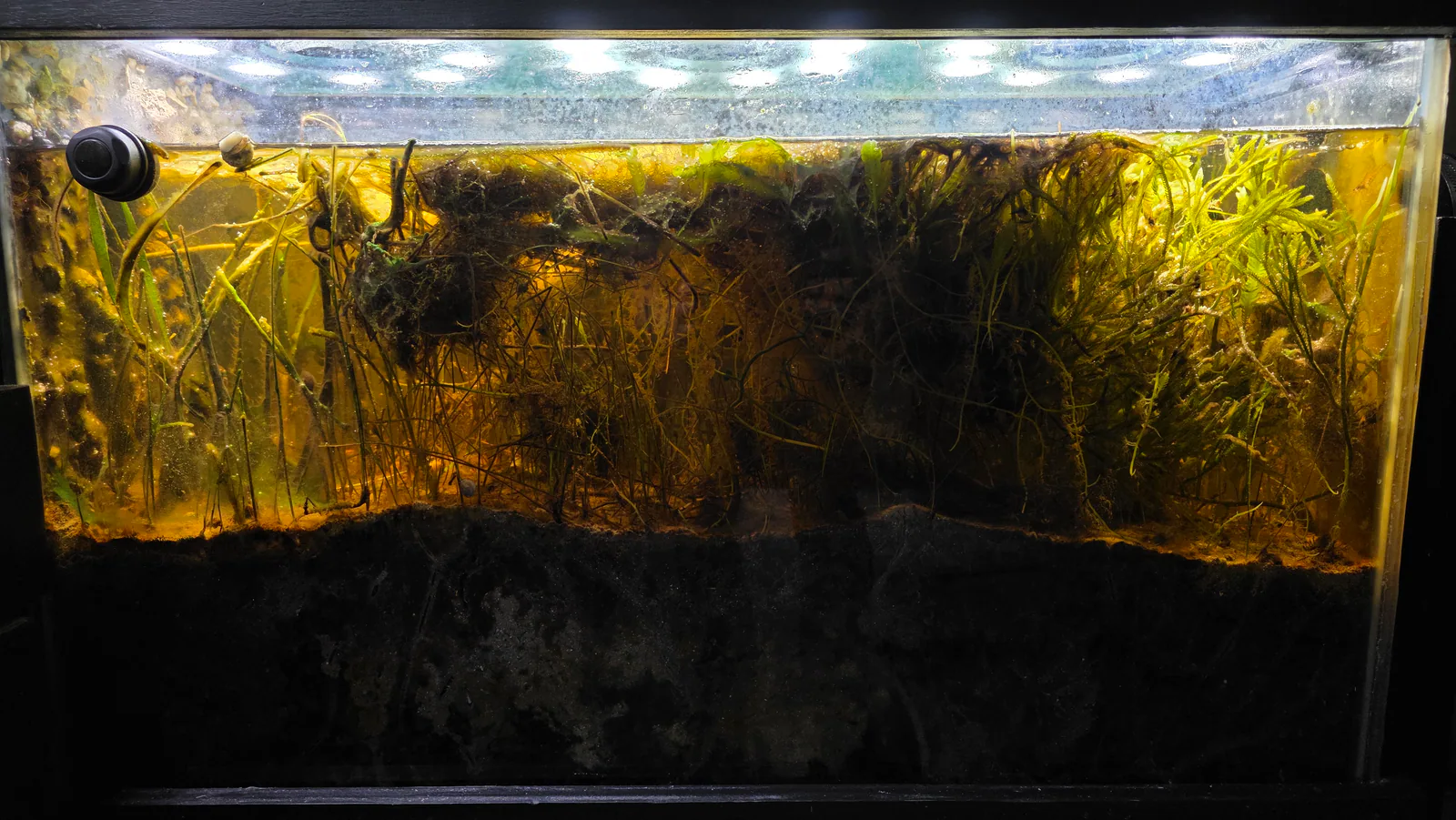
Eelgrass Isopods were introduced alongside shoal grass plantings as part of the initial marine community seeding of the Seagrass Meadow. No specific introduction date is on record. The species is tracked as arriving with the early shoal grass material.

Observation Timeline

  • March 21, 2026: Sea Anemone in the Seagrass Meadow observed actively consuming a live Eelgrass Isopod; first documented feeding event for the Sea Anemone in miniBIOTA. Video documented.
  • June 10, 2026: Two Daggerblade Grass Shrimp observed feeding on two separate dead Eelgrass Isopod carcasses in the Seagrass Meadow. Isopods appeared to have died before the scavenging began; cause of death unknown. Video documented.
  • June 27, 2026: Eelgrass Isopods observed at substantially lower apparent abundance than previously seen in the Seagrass Meadow; at least a few individuals confirmed still present. Cause uncertain: two competing hypotheses are held, predation pressure from Florida Glass Shrimp, added to the biome's shrimp presence as a new species on June 12, 2026 (their own population has not been confirmed to grow since that introduction), and an unidentified environmental change within the biome. No direct predation event was observed. Observation record, June 27, 2026.

What Is Confirmed

  • Eelgrass Isopods present in the Seagrass Meadow.
  • Sea Anemone confirmed predator of live Eelgrass Isopods (March 21, 2026, video).
  • Daggerblade Grass Shrimp confirmed scavengers of dead Eelgrass Isopod carcasses (June 10, 2026, video).
  • Eelgrass Isopod biomass documented in the Seagrass Meadow food web.

What Is Inferred

  • The isopod's cryptic body form and blade-clinging behavior suggest it actively uses seagrass structure for shelter from visual predators.
  • The short lifespan and continuous reproduction cycle mean the population turns over rapidly; the June 10, 2026 carcasses may be natural mortality from the short lifespan rather than predation.

What Remains Unknown

  • Current population size and distribution across the Seagrass Meadow.
  • Whether reproduction has occurred in miniBIOTA.
  • The cause of death of the two isopods observed on June 10, 2026.
  • The cause of the substantial population decline observed June 27, 2026: Florida Glass Shrimp predation and environmental change are both possible explanations.
  • Whether the population is stable, growing, or declining.
  • Formal species-level confirmation.