The Saltwater Realm in Global Context
Marine saltwater systems are the dominant aquatic realm on Earth by volume, covering approximately 361 million square kilometers and averaging 3.7 kilometers in depth. Coastal and inshore marine systems (including seagrass meadows, coral reefs, mangrove fringes, and intertidal shores) represent a small fraction of the global marine volume but a disproportionately large fraction of global marine biodiversity and productivity. In Florida, the Gulf Coast inshore marine zone is particularly productive: warm, shallow, high-light water over seagrass and sandy substrate supports one of the richest temperate-to-subtropical inshore marine communities in North America.
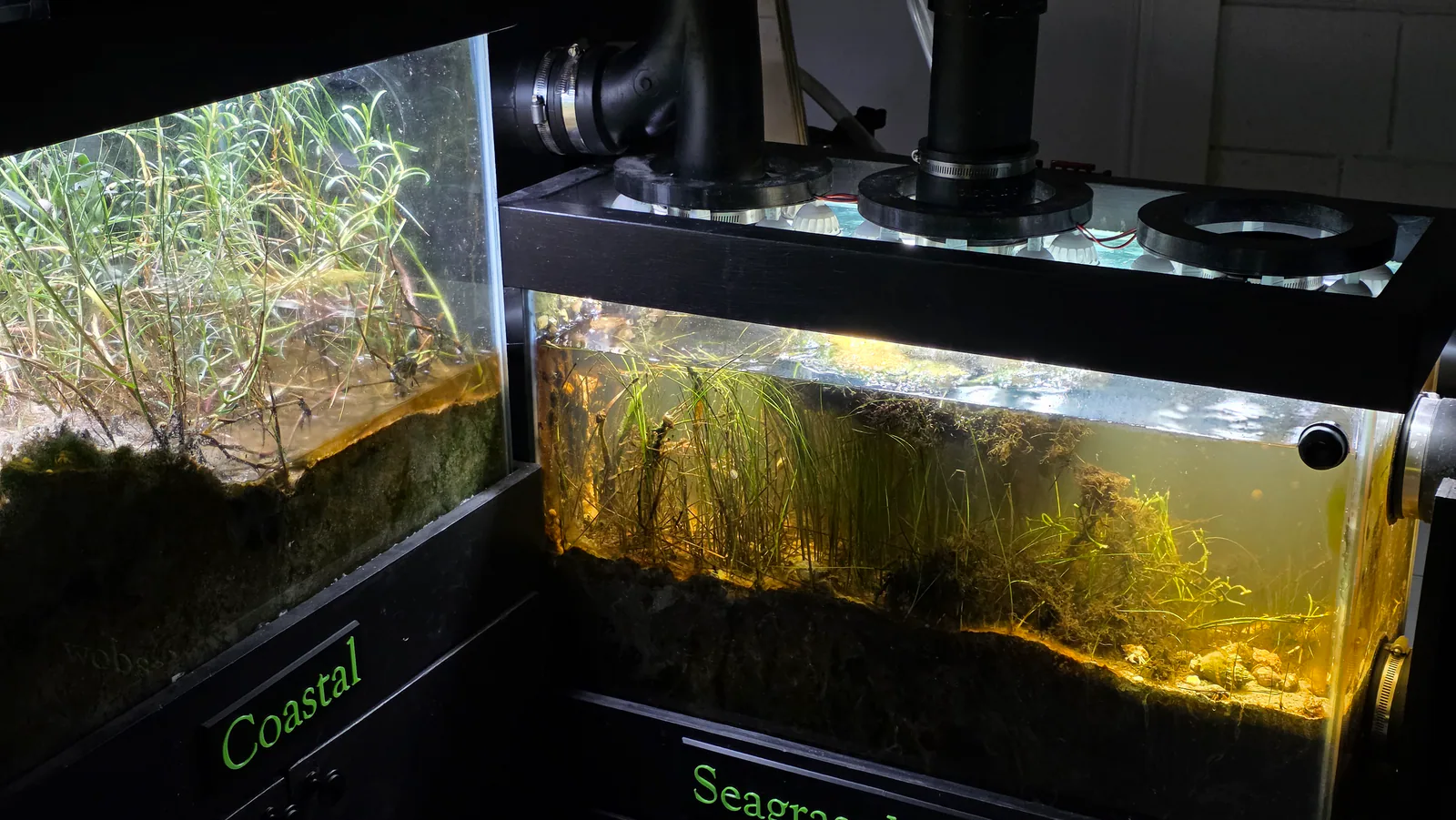
The miniBIOTA Saltwater realm is a small closed system that replicates a Florida Gulf Coast inshore community in microcosm: a seagrass meadow with multiple Florida grass species, macroalgae, invertebrate grazers and filter feeders, and an intertidal-analog shore zone where organisms move between saltwater and terrestrial surfaces. Unlike a natural open-coast system, the miniBIOTA Saltwater realm is closed: no tidal exchange, no external water input, no recruitment from outside. All populations must persist from what has been introduced, breed within the system, or immigrate from adjacent biomes.
Florida Gulf Coast Context
The Florida Gulf Coast inshore zone is dominated by shallow seagrass meadows, barrier islands, estuary fringes, and a microtidal character: tidal amplitude on the Gulf Coast of Florida is typically less than 1 meter, far smaller than Atlantic or Pacific coasts. This microtidal setting means that Gulf Coast intertidal organisms experience relatively small water-level fluctuations compared to organisms on high-tide coasts; they must still manage salinity, desiccation, and temperature at the waterline, but within a narrower physical range.
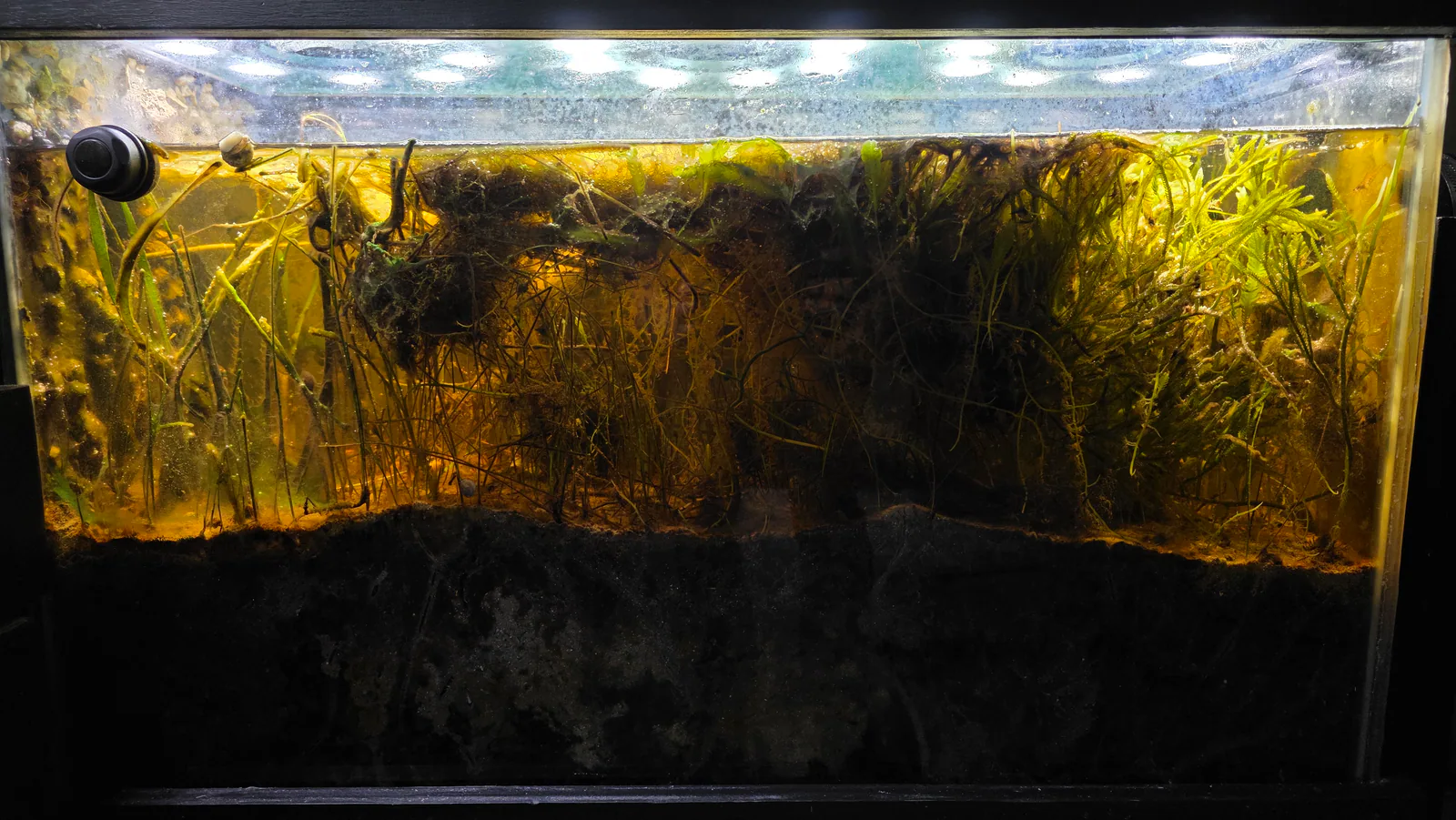
All three dominant Florida seagrasses are present in miniBIOTA's Seagrass Meadow: shoal grass (Halodule wrightii), turtle grass (Thalassia testudinum), and manatee grass (Syringodium filiforme). Together they represent the full zonation spectrum of Florida seagrass systems, from the shallow-tolerant, pioneer-character shoal grass to the deep-water, climax-community turtle grass. Understanding which species gains ground in the miniBIOTA Seagrass Meadow under current light and grazing conditions is one of the central ecological questions of the Saltwater realm.
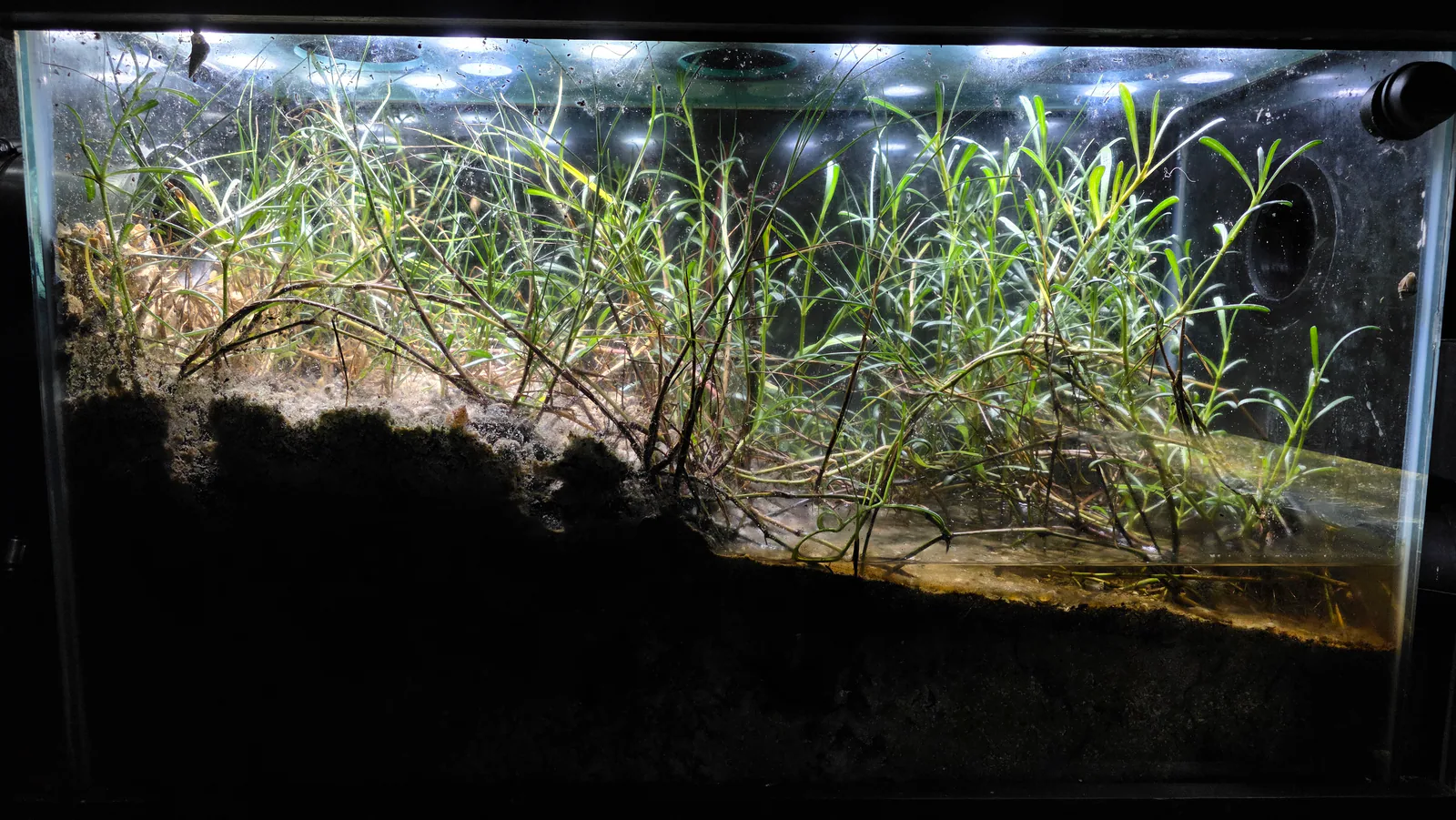
The intertidal analog in miniBIOTA, the Marine Shore, replicates the waterline zone of a Florida Gulf Coast shore: an air-water boundary where organisms live at or above the waterline, graze biofilm and detritus from exposed surfaces, and move between the water and the terrestrial side. In natural Gulf Coast intertidal zones, this community includes periwinkles, fiddler crabs, marsh crabs, and biofilm-grazing snails: many of which are represented in miniBIOTA.
Key Ecological Processes of the Saltwater Realm
Producer competition and succession: The Seagrass Meadow is the site of ongoing competition among three seagrasses, macroalgae, and cyanobacteria-like surface growth. Each producer group has different light requirements, growth rates, and susceptibility to grazers. By September 14, 2026, two Caulerpa species (Caulerpa taxifolia and Caulerpa ashmeadii) expanded to densely carpet approximately 7/8 of the tank length across the substrate. This prolific expansion has driven Graceful Redweed into renewed recession through intense nutrient competition and compressed the true seagrasses (shoal grass, turtle grass, and manatee grass) into the remaining approximately 1/8 open area where they retain light access, though their blades face visible cyanobacterial coating. Understanding whether seagrasses can persist under this extreme spatial compression and epiphyte load is the central unresolved question of the Saltwater realm.
Grazer control of producers, and its failure in 2026: Mottled Shore Crab, Mud Crab, Gulf Marsh Crab, Lightning Nerite, and amphipods graze algae, biofilm, or seagrass in the Saltwater realm; the Variegated Sea Urchin was added to this group in April 2026 as a targeted macroalgae grazer but was extirpated September 1, 2026. Grazer diversity is the primary mechanism preventing macroalgae or cyanobacteria from outcompeting seagrass in the Seagrass Meadow.
That mechanism weakened sharply over mid-2026. The Eelgrass Isopod, the realm's blade-surface epiphyte grazer, went from years of abundance to non-detected by July 29, 2026 following Florida Glass Shrimp introduction. On September 5, 2026, a nighttime observation reconfirmed a living Eelgrass Isopod, establishing that the species was not completely extirpated; however, abundance remains exceptionally low. The Lightning Nerite fell to approximately one individual from ten introduced, both cerith species declined without a confirmed sighting since February 2026, and Turbo Snail has no record since December 2024. Three of the Seagrass Meadow's four glass panes are now completely algae-covered, with the fourth kept clear by hand. Over the same period macroalgae expanded to occupy roughly seven-eighths of the substrate length and all three seagrasses became severely compressed.
Two hard-surface grazers (Chestnut Turban Snail, Astraea Snail) were introduced late July and early August 2026 in response, and the Astraea Snail population was roughly doubled on August 28, 2026 with six more individuals when the first cohort's grazing did not keep pace with regrowth (cumulative twelve introduced; one confirmed dead September 1, 2026 after prolonged overturning, maximum possible living population now eleven, itself not a confirmed count). Astraea Snails range across the connected marine water volume, so their grazing is treated as realm-wide across the Seagrass Meadow and Marine Shore. The Variegated Sea Urchin, introduced April 26, 2026 as a targeted macroalgae grazer, left the Seagrass Meadow for the Marine Shore shoreline within weeks and was found dead there September 1, 2026, extirpating sea urchins from the realm.
Filter feeder processing: Slipper Snails, mussels, and other filter feeders in the Seagrass Meadow and Marine Shore process suspended particles from the water column, removing fine organic matter and phytoplankton. Slipper Snail recruitment and persistence, and whether filter feeder capacity matches the organic load in the water column, are active questions.
Recruitment as the realm's binding constraint (documented July 29, 2026): Two separate failure modes are now visible in the Saltwater realm, and only one of them is about predation.
The snails are failing at reproduction. Lightning Nerite, Dark Cerith, and Unidentified Cerith Snail 2 all reproduce through free-swimming planktotrophic veliger larvae, and all three have laid eggs in miniBIOTA without a single confirmed juvenile. A closed system supplies neither the water volume, the residence time, nor the plankton density that stage requires, so these populations can lose individuals and never replace them. Only two gastropods have ever recruited here: Common Atlantic Marginella, a direct developer that lays benthic capsules hatching into crawl-away juveniles, and Depressed Slippersnail.
Florida Glass Shrimp have added a second, active pressure on the same life stage. Documented July 29, 2026 consuming their own zoea and the zoea of other breeding animals including crabs, they place a recruitment ceiling on any animal in the shared saltwater volume whose young pass through the water column, including themselves: their population has plateaued at approximately fifty with zero recruitment despite active reproduction. A standing husbandry decision recorded the same day excludes this species and comparable glass shrimp from future additions.
The Eelgrass Isopod is the instructive exception. It broods its young in a marsupium with no planktonic stage and was therefore fully capable of recruiting here. It crashed under predation pressure instead, going from established to non-detected within roughly seven weeks of the June 12, 2026 shrimp introduction. Although a living individual reconfirmed its survival on September 5, 2026, its abundance remains minimal. The open test is the Depressed Slippersnail, which has a three to four week planktotrophic veliger stage and recruited repeatedly through April 2026, all of it before that introduction.
Sediment disturbance and substrate reshaping: Mud Crabs have been documented excavating and moving substrate across both the Seagrass Meadow and Marine Shore (June 10, 2026). This sediment disturbance can expose buried organic material, disrupt seagrass root systems, create deposition zones, and reshuffle the substrate surface that biofilm and sessile invertebrates depend on.
Waterline exchange and cross-biome movement: The Marine Shore's intertidal character means organisms move between the saltwater realm and the terrestrial realm across the waterline. Gulf Marsh Crab, Mangrove Tree Crab, Mangrove Periwinkle, Eastern Melampus, Mottled Shore Crab, and hermit crabs all use or cross the waterline as part of their normal activity range.
Detritivore and scavenger processing: Ragworms, spaghetti worms, amphipods, and Daggerblade Grass Shrimp process dead organic matter in both the Seagrass Meadow and Marine Shore. Daggerblade Grass Shrimp were directly observed scavenging dead Eelgrass Isopods in the Seagrass Meadow (June 10, 2026), confirming an animal-carcass recycling pathway within the Saltwater realm.
Rain and freshwater input to the marine side: The Saltwater realm is not sealed off from the rain cycle. Rain falls directly on the Marine Shore from the atmosphere tank above it, and rain over the Mangrove Forest drains downhill through the Marine Shore as well. The marine-side subsurface hydraulic network connects the Mangrove Forest, Marine Shore, and Seagrass Meadow: the lower connections are passive and bidirectional and equalize water level across the three, so freshwater entering at the Marine Shore continues downhill toward the Seagrass Meadow, the lower aquatic end, while the shared level can also move back up toward the terrestrial substrate. The normal connected level sits roughly 7 inches below the terrestrial substrate. This rain is a slow freshwater addition to the marine side with no tidal exchange to offset it. That the water reaches the marine side is a physical current-state fact; whether it measurably lowers salinity over time, and at what rate, is unmeasured. The Seagrass Meadow has no direct rain input on record but participates through the shared saltwater volume. The marine network is isolated below the substrate from the freshwater side (there is deliberately no subsurface connection between the Mangrove Forest and the Prairie); the two sides remain connected above ground through the emergent habitat corridor and the shared atmosphere.
Dissolved oxygen risk (unresolved): Deep seagrass sand substrate with accumulated detritus can develop anaerobic zones at depth. The Seagrass Meadow has a documented dissolved oxygen risk from deep substrate detritus accumulation. This has not been measured but represents the primary abiotic risk to the Saltwater realm's benthic community. The August 29, 2026 Caulerpa die-off added a transient organic decomposition load to this risk; maintaining Wave and Tide System water movement through the event was identified as a priority.