Genus - Gryllus

Field cricket

Found at ground level in the Lowland Meadow, these compact dark crickets scavenge seeds, plant litter, and small invertebrates from the terrestrial floor and have been reintroduced multiple times as miniBIOTA works toward a self-sustaining cricket population.

Visual Data Unavailable

Overview

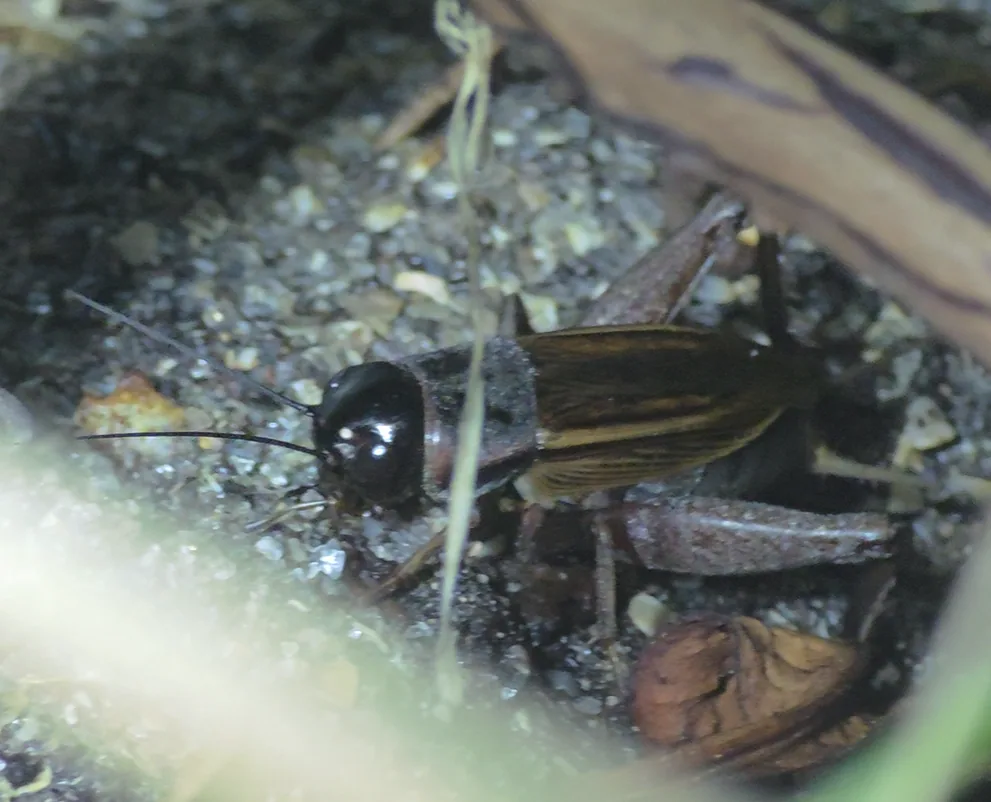
Field crickets (Gryllus sp.) are compact, ground-dwelling omnivores that scavenge seeds, plant litter, and small invertebrates from the meadow floor, living in the leaf litter and grass edges of the terrestrial realm. Tracked in miniBIOTA since June 2025, field crickets have experienced repeated reductions in population from predation pressure and have been reintroduced multiple times. As of June 11, 2026, at least seven field crickets are present in the Lowland Meadow. The record is held at the genus level (Gryllus) because multiple species may be represented and species-level identity requires adult male call analysis or expert examination that has not yet been performed.

Identity

  • Common name: Field Cricket
  • Alternate names: field cricket, black cricket, ground cricket, gryllus, common cricket
  • Scientific name: Gryllus sp.
  • Identification confidence: Genus confirmed; species uncertain. Multiple Gryllus species may be present.
  • Uncertainty label: Possible

Taxonomy

  • Kingdom: Animalia
  • Phylum: Arthropoda
  • Class: Insecta
  • Order: Orthoptera
  • Family: Gryllidae
  • Genus: Gryllus
  • Species: sp. (multiple, unresolved)

Natural History

Range and Florida Relevance

Gryllus is a large genus of field crickets distributed across the Americas, with numerous species in North America and multiple species in Florida. In the eastern United States, Gryllus species are among the most familiar terrestrial insects, common in meadows, gardens, roadsides, and disturbed habitats. Florida supports several Gryllus species that can be difficult to distinguish by appearance alone; the calls of adult males are the most reliable field identifier, and different species often differ in diel call patterns, meaning some call during the day and others only at night. Without adult male call analysis or formal taxonomic examination, genus-level identification is the conservative and appropriate standard for this miniBIOTA record.

Habitat

Field crickets are ground-dwellers. They live in leaf litter, dense grass, soil edges, and sheltered spaces at the base of vegetation. They are most active at ground level, using cover to move between foraging areas and retreating into crevices, leaf litter, or soil when disturbed. They tolerate a wide range of terrestrial conditions and are found throughout Florida in habitats from manicured lawns to dense meadow edges. In miniBIOTA, the Lowland Meadow provides the ground cover, plant litter, and grass edges that field crickets prefer.

Diet

Field crickets are opportunistic omnivores. They feed on seeds, plant material, fungi, dead insects, soft-bodied invertebrates, carrion, and other organic matter. They are not highly selective foragers; they move through the meadow floor consuming what they encounter. This flexibility makes them effective connectors between the detrital food web and the animal food web, processing plant material and passing it up the food chain as prey for larger predators.

Reproduction

Female field crickets deposit eggs directly into soil using a slender ovipositor. Eggs hatch into nymphs that pass through a series of developmental instars, typically eight to ten, over six to eight weeks before reaching adulthood. Adults of most Gryllus species live two to four months. In Florida's warm climate, multiple generations per year are biologically possible. Males produce their characteristic calling song by rubbing their forewings together, a process called stridulation, and the song is used to attract females. Successful breeding in miniBIOTA has not been directly confirmed in the current observation records.

Tolerance Ranges

Gryllus field crickets are highly adaptable and tolerate the full range of Florida terrestrial conditions, including warm temperatures, seasonal humidity variation, and the day-night temperature swings typical of the Lowland Meadow. They do not require aquatic conditions and are true terrestrial animals. No miniBIOTA-specific tolerance measurements have been taken.

Ecological Role

Field crickets function as terrestrial omnivores that link plant material, fungi, and detrital matter to higher consumers in the food web. By scavenging seeds and plant litter, they process organic matter that would otherwise accumulate, contributing to decomposition and nutrient return in the meadow. As prey, they are a food source for predatory arthropods and any insectivores present in the terrestrial realm. Their frass also contributes to soil nutrient cycling. In miniBIOTA, field crickets occupy the Lowland Meadow as part of the broader effort to establish a functioning terrestrial insect community. Predation pressure has historically been the primary limiting factor on their persistence. No symbiotic relationships have been documented in miniBIOTA. No predator species have been specifically identified, though the observation record notes that predation has consistently reduced cricket numbers before populations could stabilize.

miniBIOTA Evidence

Introduction and History

Field crickets were first introduced to miniBIOTA on June 11, 2025. Across the following months, population pressure from predation reduced numbers repeatedly. By February 19, 2026, a single individual was the apparent last surviving cricket in the system, observed foraging through the Mangrove Forest and walking directly over a crab (later identified as a context animal consistent with Humic Marsh Crab) without any predatory response from either animal. That individual had outlasted all others by approximately two months.

Josue has since reintroduced field crickets multiple times, adding different individuals collected locally, and has noted that some introductions appear to represent different species within Gryllus. By May 24, 2026, five crickets were confirmed in the terrestrial realm (including one Mole Cricket counted separately): three adult females described as distinct species and one newly added male nymph. Two additional large adult females were added on June 5, 2026, bringing the documented field cricket count to at least six.

The observer noted in May 2026 that the long-term plan is to reduce predator pressure in the terrestrial realm and focus more intentionally on establishing stable cricket and cockroach populations across the system.

Observation Timeline

  • June 11, 2025: First introduction of field crickets to miniBIOTA (earliest documented date; no obs file in the observation records).
  • February 19, 2026: Last remaining cricket in the system, in the Mangrove Forest, having outlasted all others by approximately two months. Observed foraging over a crab with no predatory interaction from either animal. Video documented.
  • March 26, 2026: New female field cricket introduced to the Lowland Meadow, noted as likely a different species from the current survivor. Count rises to approximately three individuals. Video documented.
  • May 24, 2026: Field cricket nymph (appears male, found in yard) introduced to the Lowland Meadow. Same-day count of five crickets confirmed in the terrestrial realm: one Mole Cricket, three adult female field crickets, and the newly added nymph. Video documented.
  • June 5, 2026: Two large adult female field crickets of the same unresolved species added to the Lowland Meadow. Field cricket count reaches at least six. No video.
  • June 11, 2026: One additional large adult female field cricket introduced to the Lowland Meadow alongside a Cuban cockroach (Panchlora nivea), as part of the ongoing effort to strengthen the terrestrial invertebrate community. Documented count rises to at least seven field crickets. No video.
  • June 13, 2026: A second male field cricket nymph introduced to the Lowland Meadow. The individual is relatively large and estimated to be approximately one molt from adulthood. Documented count rises to at least eight field crickets. No video.

What Is Confirmed

  • Field crickets introduced to miniBIOTA as early as June 11, 2025.
  • Recurring population reduction from predation pressure, with at least one episode reducing the population to a single individual by February 2026.
  • Multiple reintroduction events through June 2026.
  • At least eight field crickets in the Lowland Meadow as of June 13, 2026.
  • A male nymph introduced May 24, 2026 (sex and species tentative; individual was a nymph at time of introduction).
  • A second male nymph introduced June 13, 2026; described as large and approximately one molt from adulthood.
  • Neutral coexistence observed between a cricket and a crab-type animal on February 19, 2026.

What Is Inferred

  • Multiple Gryllus species may be represented across the introduction history; some observations note that introduced individuals appeared to be different species from those already present.
  • Predation pressure from organisms in the terrestrial realm has been the primary limiting factor on cricket persistence.
  • A larger group of adult females increases the probability of eventual breeding if a compatible male is present.

What Remains Unknown

  • Whether any of the at least six individuals remain present and active as of mid-June 2026.
  • Which Gryllus species or species groups are represented across the introduction history.
  • Whether any breeding has occurred in miniBIOTA; the system-reproduction-status note references earlier cricket generations, but direct evidence of successful reproduction in the observation records is not documented.
  • Whether the male nymph introduced May 24, 2026 survived to adulthood.
  • Which specific predators have reduced cricket populations.