Nesticodes rufipes

Red House Spider

A small reddish-legged cobweb spider that has established a reproducing population across the Mangrove Forest and Lowland Meadow, documented through egg sacs, spiderlings, and active prey capture including Florida woods cockroaches caught in its webs.

Visual Data Unavailable

Overview

A small reddish-legged cobweb spider that has established a reproducing population across the Mangrove Forest and Lowland Meadow, documented through egg sacs, spiderlings, and active prey capture including Florida woods cockroaches caught in its webs. Exact population size and abundance are unresolved.

Identity

  • Common name: Red House Spider
  • Alternate names: Cobweb spider, red spider; "redback" is a misidentification
  • Scientific name: Nesticodes rufipes
  • Identification confidence: High
  • Uncertainty label: Observed

Taxonomy

  • Kingdom: Animalia
  • Phylum: Arthropoda
  • Class: Arachnida
  • Order: Araneae
  • Family: Theridiidae
  • Genus: Nesticodes
  • Species: Nesticodes rufipes (Lucas, 1846)

Natural History

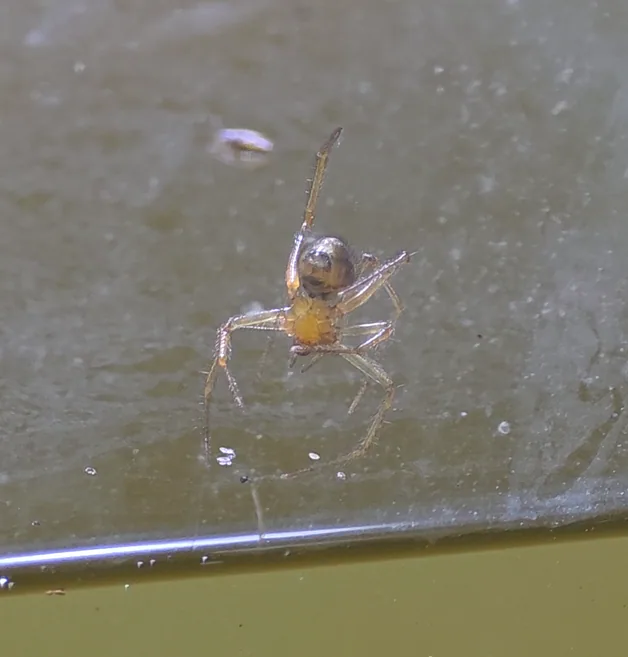
Nesticodes rufipes is a small cobweb spider (family Theridiidae) originally native to tropical Africa, now established across warm-temperate and tropical regions worldwide, including throughout Florida. Workers are visually distinctive: reddish-orange legs contrast with a dark reddish-brown abdomen. Females are larger than males, typically 4 to 6 mm in body length. The species is sometimes misidentified as the redback spider (Latrodectus hasselti) due to superficial color similarity, but it is not closely related and is not medically significant.

N. rufipes builds irregular, tangled cobwebs in sheltered, protected spots: under overhangs, in dense vegetation, in the corners of structures, and along edges where other invertebrates are likely to travel. It is a sit-and-wait predator, relying on the web to intercept prey rather than actively hunting. Diet includes small flying insects, crawling invertebrates, and any small animals that blunder into the web structure.

Mating in Theridiidae follows a well-documented pattern: males locate and enter a female's web, court the female, and mate; in many species including N. rufipes, the male is cannibalized by the female during or after mating. Females produce egg sacs suspended within the web, each containing many eggs. Spiderlings hatch and disperse by ballooning on silk threads. The species is tolerant of sheltered indoor and outdoor conditions and can reproduce year-round in warm climates like Florida.

Ecological Role

Nesticodes rufipes functions as a secondary consumer, capturing invertebrate prey and converting it into spider biomass and frass within the terrestrial food web. In a closed system like miniBIOTA, a resident and reproducing spider population represents a persistent source of top-down pressure on small invertebrates across multiple biomes. Unlike prey species that decline after introduction, the Red House Spider has expanded and reproduced across the system, making it one of the more ecologically established terrestrial predators in miniBIOTA.

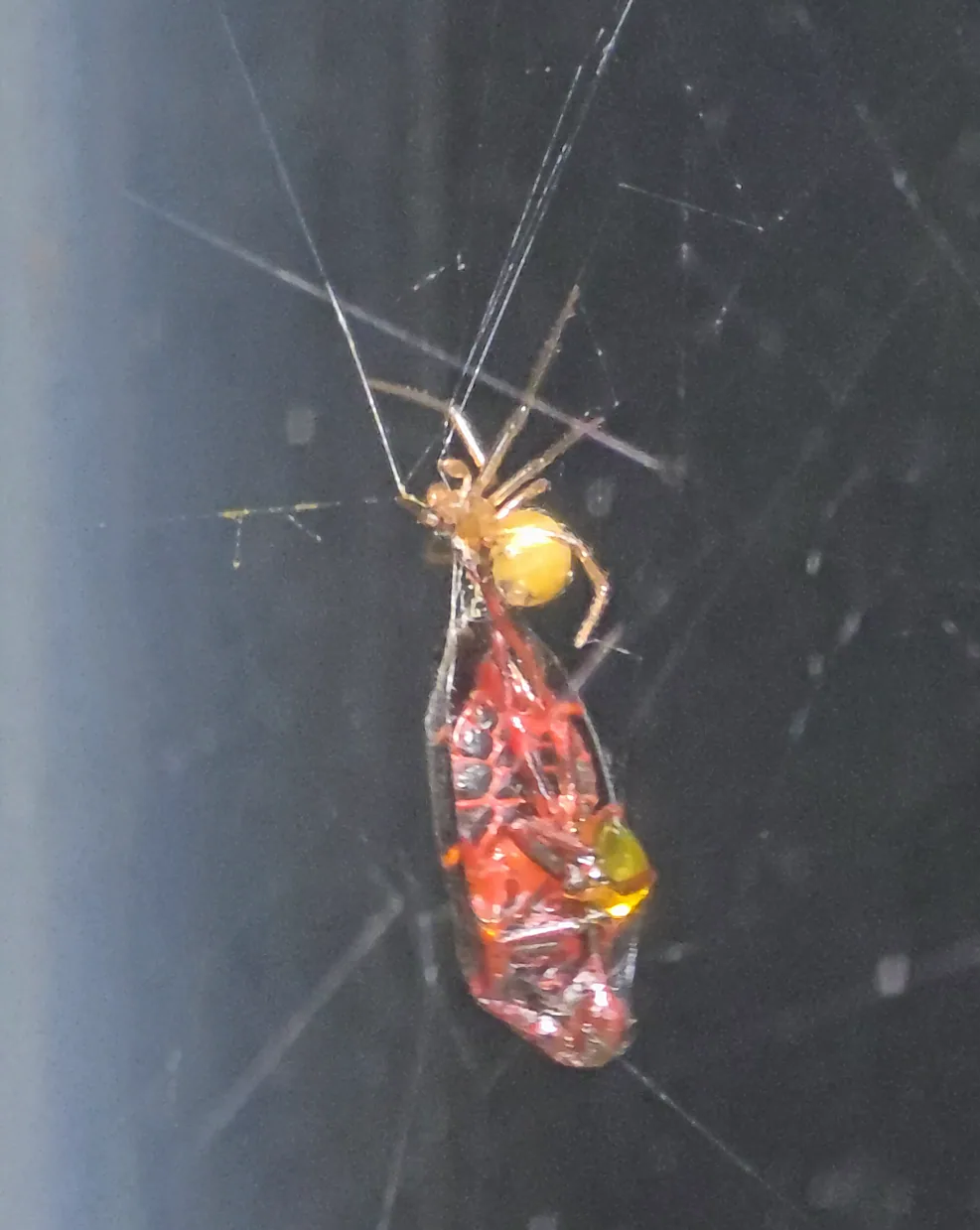
Active predation on Florida woods cockroaches has been confirmed directly: a juvenile cockroach was found dead in a Red House Spider web in the Mangrove Forest on April 22, 2026. This links the spider to the cockroach population's dynamics in the closed system. Prey remains are rarely visible in the webs, suggesting either frequent web clearing or efficient consumption, but the January 2026 note specifically observed that reproduction continues despite limited visible prey capture, suggesting the population is sustaining itself on prey sources that are difficult to observe.

No symbiotic relationships have been documented. No predation on the Red House Spider by other miniBIOTA residents has been recorded.

miniBIOTA Evidence

Introduction context: No specific introduction event is recorded. N. rufipes is a common colonizer of sheltered structures and enclosed environments throughout Florida and was likely present as an incidental arrival before the earliest observation. The first archived observation dates to April 2025.

Observation timeline:

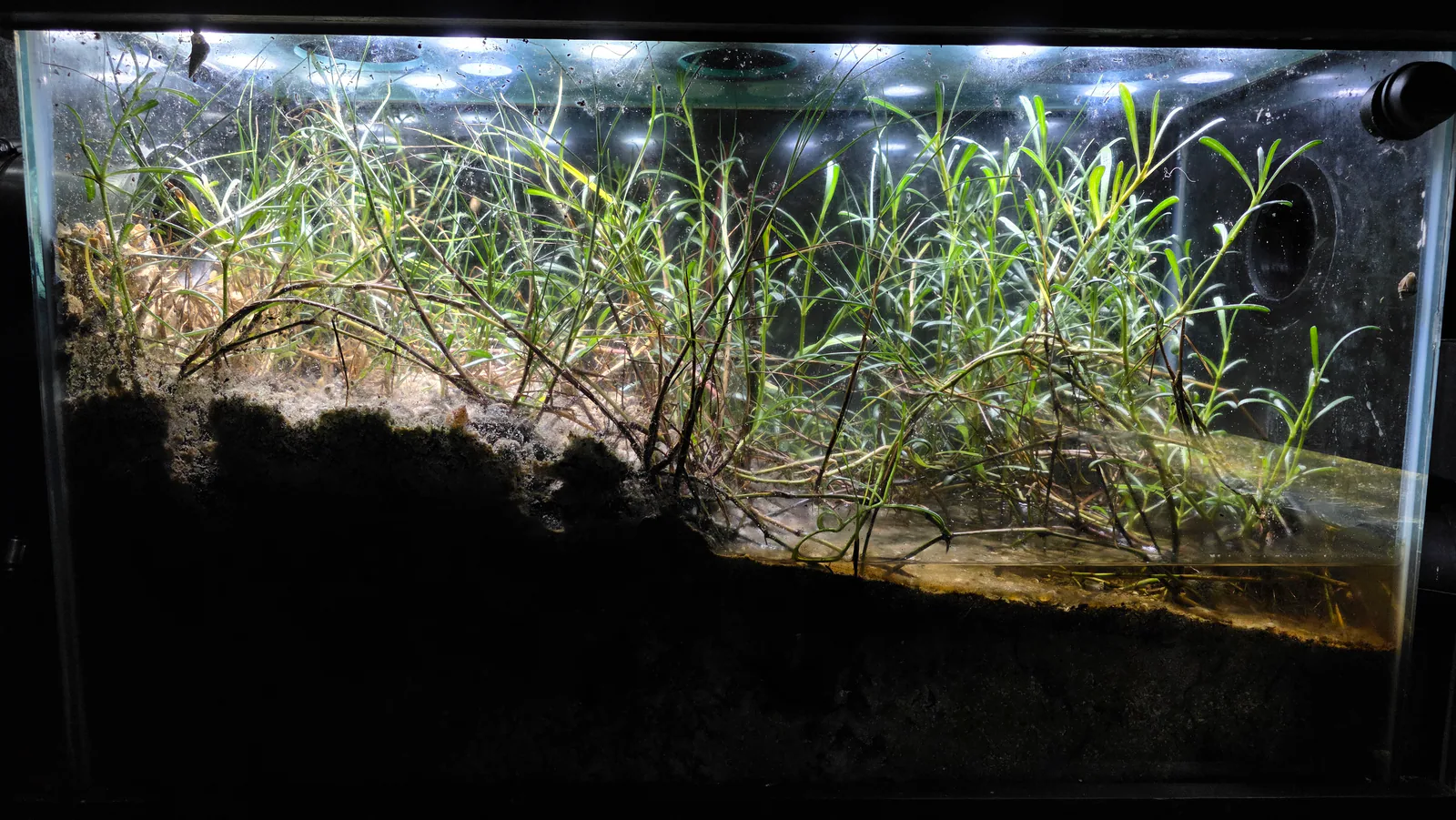
  • April 6, 2025: A second spider with a smaller abdomen was spotted in the Marine Shore biome adjacent to the established Red House Spider. Identity unconfirmed; noted as possibly another Red House Spider.
  • April 14, 2025: A female Red House Spider in the Marine Shore biome was observed with an egg sac in her web. A smaller spider had visited and established itself on the same web the prior week and was no longer present; consistent with post-mating male cannibalism.
  • January 26, 2026: Red House Spiders described as "highly prolific across terrestrial areas, reproducing consistently despite limited visible prey capture." Prey remains rarely observed. All food sources originating entirely within the closed ecosystem.
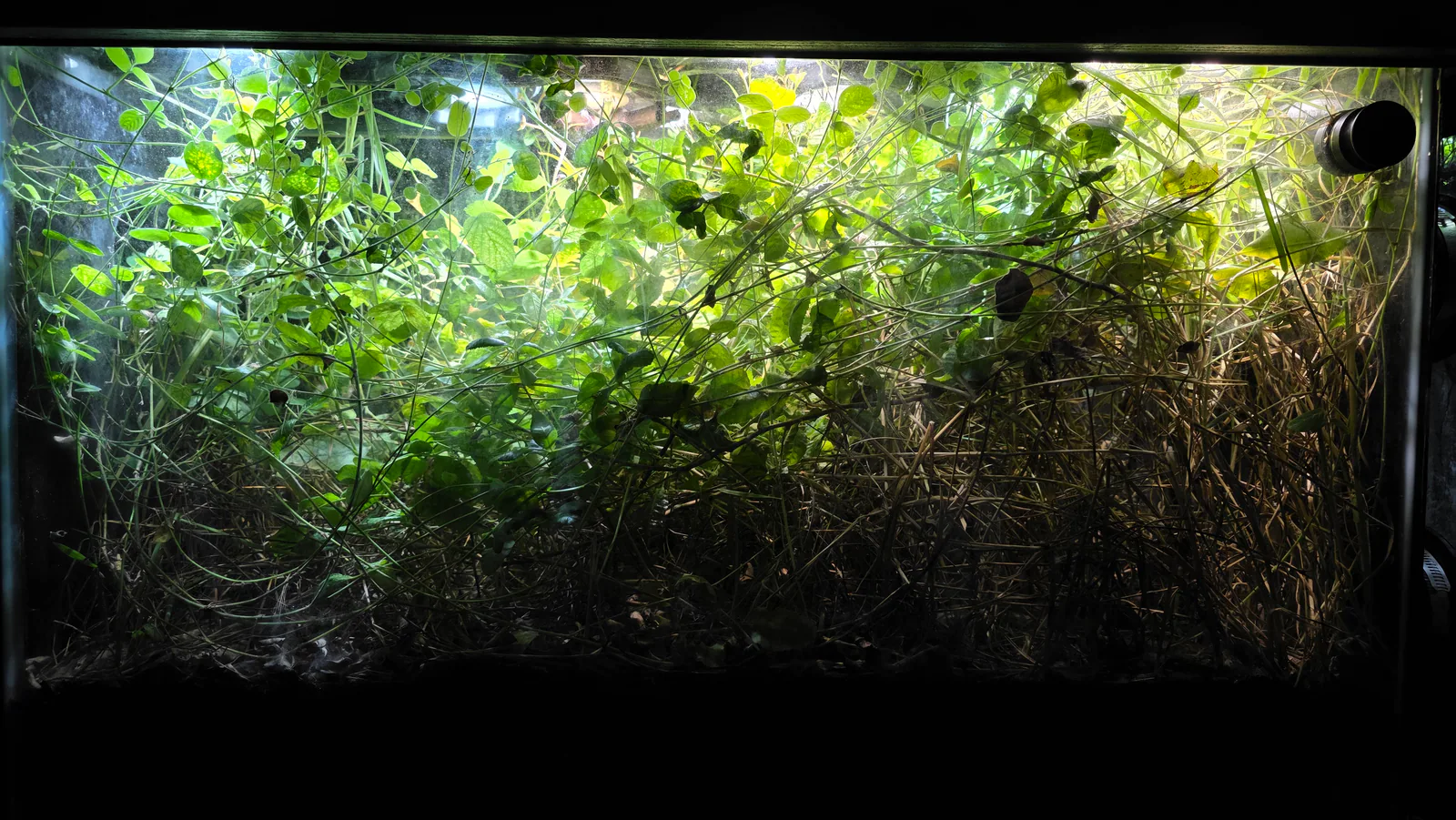
  • April 22, 2026: A juvenile Florida woods cockroach was found deceased in a Red House Spider web in the Mangrove Forest biome, confirming active predation on that species. Video evidence.

Confirmed:

  • Resident and reproducing population across multiple terrestrial biomes
  • Egg sac produced by female in Marine Shore biome, April 14, 2025
  • Post-mating male cannibalism consistent with observation of male's disappearance from female's web
  • Described as highly prolific across terrestrial areas as of January 26, 2026
  • Active predation on Florida woods cockroach confirmed April 22, 2026; video evidence

Inferred:

  • Spiderlings and second-generation individuals present, consistent with observed egg sac production and prolific population description
  • Population is sustaining itself on prey that is difficult to directly observe, based on January 2026 note

Unknown:

  • Exact population size and distribution
  • Whether the population is expanding, stable, or declining
  • What proportion of prey comes from each biome and invertebrate guild
  • Whether predation pressure from the Red House Spider measurably affects any other miniBIOTA population