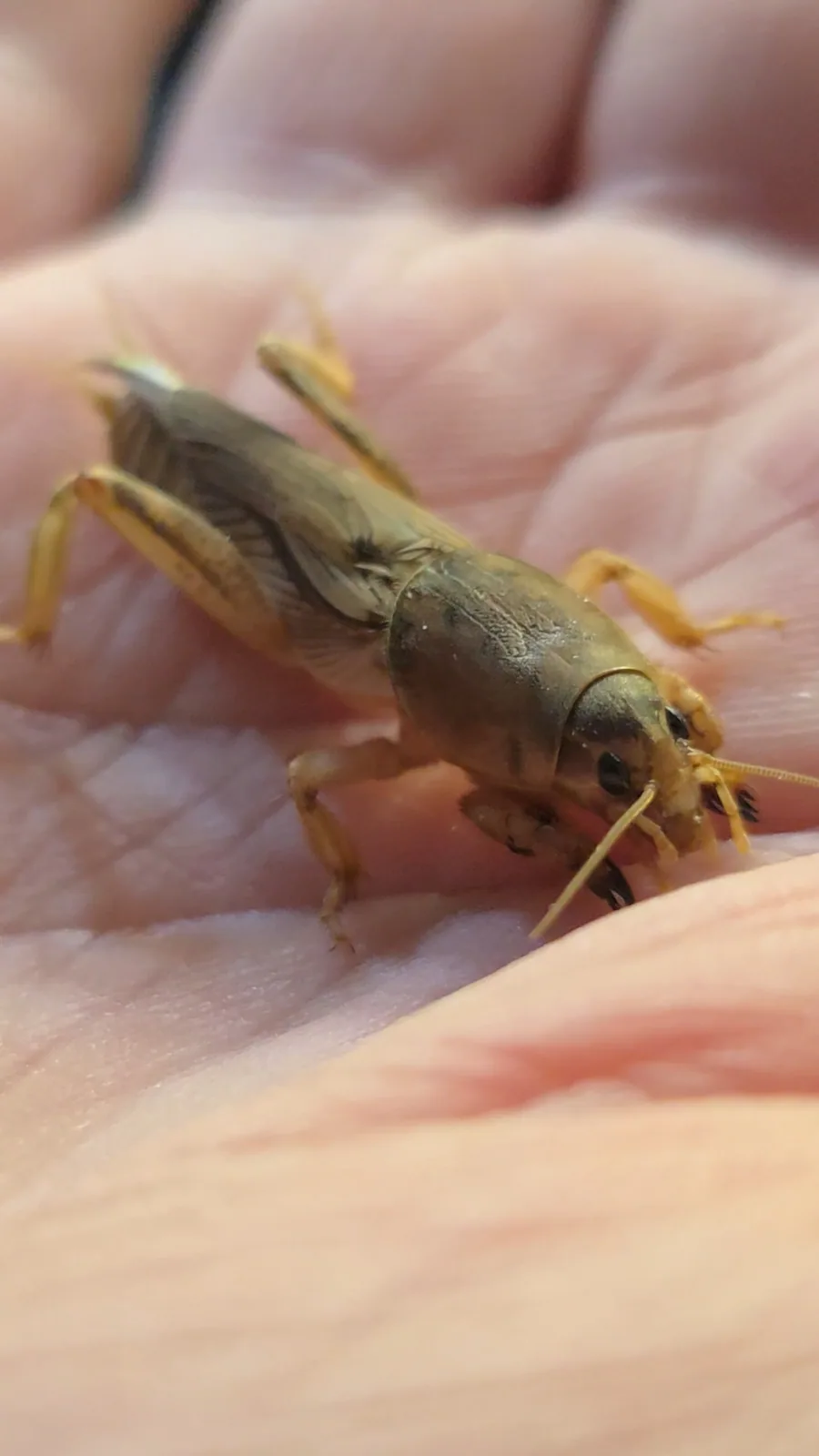
Gryllotalpidae sp. (unidentified)

Mole Cricket

A single male Mole Cricket burrows through the Lowland Meadow substrate and feeds on grass roots from below, chirping at night from its tunnel entrance and blocking the burrow with a mud ball when a Field Cricket attempted to enter in May 2026.

Overview

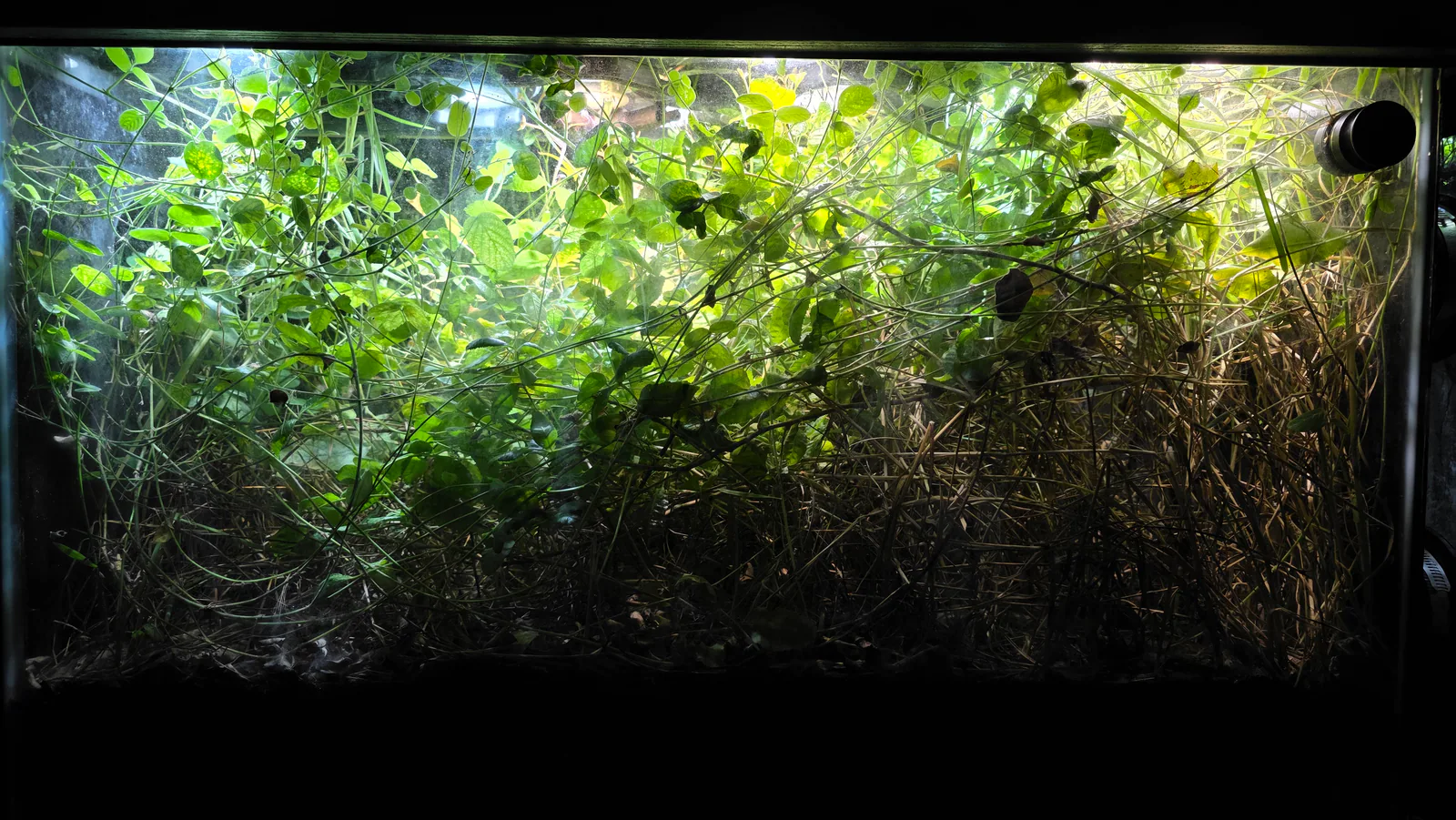
A single male Mole Cricket introduced to the Lowland Meadow in March 2026 has built a tunnel system through the substrate, feeds on grass roots from below, and chirps at night from the burrow entrance. By May 2026, its root feeding was associated with widespread grass die-off across the biome, leaving primarily the Creeping beggarweed legume vine and an adjacent Brazilian pepper branch as the remaining visible vegetation. On the night of May 6, 2026, it was observed blocking its burrow entrance with a ball of mud after a female Field Cricket attempted to enter. Species identity within the family Gryllotalpidae is unresolved.

Identity

  • Common name: Mole Cricket
  • Alternate names: mole cricket, changa, topo grillo, ground cricket (misidentified), gryllotalpidae, burrowing cricket
  • Scientific name: Gryllotalpidae sp. (unidentified)
  • Identification confidence: Family-level ID applied; identified as a member of Gryllotalpidae from body form, digging forelimbs, and burrowing behavior. Species unresolved; no specimen examination has been performed
  • Uncertainty label: Confirmed

Taxonomy

  • Kingdom: Animalia
  • Phylum: Arthropoda
  • Class: Insecta
  • Order: Orthoptera
  • Suborder: Ensifera
  • Family: Gryllotalpidae
  • Genus: Unknown
  • Species: Unknown

Natural History

Mole crickets (family Gryllotalpidae) are fossorial insects with highly modified forelegs adapted for digging, resembling miniature mole paws. They tunnel through soil with these limbs, creating extensive subsurface networks for shelter, food access, and reproduction. Most species are largely nocturnal, spending daylight underground and emerging at night to forage from the burrow entrance or disperse.

Mole crickets are genuinely omnivorous: they consume plant roots and surface vegetation, small invertebrates, earthworms, organic detritus, and fungi encountered during tunneling. Root consumption is often the most ecologically significant feeding behavior, as it can cause surface vegetation die-off by severing root systems while leaving no visible surface disturbance until plants collapse. This is the pattern seen in the Lowland Meadow by May 2026.

Males stridulate (chirp) from burrow entrances at night to attract females, amplifying the call through the tunnel geometry. The burrow itself acts as a resonance chamber, making the call audible well beyond the burrow entrance. Males are territorial about burrow access, and blocking behavior using soil or substrate material to seal the entrance when threatened is documented in the literature and was directly observed in miniBIOTA on May 6, 2026.

Florida mole crickets are strong fliers and are commonly attracted to artificial lights at night, which explains the mode of introduction.

Ecological Role

The Mole Cricket's most documented impact in miniBIOTA is vegetation damage. By May 2026, less than two months after introduction, widespread grass die-off was visible across the Lowland Meadow, consistent with sustained subterranean root feeding. The only vegetation visibly surviving as of May 6, 2026 was the Creeping beggarweed legume vine and a Brazilian pepper branch extending from the adjacent Mangrove Forest.

The tunneling activity also aerates and disturbs the soil substrate, which can benefit soil structure and microbial activity in small systems, but in miniBIOTA the vegetation impact has been the dominant observable outcome.

As a single male with no female mole cricket present, breeding is not possible and the population is unlikely to increase beyond one individual unless another is introduced.

miniBIOTA Evidence

March 3, 2026: A mole cricket flew toward the observer at night and was introduced to the Lowland Meadow (then called the grassland biome). Species was unidentified at the time of introduction. Intended role: soil aeration and natural root-feeding behavior. No media.

May 3, 2026: A tunnel attributed to the mole cricket was identified in the Lowland Meadow. Most grass across the biome was brown and dead; only limited areas showed healthy growth. The observer noted that root system feeding was the likely cause of widespread decline. Video evidence.

May 3, 2026: Four crickets confirmed present in the miniBIOTA system: three female field crickets of different species, plus the single male mole cricket (confirmed by chirping behavior). No media.

May 6, 2026: The mole cricket was directly observed inside its burrow running along the glass. Identified as male from nighttime chirping. The individual repeatedly emerged from the burrow entrance to grab loose grass blades from the surface and retreat underground. Behavior repeated multiple times in succession. Video evidence.

May 6, 2026: Panning footage across the Lowland Meadow showed widespread vegetation loss: most grass brown and dead, with the legume vine (Creeping beggarweed) and a Brazilian pepper branch from the Mangrove Forest as the primary remaining vegetation. Interpreted as evidence of sustained root feeding impact. Video evidence.

May 6, 2026 night: Extended nighttime footage of the mole cricket chirping inside its burrow. A female Field Cricket approached and partially entered the tunnel; the two made antenna contact. The mole cricket retreated deeper into the burrow, then returned carrying a ball of mud and pushed it toward the entrance, driving the Field Cricket away. The Field Cricket eventually backed away and left. Video evidence confirms: chirping stridulation, intraspecific interaction, and active mud-ball burrow-blocking behavior.

Confirmed:

  • Introduction March 3, 2026, after flying to observer at night
  • Male sex confirmed by nighttime stridulation (chirping)
  • Tunnel construction in Lowland Meadow substrate
  • Surface foraging from burrow entrance: grabbing grass blades (May 6, 2026)
  • Widespread grass die-off in Lowland Meadow by May 2026; associated with root feeding
  • Mud-ball burrow-blocking behavior observed against female Field Cricket (May 6, 2026 night)
  • Antenna contact with female Field Cricket documented

Inferred:

  • Ongoing subterranean root and organic matter foraging since March 2026
  • Grass die-off is the primary observable ecological impact

Unknown:

  • Species identity within Gryllotalpidae
  • Current status of the individual beyond May 2026
  • Whether the grass layer has recovered or declined further since May 2026
  • Whether the individual remains in the system