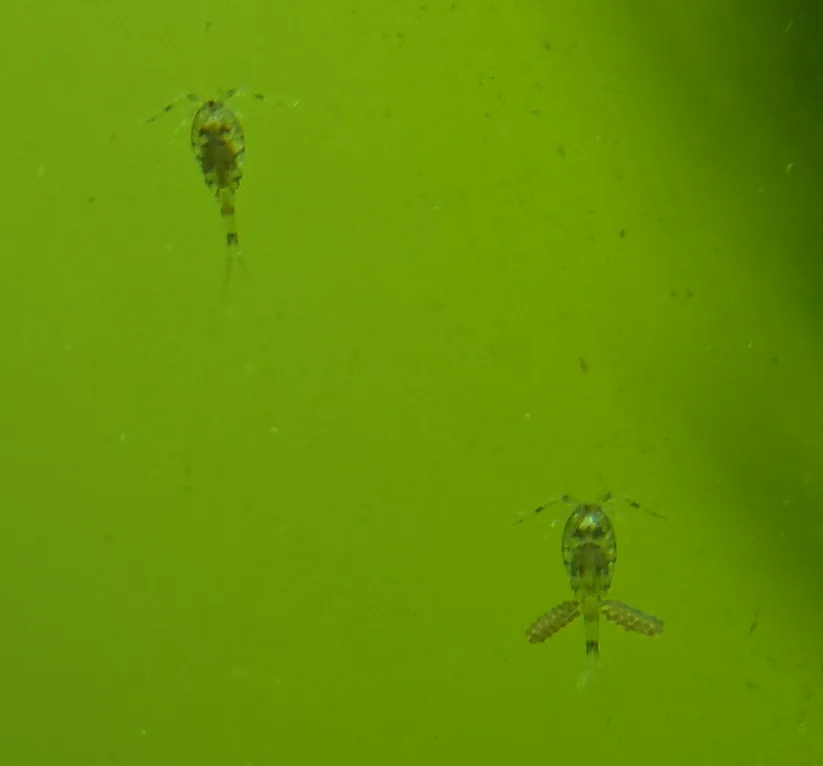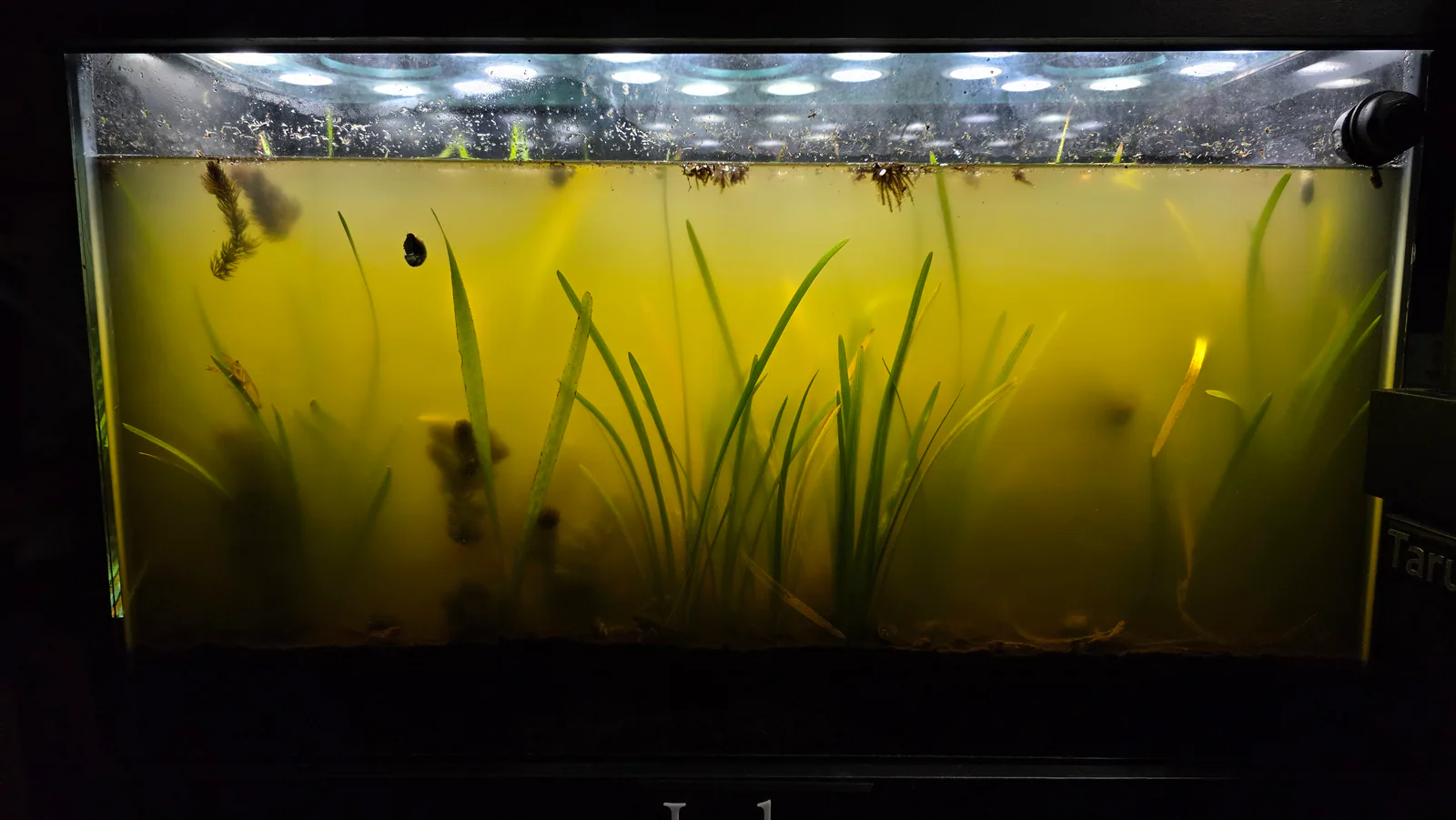
Cyclopoida sp. (unidentified)

Freshwater Copepod (Cyclopoida)

Tiny benthic crustaceans that hunt bacteria, rotifers, and organic particles along the substrate and plant surfaces of the Freshwater Lake, this group expanded after the removal of the Flagfish and is closely associated with the decomposing plant matter and biofilms accumulating on the lake bottom.

Visual Data Unavailable

Overview

Tiny benthic crustaceans that hunt bacteria, rotifers, and organic particles along the substrate and plant surfaces of the Freshwater Lake, this order-level group expanded after the removal of the Flagfish and is closely associated with the decomposing plant matter and biofilms accumulating on the lake bottom. Order-level identity only; no species-level determination has been made.

Identity

  • Common name: Freshwater Copepod (Cyclopoida)
  • Alternate names: Copepod, cyclops, cyclopoid copepod, freshwater copepod, zooplankton, freshwater pods
  • Scientific name: Cyclopoida sp. (unidentified)
  • Identification confidence: Order-level only
  • Uncertainty label: Observed

Taxonomy

  • Kingdom: Animalia
  • Phylum: Arthropoda
  • Class: Copepoda
  • Order: Cyclopoida
  • Family: Unresolved
  • Genus: Unresolved
  • Species: Unresolved

Natural History

Cyclopoida is among the most diverse and abundant orders of copepods in freshwater ecosystems, with thousands of described species worldwide. Unlike the open-water calanoids, cyclopoid copepods are predominantly benthic or semi-benthic: they live near the substrate, on submerged plant surfaces, and in organic sediment, spending more time crawling than swimming. They are visually identified by their single median nauplius eye, which gives one common genus its name, Cyclops, and by the females' two prominent egg sacs carried symmetrically at the abdomen.

Cyclopoids are largely predatory or omnivorous. They feed on bacteria, rotifers, nematodes, protists, small invertebrates, and fine organic particles, making them functionally different from the filter-feeding calanoids. Some species also consume algae and detritus. This more varied diet suits their bottom-dwelling lifestyle where diverse microbial and small invertebrate prey is available.

Cyclopoids are notably tolerant of low oxygen and elevated organic load, reflecting their adaptation to the sediment and detritus layer. Generation times of two to four weeks are typical in warm freshwater systems. Females carry two egg sacs; eggs hatch into nauplii that pass through several larval stages before reaching adult form.

Ecological Role

Cyclopoid copepods function as secondary consumers and detritivores in the benthic zone, hunting small invertebrates and processing microbial and fine organic material at the sediment surface and plant leaf layer. In miniBIOTA, the Cyclopoida node is specifically associated with the submerged vegetation and decomposing organic debris in the Freshwater Lake: tapegrass and Creeping Primrose-Willow (Ludwigia repens) surfaces provide both physical habitat and concentrate the microbial prey they feed on.

This positions Cyclopoida at a different trophic interface than the Calanoida node: rather than grazing the water column, they process material from the lake bottom and plant surfaces, channeling benthic microbial production into crustacean biomass available to crayfish, shrimp, and other invertebrates. The Flagfish removal (April 5, 2026) removed predation pressure on both larval and adult cyclopoids, enabling the population to expand visibly.

miniBIOTA Evidence

Introduction context: No specific introduction event is documented. the record notes the species was "introduced as part of a mixed wild-collected microfauna batch to seed the Freshwater Lake." No introduction date is on record. Cyclopoids were likely present in the lake before the April 2026 observations but suppressed by Flagfish predation.

Observation timeline:

  • April 13, 2026: Lake clearing notably, with visibility reaching the far end of the tank for the first time in some time. "Copepods thriving throughout the water column" noted approximately one week after Flagfish removal (April 5, 2026). Microcrustaceans described as now functioning as the intermediary food web layer.
  • April 16, 2026: Close-up video at approximately 100x magnification showing copepods and ostracods actively swimming in the water column under flashlight. Both groups present in significant numbers. Video evidence.

Confirmed:

  • Copepods active in the Freshwater Lake, April 13, 2026
  • Visible at 100x magnification, April 16, 2026; video evidence
  • Population expansion linked to Flagfish removal (April 5, 2026)

Inferred:

  • Benthic and surface-associated feeding on bacteria, rotifers, and organic particles, consistent with Cyclopoida order biology
  • Population was likely present but suppressed before Flagfish removal
  • Association with Tapegrass and Creeping Primrose-Willow surfaces as microhabitat

Unknown:

  • Species-level identity within Order Cyclopoida
  • Whether observations include Cyclopoida specifically or only undifferentiated copepods
  • Introduction date and source
  • Current population size
  • Whether Calanoida and Cyclopoida individuals are visually distinguishable in the system without microscopy