
Turbo sp. (unidentified)

Turbo Snail

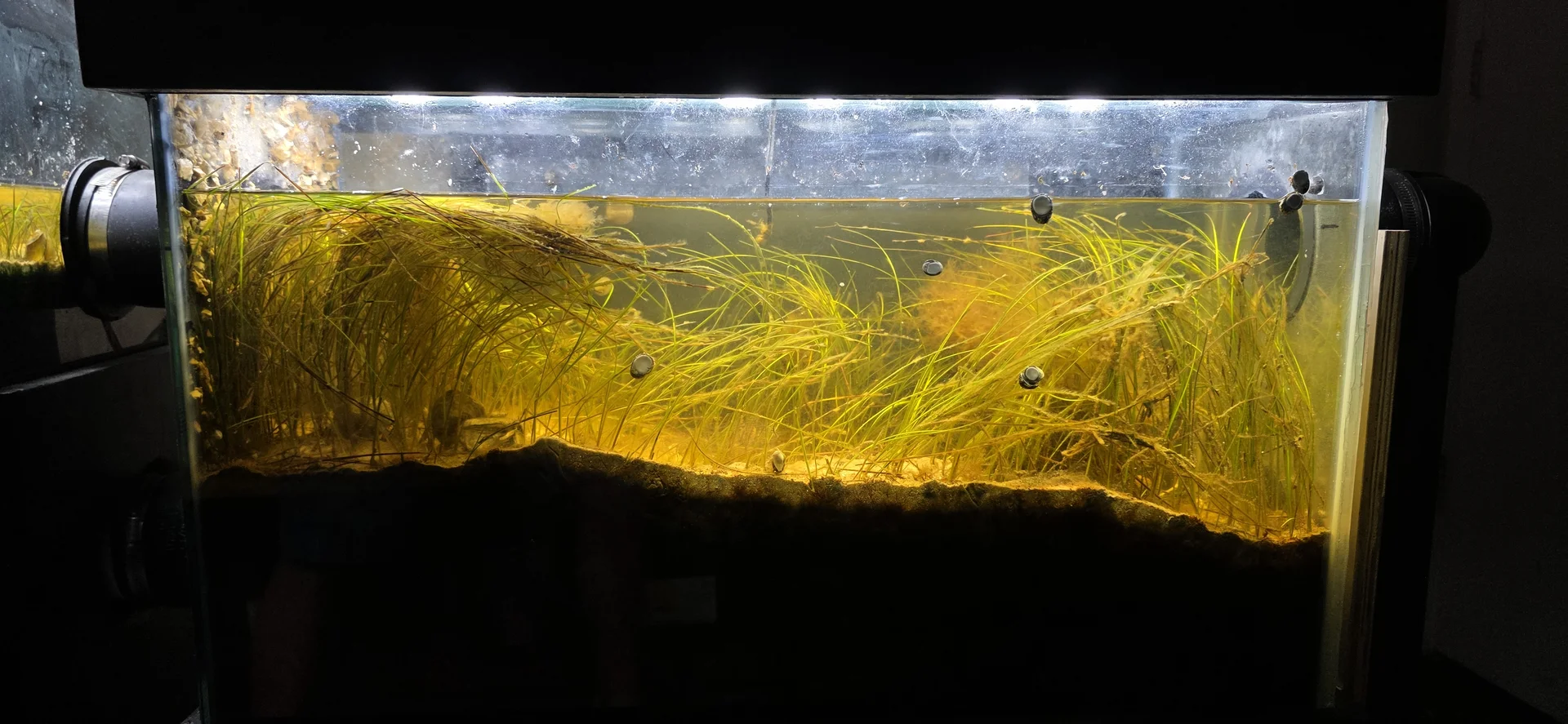
A heavy-shelled marine grazer in the Seagrass Meadow, this Turbo snail rasps algae and biofilm from glass and substrate surfaces, leaving visible fecal deposits that unidentified bristle worms consume within hours.
Visual Data Unavailable

Overview

Turbo Snails (genus Turbo, species unidentified) were introduced to miniBIOTA's Seagrass Meadow as algae-grazing clean-up crew. Multiple individuals were confirmed present in December 2024, with active grazing documented by visible fecal deposits, and a small unidentified bristle worm consuming those deposits within a day, a brief detrital chain captured in a single observation. Current population status is unconfirmed beyond December 2024.

Identity

  • Common name: Turbo Snail
  • Alternate names: turbo snail, turbo, top snail, turbinid snail
  • Scientific name: Turbo sp. (unidentified)
  • Identification confidence: Genus-level. Genus Turbo (family Turbinidae) is inferred from the common name and the characteristic heavy, globular shell typical of this group; species is not identified.
  • Uncertainty label: Uncertain. Genus-level ID is reasonable; species within Turbo is unresolved.

Taxonomy

  • Kingdom: Animalia
  • Phylum: Mollusca
  • Class: Gastropoda
  • Order: Trochida
  • Family: Turbinidae
  • Genus: Turbo
  • Species: Unidentified

Natural History

Range and Florida Relevance

Genus Turbo is distributed across tropical and subtropical marine environments globally. In the western Atlantic and Gulf region, Turbo castanea (Chestnut Turbo Snail) is native to Florida, the Gulf of Mexico, and the Caribbean; it inhabits rocky and hard-substrate shallow marine environments. The Mexican Turbo Snail (T. fluctuosa) is native to the eastern Pacific but is the most commonly sold species in the US aquarium trade and is frequently used in reef and seagrass aquarium systems as algae control. Without species-level ID, the specific native range and source of the miniBIOTA individuals is unresolved.

Habitat

Turbo snails are marine grazers that inhabit hard substrate in shallow tropical and subtropical saltwater environments. They move across glass, rock, shell, and other hard surfaces using a broad muscular foot, rasping algae and biofilm with a radula. In captivity, they are valued for covering large surface areas and consuming filamentous algae, coralline algae, diatoms, and biofilm. In miniBIOTA, they were placed in the Seagrass Meadow.

Diet

Turbo snails are herbivores and biofilm grazers. The radula is broad and effective at scraping algae and biofilm from hard surfaces. Primary dietary inputs include filamentous algae, coralline algae, cyanobacteria, diatoms, and surface biofilm. Active grazing was confirmed in miniBIOTA by the visible fecal output documented in December 2024. Turbo species produce notably large, compacted fecal pellets relative to their body size; this has been observed directly in miniBIOTA.

Reproduction

Turbo species are broadcast spawners. Males and females release gametes into the water column simultaneously; fertilized eggs develop into free-swimming veliger larvae that must settle on hard substrate. In a closed system without planktonic larval food or adequate water volume for larval survival, natural reproduction is not expected. No reproductive observations have been made in miniBIOTA.

Tolerance Ranges

Turbo snails require full to near-full marine salinity and tropical to subtropical water temperatures, consistent with their native reef and rocky coastal habitats. They are sensitive to low oxygen, high temperatures, and salinity fluctuations. Specific tolerance measurements for miniBIOTA conditions have not been taken.

Ecological Role

Turbo Snails are heavy-bodied algae grazers that cover surface area efficiently, rasping algae and biofilm from glass, rock, and substrate. In miniBIOTA's Seagrass Meadow, their primary function is controlling filamentous algae and biofilm on hard surfaces, a role shared with cerith snails, nerites, and periwinkles, but at much larger individual body size and correspondingly larger grazing impact per individual.

The December 2024 observation documented both the grazing output (large fecal deposits) and a secondary detrital interaction: an unidentified small bristle worm swarmed the fecal deposits and consumed them within a day. This is a direct observation of a detrital chain, Turbo feces becoming a food source for a polychaete, in the Seagrass Meadow substrate.

miniBIOTA Evidence

Introduction Context

Turbo Snails were introduced to the Seagrass Meadow as algae-grazing clean-up crew. Introduction date, source, and method are not documented. The plural "snails" in the December 2024 observation confirms multiple individuals were present.

Observation Timeline

  • December 16, 2024: Active grazing documented: "Turbo snails leaving large feces. A small bristle-looking worm (species unidentified) swarms the droppings and consumes them within a day." This is the only formal observation on record. Multiple individuals confirmed present.

What Is Confirmed

  • Multiple Turbo Snails were present and actively grazing in the Seagrass Meadow as of December 16, 2024.
  • Large fecal deposits produced by the snails were observed on December 16, 2024.
  • An unidentified small bristle worm consumed the fecal deposits within one day, a detrital interaction in the Seagrass Meadow substrate.

What Is Inferred

  • Introduction as deliberate aquarium clean-up crew is inferred from the species' widespread use in marine aquarium systems and the absence of any wild-collection record.
  • Genus Turbo is inferred from the common name; species is unresolved.
  • Continued grazing on algae and biofilm surfaces in the Seagrass Meadow between introduction and December 2024.

What Remains Unknown

  • Introduction date, source, and method.
  • Number of individuals introduced and currently present.
  • Species within genus Turbo.
  • Whether individuals are still alive and present after December 2024.
  • Identity of the bristle worm consuming the fecal deposits.