Agathistoma eiseni

Banded Tegula

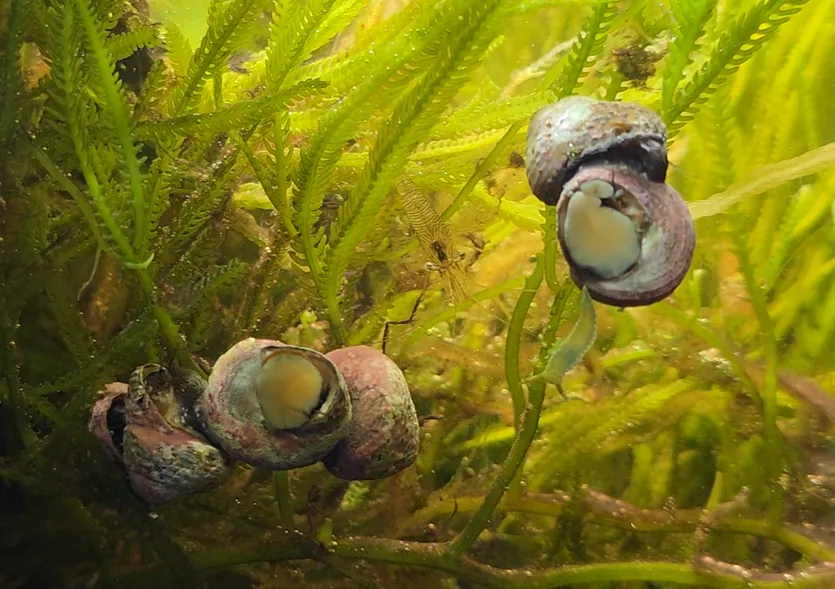
With its banded shell and prominent opening underneath, this small eastern Pacific snail grazes algae from hard surfaces and has been observed feeding among the marine grazers of miniBIOTA's Seagrass Meadow.

Realm
Saltwater
Population
Vulnerable

Overview

Josue identifies the snail previously called Margarita Snail in miniBIOTA as Banded Tegula (Agathistoma eiseni, family Tegulidae). On September 28, 2026, he corrected the earlier Margarites pupillus identification after someone questioned it and he compared the shell features further, especially its distinct, prominent umbilicus, the opening on the underside of the shell. Six snails were introduced to the Seagrass Meadow on July 31, 2026. Five were returned to the aquarium store on August 1 under the earlier identification; one remained and was last explicitly documented feeding on August 18. The identification correction changes the species account without adding a new population count or dated feeding observation.

Identity

  • Common name: Banded Tegula
  • Alternate names: western banded tegula, banded turban snail
  • Scientific name: Agathistoma eiseni (E. K. Jordan, 1936)
  • Earlier scientific combination: Tegula eiseni E. K. Jordan, 1936
  • Identification confidence: Likely, based on Josue's species-level reassessment and reported shell morphology. He reports using several identification features, with the prominent umbilicus the clearest feature described. No specimen or image was independently examined for this correction.
  • Uncertainty label: Likely

Taxonomy

  • Kingdom: Animalia
  • Phylum: Mollusca
  • Class: Gastropoda
  • Order: Trochida
  • Family: Tegulidae
  • Genus: Agathistoma
  • Species: eiseni

WoRMS accepts Agathistoma eiseni. Older species literature uses Tegula eiseni and may place it in Trochidae; the classification here follows the current WoRMS treatment.

Natural History

Shell and distinguishing features

The published diagnosis describes a small, thick shell with rounded whorls, nodular spiral ridges, alternating dark and pale markings, and a pale umbilical area. The broad umbilicus contains an internal spiral ridge; typical described shell height is about 20 to 25 mm. These are literature characters, not additional features observed in miniBIOTA.

Josue's reported prominent umbilicus agrees with an important feature of this species. An open umbilicus also occurs in other marine top snails, so it should be evaluated alongside shell sculpture, banding, aperture features, size and provenance. Its presence alone does not uniquely establish the species.

Range and habitat

The documented range extends from Los Angeles County, California, to Punta Entrada at Magdalena Bay, Baja California. It inhabits rocky shores from the lower intertidal into shallow subtidal water, reported to about 20 m. This eastern Pacific distribution does not establish Florida-native status; the actual collection locality of the aquarium-store animals is unknown.

Diet

Species-specific stomach-content research found diatoms and macroalgal material, together with associated small-organism remains. It is best described as an algal grazer rather than an exclusively diatom-eating or strictly herbivorous snail. Grazing is documented in miniBIOTA, but the specific food consumed has not been identified.

Reproduction

Laboratory work on Tegula eiseni documents spawning, external fertilization and free-swimming larvae followed by settlement. Under that study's conditions, veligers appeared by day two and larvae settled by day four. The study followed development for 63 days; that was not the duration of the swimming larval stage. No spawning or recruitment is documented in miniBIOTA.

Tolerance ranges

A validated temperature, pH or salinity tolerance range for miniBIOTA has not been established. One developmental study cultured larvae and juveniles at 20 ± 2°C. A separate adult aquarium study used heaters set to 25°C and recorded 35% mortality over 53 days amid water-quality complications. Neither study establishes an optimum or proves that temperature caused mortality.

The old claim that this animal is necessarily an unsuitable cold-water Margarites pupillus no longer applies to the corrected identification. That removes a mistaken species-based rationale; it does not demonstrate long-term compatibility with Seagrass Meadow conditions.

Ecological Role

Banded Tegula is an algal grazer on hard marine surfaces. The tracked miniBIOTA individual was observed feeding on August 7 and was described by Josue as one of the Seagrass Meadow's most active grazers on August 18. Its contribution to total algae removal has not been measured, and a single active grazer does not demonstrate that the biome's grazing shortfall has been resolved.

The Seagrass Meadow and Marine Shore share connected water. Movement into the Marine Shore remains plausible, but there is no documented sighting of this individual there.

miniBIOTA Evidence

Introduction context

Six aquarium-store snails sold as margarita snails were introduced July 31, 2026, alongside two Chestnut Turban Snails and an unidentified hitchhiker sea slug, during a response to hard-surface algae accumulation. The purchase occurred without prior species research.

Observation timeline

  • July 31, 2026: Six snails purchased and introduced to the Seagrass Meadow.
  • August 1, 2026: Five located and returned to the store under the then-current cold-water identification. The sixth could not be located and was not removed. The historical reason for removal is preserved, but the species assignment supporting it has since been corrected.
  • August 7, 2026: Josue corrected the removal count to five of six. A separate observation that day documented the remaining individual alive and feeding normally, its first confirmed sighting since introduction.
  • August 7, 2026: Marine Shore was added as a plausible secondary biome because of the water connection, without a sighting there.
  • August 18, 2026: Josue reported the remaining individual doing very well and among the most active grazers in the biome. His surprise reflected the identification used at that time. He considered whether additional individuals might eventually merit testing; this did not establish suitability.
  • September 28, 2026: Josue rejected Margarites pupillus and identified the snail as Agathistoma eiseni, citing several features and especially a distinct, prominent umbilicus after an outside comment prompted further comparison. No new census, feeding observation or date of shell examination was supplied.

What is confirmed

  • Six individuals were introduced July 31 and five were returned August 1.
  • One was not removed and was explicitly observed alive and feeding August 7 and active August 18.
  • Josue reported the identification correction and a prominent umbilicus on September 28.

What is inferred

  • The working species identification is Agathistoma eiseni, supported by Josue's reassessment and morphology reported to date.
  • The unidentified food being grazed may include algae or surface biofilm.
  • The connected Marine Shore is a possible movement destination, not a confirmed occupied biome.

What remains unknown

  • Independent specimen-level confirmation and the other identification characters Josue used.
  • Current abundance and the individual's exact current location.
  • Long-term survival, recruitment, specific foods and quantitative grazing impact.
  • Whether it has entered the Marine Shore.