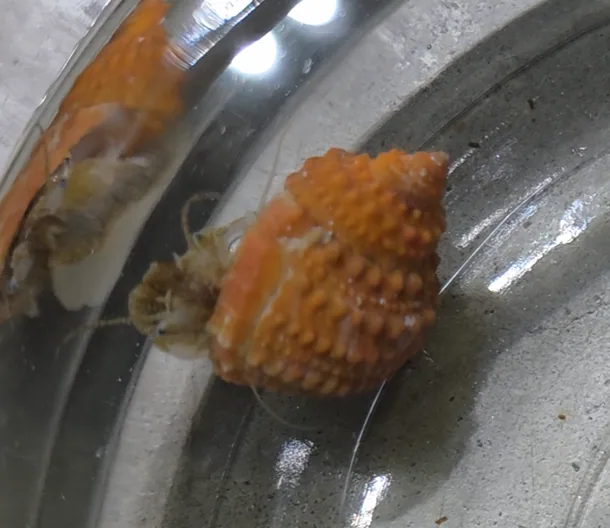
Turbo castanea

Chestnut Turban Snail

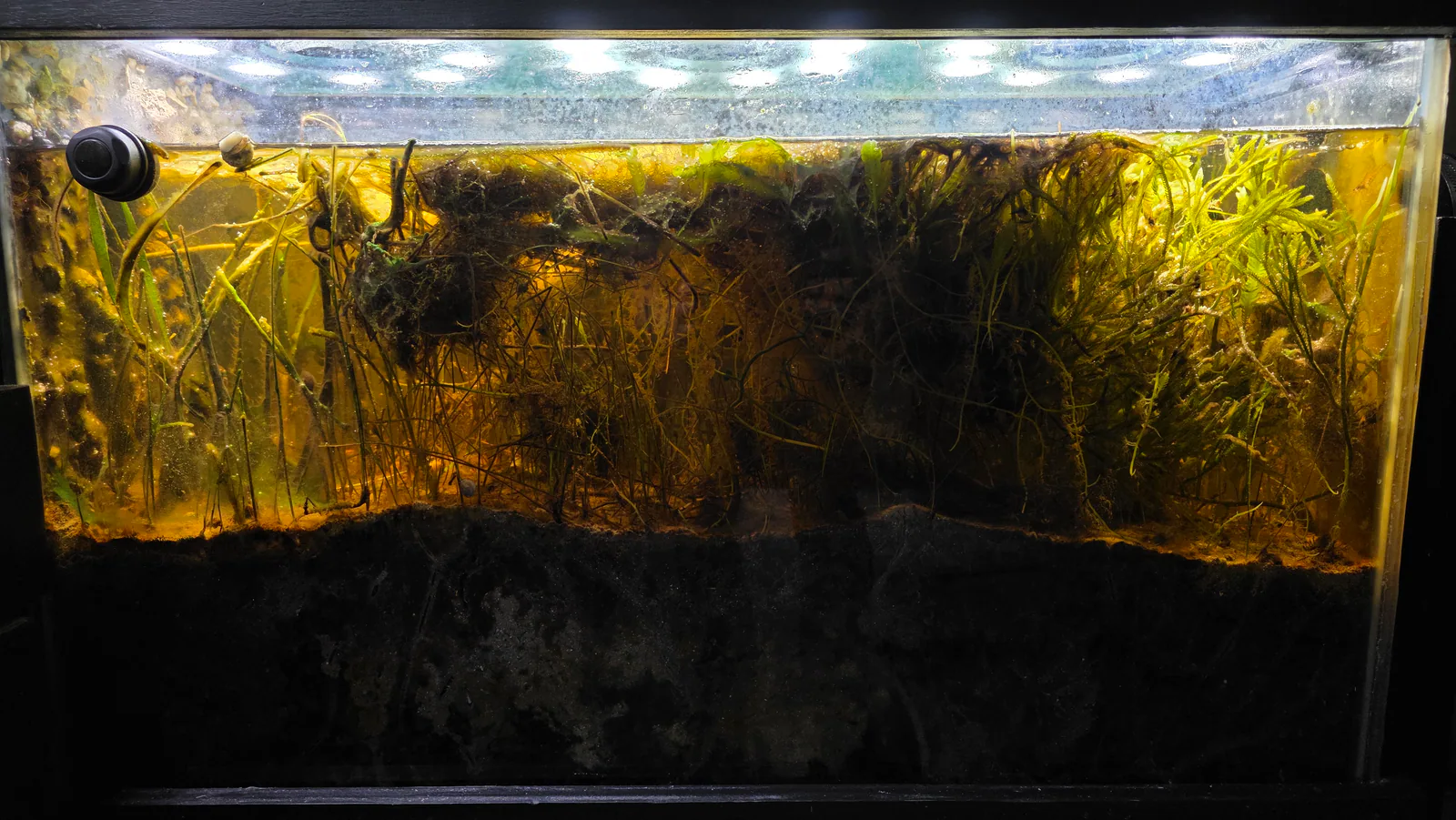
Purchased after repeated failed attempts to find it in the wild, this heavy-shelled grazer was added to the Seagrass Meadow to take on the algae-covered glass panes that the resident cleanup crew could no longer keep up with.

Realm
Saltwater
Population
Uncertain
Primary biome
Seagrass Meadow

Overview

Two Chestnut Turban Snails (Turbo castanea) were purchased from a local saltwater aquarium store and introduced to miniBIOTA's Seagrass Meadow on July 31, 2026, after repeated attempts to wild-collect the species from suitable Florida seagrass habitat were unsuccessful. The introduction directly targets a documented cleanup-crew shortfall: three of the biome's four glass panes were fully algae-covered as of July 29, 2026, following the Florida Glass Shrimp's probable role in the Eelgrass Isopod's extirpation. This is a separate species record from the long-unresolved Turbo Snail node, now identified as Mexican Turbo Snail (Turbo fluctuosa); no observation links the two. Shortly after introduction, the larger individual released a substantial white discharge; external secondary research shared by Josue August 3, 2026 interprets this as most likely an acclimation-triggered release of already-stored gametes (probably sperm, tentatively suggesting that individual is male), citing a species-specific aquarium breeding record, though a stress-response explanation remains equally plausible from the event alone. That same individual was confirmed dead on August 10, 2026, cause unknown. The second, remaining individual has not been seen since and is regarded as possibly extirpated as of August 18, 2026, though this is based on prolonged absence rather than a confirmed death.

Identity

  • Common name: Chestnut Turban Snail
  • Alternate names: chestnut turban, chestnut turbo, Turbo castanea
  • Scientific name: Turbo castanea
  • Identification confidence: Species-level. Purchased and labeled as Chestnut Turban Snail at a saltwater aquarium store; species-level identity is a vendor-confirmed purchase, not a field identification.
  • Sex: Unconfirmed; the larger individual is tentatively, not confirmedly, suspected to be male, based on external secondary research interpreting its July 31, 2026 white discharge as a likely sperm release (see Reproduction and Sources). The species' eggs are documented elsewhere as greenish and veil-like, distinct from the white cloud observed.
  • Uncertainty label: Confirmed. Species identity is solid at time of purchase; ecological role, sex, and establishment in miniBIOTA are unresolved.

Taxonomy

  • Kingdom: Animalia
  • Phylum: Mollusca
  • Class: Gastropoda
  • Order: Trochida
  • Family: Turbinidae
  • Genus: Turbo
  • Species: T. castanea

Natural History

Range and Florida Relevance

Turbo castanea is native to Florida, the Gulf of Mexico, and the Caribbean, where it inhabits rocky and hard-substrate shallow marine environments including seagrass bed margins. It is common enough in Florida that Josue expected to be able to wild-collect it, but repeated searches did not locate individuals in accessible seagrass meadow habitat, leading to the July 31, 2026 store purchase instead.

Habitat

Turbo castanea is a marine grazer that inhabits hard substrate in shallow subtropical and tropical Florida and Caribbean waters, moving across rock, shell, and other hard surfaces with a broad muscular foot and rasping algae and biofilm with its radula. In miniBIOTA, it was placed in the Seagrass Meadow.

Diet

Turbo castanea is a herbivorous grazer of algae and biofilm on hard surfaces, using a broad radula to scrape filamentous algae, diatoms, cyanobacteria, and biofilm from rock, shell, and glass. No direct feeding observation exists yet in miniBIOTA beyond the introduction context.

Reproduction

Turbo castanea is a broadcast spawner, releasing gametes into the water column during warmer months, with planktonic trochophore and then veliger larval development before settlement on hard substrate. This was confirmed for the species specifically in a July 29, 2026 husbandry review (documented in the Mexican Turbo Snail dossier) prior to this introduction. In a closed system without planktonic larval food or adequate water volume for larval survival, natural reproduction is not expected; any Chestnut Turban Snail in miniBIOTA should be treated as a consumable grazer requiring periodic restocking rather than a self-sustaining population.

External secondary research shared by Josue on August 3, 2026 interprets the larger individual's July 31, 2026 white discharge (see miniBIOTA Evidence) as most likely a case of this broadcast-spawning biology being triggered by the shock of transfer into miniBIOTA: an already sexually mature individual releasing previously stored gametes in response to abrupt changes in temperature, salinity, aeration, or handling, rather than producing new material within the ten-minute window. This reading is supported by a species-specific aquarium breeding record documenting T. castanea spawning repeatedly after water changes, and by general induced-spawning literature in other marine gastropods. The white coloration, contrasted with the species' eggs being documented elsewhere as greenish and veil-like, tentatively suggests the discharge was sperm and that the larger individual is male. A stress-response explanation for the same event remains equally plausible and is not excluded by this interpretation; the two are not mutually distinguishable from the discharge event alone.

Tolerance Ranges

Requires full to near-full marine salinity and tropical to subtropical water temperatures. Sensitive to low oxygen, high temperatures, and salinity fluctuations, consistent with genus Turbo generally. Specific tolerance measurements for miniBIOTA conditions have not been taken.

Ecological Role

Chestnut Turban Snail is a heavy-bodied algae grazer introduced specifically to address the Seagrass Meadow's documented hard-surface grazing shortfall: as of July 29, 2026, three of the biome's four glass panes were completely algae-covered, with only the front camera pane kept clear by hand. Alongside the Astraea Snails introduced August 1, 2026, this is one of two concurrent, unevaluated attempts to restore hard-surface grazing capacity lost with the decline of the Lightning Nerite and both cerith species and the presumed loss of the Mexican Turbo Snail.

miniBIOTA Evidence

Introduction Context

Two Chestnut Turban Snails were purchased from a local saltwater aquarium store on July 31, 2026, after unsuccessful attempts to wild-collect the species from Florida seagrass habitat. Introduced alongside six margarita snails (removed the next day) and one unidentified hitchhiker sea slug, all drip-acclimated before introduction.

Observation Timeline

  • July 31, 2026: Two Chestnut Turban Snails purchased and drip-acclimated, then introduced to the Seagrass Meadow. All appeared to be doing adequately during the initial observation period. Observation record, July 31, 2026.
  • July 31, 2026: Approximately 10 minutes after introduction, the larger individual released a substantial quantity of white, cloudy material into the water column, which dispersed through the surrounding water. Cause unknown; candidate explanations include a reproductive release, an acclimation/transfer stress response, or an excretory event, undistinguished. Observation record, July 31, 2026.
  • August 3, 2026: Josue shared external secondary research interpreting the July 31, 2026 discharge as most likely acclimation-triggered release of already-stored sperm, citing a species-specific aquarium breeding record; the larger individual is tentatively suggested to be male on this basis. A stress-response explanation remains equally plausible from the event alone. Not a new direct observation. Observation record, August 3, 2026.
  • August 9, 2026: One individual observed overturned on the substrate with its body extended partly out of the shell. At the time, this could indicate either a normal righting attempt or distress; cause undetermined from this observation alone. Observation record, August 9, 2026.
  • August 10, 2026: This same individual confirmed dead: an Orangeclaw Hermit Crab was observed feeding on the carcass, with a Mottled Shore Crab separately approaching and competing for access to the tissue. Cause of death unknown; other snails and water quality appear normal. One Chestnut Turban Snail remains. Observation record, August 10, 2026.
  • August 18, 2026: The second, remaining Chestnut Turban Snail has not been observed at all since the August 10, 2026 mortality. No direct mortality confirmed for this individual; its shell may be hidden in an obscured area (e.g. a tunnel) of the biome. Regarded as possibly extirpated based on prolonged absence of sightings, not confirmed death. Observation record, August 18, 2026.

What Is Confirmed

  • Two Chestnut Turban Snails introduced to the Seagrass Meadow July 31, 2026, purchased rather than wild-collected.
  • The larger individual released a substantial white, cloudy discharge approximately 10 minutes after introduction.
  • One individual confirmed dead August 10, 2026, via observed hermit crab and Mottled Shore Crab scavenging of the carcass. One individual remains.
  • The remaining individual has not been observed since August 10, 2026; no sighting through August 18, 2026.

What Is Inferred

  • The remaining individual is possibly also dead, its shell potentially hidden in an obscured area of the biome; this is not confirmed, and the prolonged absence is the basis for this interpretation rather than direct evidence.
  • Algae and biofilm grazing role, consistent with Turbo castanea natural history and the documented motivation for introduction.
  • Broadcast spawning reproductive mode, confirmed for the species generally but not observed in miniBIOTA.
  • Most likely explanation for the white discharge: acclimation-triggered release of previously stored sperm, tentatively indicating the larger individual is male; a stress-response explanation remains equally plausible and is not excluded.

What Remains Unknown

  • Confirmed cause of the white discharge event; the acclimation-triggered-spawning interpretation is the most likely reading of external secondary research, not a confirmed fact.
  • Confirmed sex of either individual; "probably male" for the larger individual is a tentative inference from discharge color alone.
  • Whether both individuals have survived past the initial introduction period.
  • Whether grazing on the algae-covered glass panes has begun.
  • Whether the species will establish any reproductive activity in this system (not expected, per broadcast-spawning biology).
  • What caused the death of one individual on August 10, 2026; no environmental or system-wide factor was identified, and other snails and water quality appeared normal.
  • Whether the second individual is truly extirpated or alive but hidden; no direct sighting or confirmed mortality exists as of August 18, 2026.