Order - Amphipoda

Marine Scud

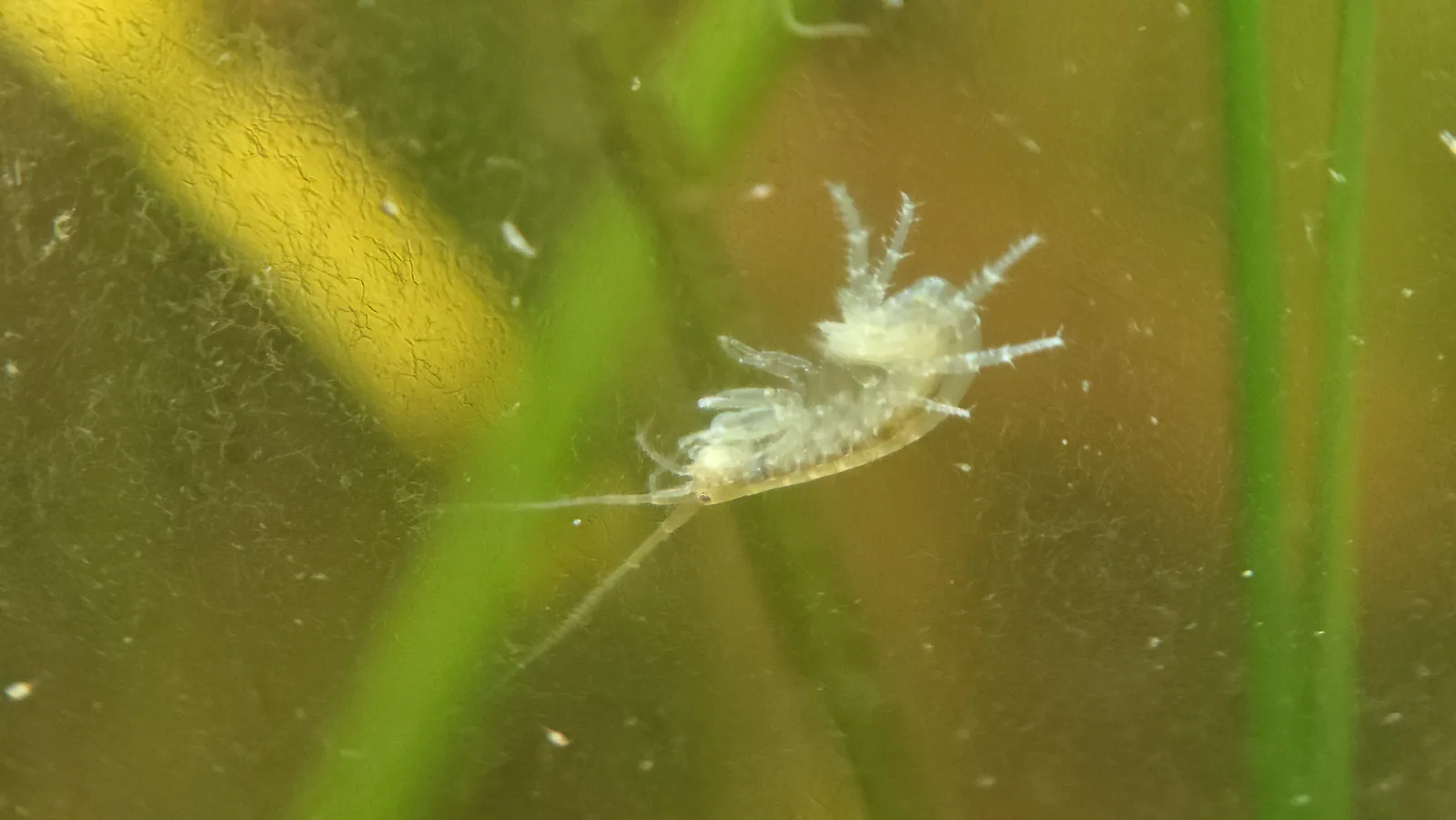
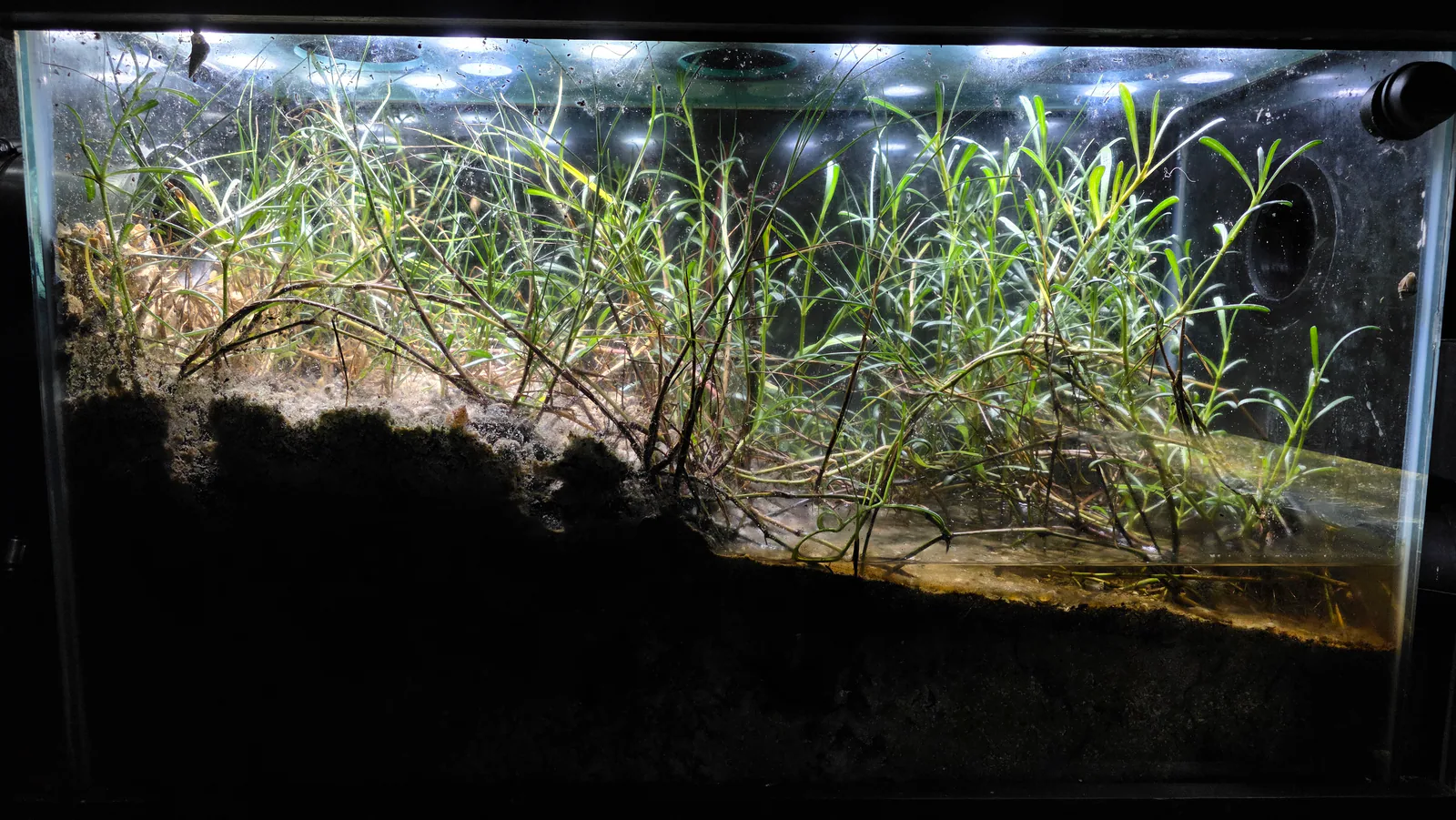
Marine Scuds are tiny crustaceans that have built a population of likely thousands in the Seagrass Meadow, converting dead Shoal grass and fine organic debris into animal biomass for sea anemones, crabs, and other saltwater predators.

Overview

Marine Scuds are small benthic crustaceans that arrived as hitchhikers on oysters in November 2024 and established quickly in the Seagrass Meadow, reaching a visible population of likely thousands by spring 2026. Their exact species is unresolved within the broad order Amphipoda, but their ecological role as detritivores processing dead plant material and organic debris is well-supported by miniBIOTA observation.

Identity

  • Common name: Marine Scud
  • Alternate names: Amphipod, scud, beach hopper, saltwater scud, marine amphipod, gammarid
  • Scientific name: Order Amphipoda (species unresolved)
  • Identification confidence: Order-level only; no genus or species confirmed
  • Uncertainty label: Confirmed (ecological identity and establishment); Unknown (species-level ID)

Taxonomy

  • Kingdom: Animalia
  • Phylum: Arthropoda
  • Subphylum: Crustacea
  • Class: Malacostraca
  • Order: Amphipoda
  • Family: Unknown
  • Genus: Unknown
  • Species: Unknown

Natural History

Marine Scuds are small, laterally compressed crustaceans belonging to the order Amphipoda, one of the most ecologically important crustacean groups in coastal and marine environments worldwide. Florida coastal habitats, including seagrass beds, mangrove margins, and intertidal zones, commonly host gammaridean amphipods closely matching the miniBIOTA record. In the wild they occur from wave-washed shorelines to soft-bottom benthic habitats, sheltering within algae clumps, under shells, and in detritus layers where organic matter accumulates.

Marine Scuds feed opportunistically on fine detritus, bacteria, algae, microbes, and suspended organic particles. Their feeding activity positions them as converters of dead plant material into animal protein, a role especially visible where seagrass detritus accumulates seasonally. In miniBIOTA, preferred habitat includes benthic detritus layers, macroalgae clumps including Graceful Redweed, the underside of shells, and active sand interfaces, with a preference for low to moderate light and low to moderate water flow.

Reproduction occurs through amplexus, in which the male carries the female until she undergoes a reproductive molt. Fertilized eggs are brooded in a ventral marsupium and hatch as miniature adults with no larval dispersal stage. This direct-development strategy allows enclosed populations to grow without a free-swimming larval period. In warm water, individuals can mature in a few weeks and may live six to twelve months. Marine Scuds are generally very hardy and tolerant of wide environmental fluctuations, though they are sensitive to severe oxygen crashes and rapid salinity spikes.

Ecological Role

In coastal seagrass ecosystems, amphipods are central detritivores that convert accumulated organic matter into animal biomass accessible to larger predators. By processing dead plant material, bacterial biofilm, and fine organic particles, Marine Scuds move nutrients from the detritus layer into the food web. In miniBIOTA they are preyed on by sea anemones, crabs, and other macro-invertebrates. Their commensal association with macroalgae and seagrasses provides physical cover, while their grazing and detritivory may reduce organic loading in the benthic zone.

In miniBIOTA, Marine Scuds are the most abundant benthic detritivore of the Seagrass Meadow. Their population surge in April 2026, coinciding with winter Shoal grass shedding and detritus accumulation, suggests they actively respond to organic pulses. Whether their processing reduces algal pressure or primarily recycles nutrients back to algae is unresolved. They are also linked to the Marine Shore biome but appear most concentrated in the Seagrass Meadow. Their sensitivity to low-flow conditions, observed in June 2026, highlights how closely their behavior tracks water quality and circulation in a closed system.

miniBIOTA Evidence

Marine Scuds arrived as hitchhikers on oysters and live rock introduced to the Seagrass Meadow on November 11, 2024.

December 15, 2024: Babies were observed alongside parents, described as a second generation establishing. The observation noted that amphipods are notoriously hard to sustain in enclosed systems without sufficient food, habitat, and low predation, making confirmed breeding meaningful evidence of environmental support.

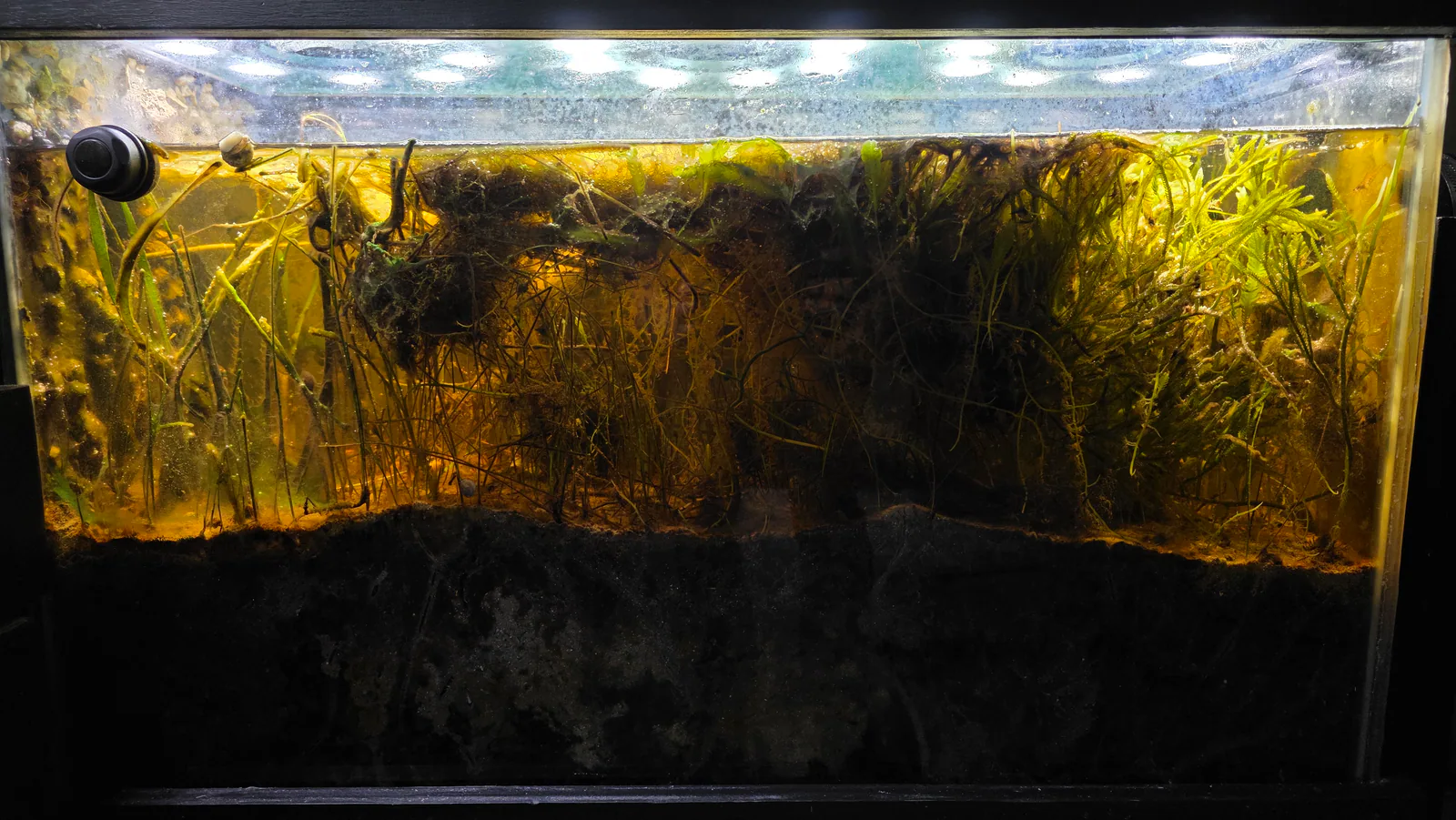
April 19, 2026: A massive population surge was observed, with likely thousands of individuals clustered along the glass in the benthic region of the Seagrass Meadow. Video evidence documented dense clusters. The surge appeared to coincide with winter Shoal grass shedding and detritus accumulation, suggesting the population was actively processing accumulated organic material. Whether the surge was sufficient to reduce macroalgal pressure at the time was left uncertain.

June 11, 2026: Many Marine Scuds were observed positioned on the glass of the Seagrass Meadow as if seeking higher ground. Water was noticeably cloudy. The Wave and Tide System had been running at an extremely slow setting overnight due to a programming change during remote-control integration work. Wave motion was restored to a more appropriate level. The Variegated Sea Urchin was simultaneously observed almost completely out of the water. Possible contributing factors include a bacterial bloom and lowered dissolved oxygen; neither was confirmed. No media was recorded.

June 27, 2026: Marine Scuds observed at noticeably lower apparent abundance than previously observed in the Seagrass Meadow. The population is still present but at levels substantially below prior observations, including the April 2026 surge. Cause uncertain: two competing hypotheses are held, predation pressure from Florida Glass Shrimp, added to the biome's shrimp presence as a new species on June 12, 2026 (their own population has not been confirmed to grow since that introduction), and an unidentified environmental change within the biome. No direct predation event on Marine Scuds was observed. Observation record, June 27, 2026.

Confirmed:

  • Introduction as hitchhiker on oysters and live rock, November 11, 2024
  • Established population in the Seagrass Meadow
  • Confirmed breeding as of December 15, 2024
  • Visible population of likely thousands as of April 19, 2026
  • Glass-surface concentration during a low-flow event, June 11, 2026

Inferred:

  • Active processing of winter Shoal grass detritus into animal biomass
  • Serving as prey for sea anemones, crabs, and other Seagrass Meadow predators
  • Stress or avoidance behavior during periods of reduced water circulation or lowered dissolved oxygen

Unknown:

  • Exact species-level identity within order Amphipoda
  • Whether the April 2026 surge reduced macroalgal pressure or recycled nutrients back to algae
  • Whether Seagrass Meadow and Marine Shore amphipods represent the same organism record or multiple types
  • What predators actively regulate Marine Scud density inside the Seagrass Meadow
  • Whether glass-climbing reliably signals oxygen stress versus other behavioral factors
  • Long-term carrying capacity and population stability
  • Whether water clarity and organism behavior returned to normal after wave motion was restored on June 11, 2026
  • The cause of the substantial decline in apparent abundance observed June 27, 2026; Florida Glass Shrimp predation and environmental change are both possible explanations