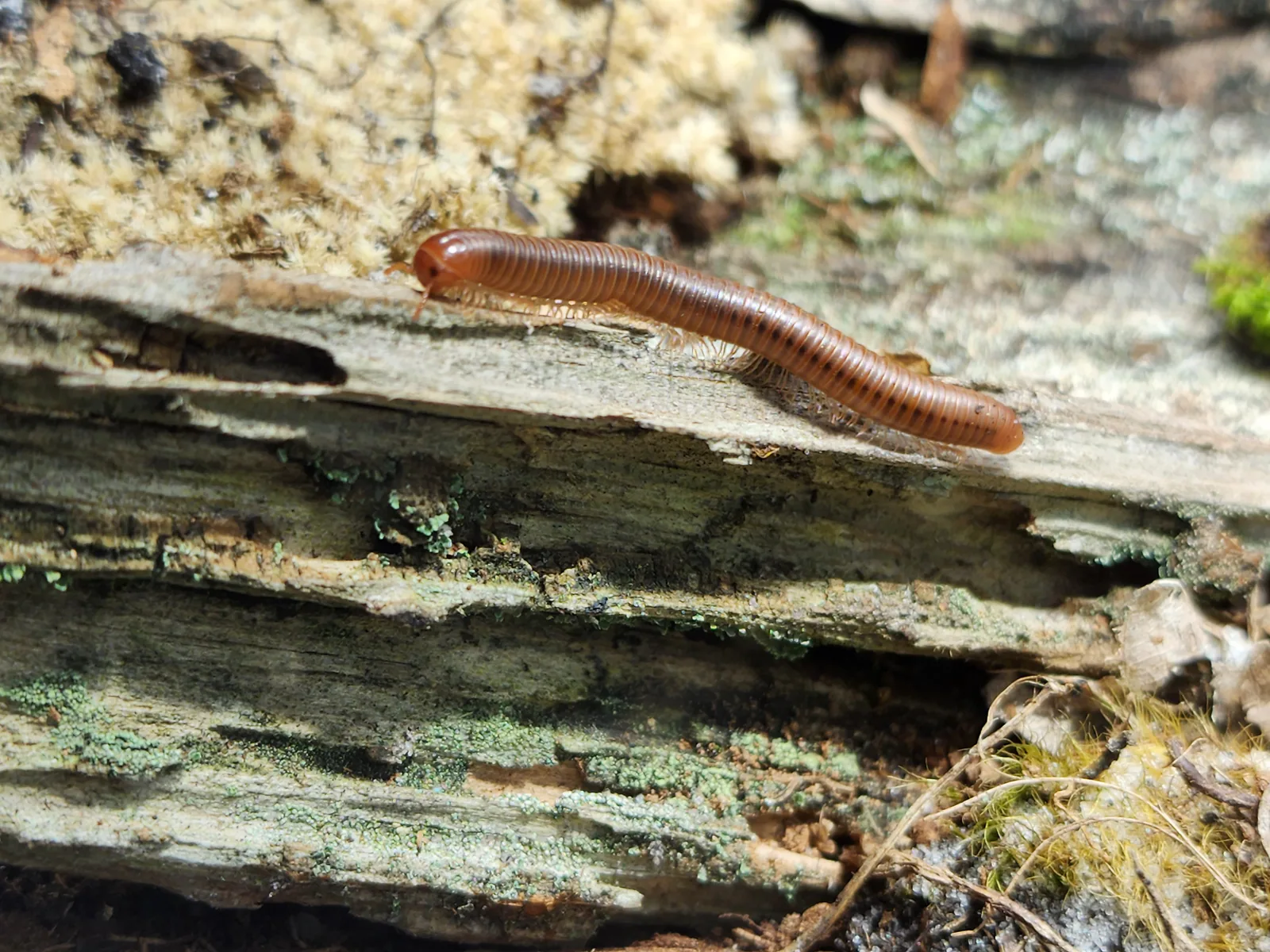
Trigoniulus corallinus

Rusty Millipede

A small coral-red cylindrical millipede of the Lakeshore, Trigoniulus corallinus is a Southeast Asian species now established across South Florida; it processes decaying plant matter and fungi in moist leaf litter and contributes to nutrient cycling at the terrestrial detrital base.

Visual Data Unavailable

Overview

A small coral-red cylindrical millipede of the Lakeshore, Trigoniulus corallinus is a Southeast Asian species now established across South Florida; it processes decaying plant matter and fungi in moist leaf litter and contributes to nutrient cycling at the terrestrial detrital base. No dedicated observation record has been found in the miniBIOTA observation records.

Identity

  • Common name: Rusty Millipede
  • Alternate names: coral millipede, small red millipede, red millipede, rusty red millipede
  • Scientific name: Trigoniulus corallinus
  • Identification confidence: Species-level (Trigoniulus corallinus); scientific name already on record; common name and coral-red coloration are species-consistent
  • Uncertainty label: Observed

Taxonomy

  • Kingdom: Animalia
  • Phylum: Arthropoda
  • Subphylum: Myriapoda
  • Class: Diplopoda
  • Order: Spirobolida
  • Family: Trigoniulidae
  • Genus: Trigoniulus
  • Species: Trigoniulus corallinus (Gervais, 1847)

Natural History

Trigoniulus corallinus (rusty millipede, coral millipede) is a small, cylindrical millipede native to Southeast Asia and the Indo-Pacific. Adults reach 10 to 20 mm in length with a uniform coral-red to rusty-orange coloration that makes this species one of the most recognizable millipedes in South Florida. The body is cylindrical in cross-section with smooth, rounded body segments; like most millipedes, it has two pairs of legs per body segment. When disturbed, it typically coils into a tight spiral rather than conglobating into a ball.

T. corallinus is now established throughout tropical and subtropical regions globally, spread primarily through the horticultural trade and the movement of nursery soils and potted plants. In Florida, it is one of the most commonly encountered millipedes in gardens, landscaped areas, and disturbed moist habitats with leaf litter and organic debris. It is not a pest and does not damage living plant tissue; it feeds on decaying organic matter, fungi, and decomposing plant material.

In moist tropical and subtropical environments, T. corallinus can achieve high local densities in favorable microhabitats: under leaf litter, in loose topsoil, under bark, and in the organic debris layer at soil level. It requires consistent moisture to remain active and is desiccation-sensitive, retreating into soil or leaf litter during dry or hot conditions.

Reproduction is sexual; females lay eggs in moist soil or leaf litter, and juveniles develop through multiple molts, adding body segments with each molt until reaching adult form. Some Trigoniulus populations are reported to reproduce parthenogenetically, allowing population establishment from a single individual.

Ecological Role

In the Lakeshore, Rusty Millipede functions as a leaf-litter detritivore, processing decaying plant material and organic debris at the terrestrial ground level. Millipede detritivory fragments leaf litter and other organic material, increasing surface area for microbial decomposition and contributing to nutrient cycling. In the Lakeshore, T. corallinus complements Woodlouse (Oniscidea) and Earthworm as detrital processors in the moist terrestrial margin.

miniBIOTA Evidence

Introduction context: No introduction event is recorded. T. corallinus is an established South Florida species commonly encountered in moist gardens and disturbed habitats. No introduction date, source, or method is on file.

Observation timeline:

  • No dedicated observation records have been found in the miniBIOTA observation records for Rusty Millipede.

Confirmed:

  • Species node exists for Rusty Millipede in the Lakeshore; species-level identification as Trigoniulus corallinus from the pre-existing DB scientific name

Inferred:

  • Leaf-litter detritivory in the Lakeshore, inferred from T. corallinus biology and Lakeshore biome assignment

Unknown:

  • Whether Rusty Millipede is currently present in the Lakeshore
  • Introduction date, source, and method
  • Local population size or density