Conocephalus brevipennis
Short-winged Meadow Katydid
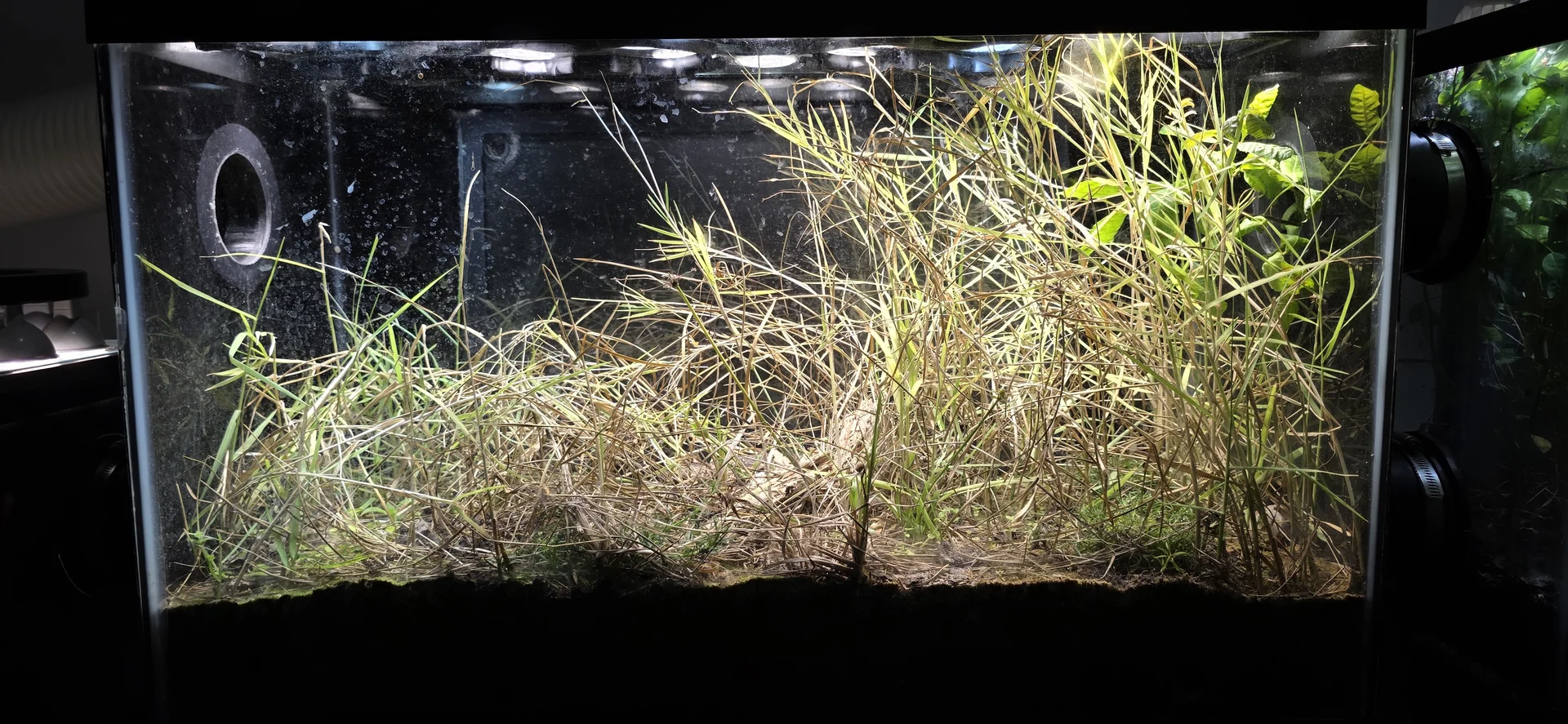
Found among the grasses of the Lowland Meadow, this small katydid grazes on plant material and soft invertebrates and depends on morning dew and rainfall for hydration.

Conocephalus brevipennis
Found among the grasses of the Lowland Meadow, this small katydid grazes on plant material and soft invertebrates and depends on morning dew and rainfall for hydration.
The short-winged meadow katydid (Conocephalus brevipennis) is a small, grass-associated katydid native to eastern North America and common in Florida's moist meadow habitats. It feeds primarily on grasses, forbs, and seeds, with small invertebrates taken opportunistically. One individual was introduced to the Lowland Meadow on July 1, 2025. Its survival appeared to be constrained by water availability; the individual was observed drinking heavily after a rainstorm in July 2025, with lack of morning dew identified as a potential limiting factor. Population status is Uncertain; the species has not been observed since late July 2025.
Conocephalus brevipennis is distributed throughout eastern North America, from southern Canada through the eastern United States and into Florida. In Florida it is a common inhabitant of moist grasslands, wet meadow edges, sedge marshes, and humid terrestrial borders. It is one of several Conocephalus species found in the state. Its presence in the Lowland Meadow is ecologically appropriate given the biome's grass-dominated, humid terrestrial character.
Short-winged meadow katydids are strongly associated with grasses and sedges in moist microhabitats. They favor areas with dense low-growing vegetation, particularly where tall grasses, forbs, and plant debris create sheltered resting sites at or near ground level. Despite their reduced wings, they are capable of short flights and can move between plant stems with agility. They are active during the day and into the evening; males stridulate throughout daylight hours and can be heard into the night.
Conocephalus brevipennis is primarily herbivorous, feeding on grasses, sedges, forbs, seeds, and soft plant tissue. It supplements its plant diet opportunistically with small invertebrates and insect eggs. Unlike grasshoppers, it uses its chewing mouthparts to bite into plant stems as well as blades. Katydids are known to be moisture-dependent; dew and rainfall are important water sources in the wild.
Females use a well-developed ovipositor to insert eggs into plant stems, leaf sheaths, or soil. Eggs overwinter in temperate populations and hatch in spring, with one generation produced per year. Adults live through the summer and early fall season. Males produce sound by rubbing the forewings together (tegminal stridulation), a high-pitched song that is a conspicuous feature of humid meadow habitats in summer.
Conocephalus brevipennis is a warm-season species requiring warm temperatures and reliable moisture. Water availability is a notable constraint: katydids obtain much of their hydration from dew and plant moisture rather than standing water, and systems lacking morning condensation or regular rainfall may not sustain them. In miniBIOTA, lack of morning dew was directly flagged as a limiting factor for the individual's survival in July 2025.
In the terrestrial food web, the short-winged meadow katydid functions primarily as an herbivore, consuming grass tissue, forbs, and seeds and transferring plant energy into insect biomass. This biomass is available to predatory arthropods, insectivorous vertebrates, and other consumers in the food web. As a soft-bodied, moderately mobile insect it is well within the prey range of spiders, centipedes, and larger insectivores. In miniBIOTA, no ecological interactions were observed; the individual's brief tenure in July 2025 did not produce documented feeding or predation records. The key ecological signal from miniBIOTA is environmental rather than trophic: the water-limitation observation from July 20, 2025 points to morning condensation as a possible prerequisite for sustaining this species in the terrestrial realm.
One short-winged meadow katydid was introduced to the Lowland Meadow on July 1, 2025. No introduction method or source origin is documented. The individual was last recorded on July 25, 2025, with the most substantive observation coming on July 20, 2025, when the katydid was observed drinking heavily following a rainstorm. At that time, lack of morning dew was identified as a potential limiting factor for katydid and grasshopper survival in the Lowland Meadow. Population status remains Uncertain; no subsequent observation has been recorded.
Single individual introduced July 1, 2025. Last observed July 25, 2025. On July 20, 2025, the individual was observed drinking heavily after a rainstorm; lack of morning dew was flagged as a potential limiting factor for survival. No subsequent observation recorded. Outcome unresolved; desiccation, predation, or escape are all possible.
Conocephalus brevipennis is primarily herbivorous, feeding on grasses, forbs, and seeds, with small invertebrates taken opportunistically. It is not predatory in the true sense. In miniBIOTA, its herbivory would act on the Lowland Meadow's grasses and forbs; no feeding behavior was directly observed during its brief July 2025 presence.
Warm-season species requiring reliable moisture; dew and rainfall are primary water sources. In miniBIOTA, lack of morning dew was directly observed limiting survival in July 2025. Water availability is the key environmental constraint identified for this species in the system.
Nymphs develop through successive molts to adulthood over several weeks in spring and early summer. Adults persist through summer and fall; females oviposit into plant tissue. No reproduction was possible in miniBIOTA; only one individual was present.
Primary herbivory on Lowland Meadow grasses and forbs transfers plant energy into insect biomass. As a soft-bodied, ground-level insect it is within the prey range of spiders and other terrestrial predators. No ecological interactions were observed in miniBIOTA.
Follow this species across the habitats where it currently appears in the miniBIOTA biosphere.