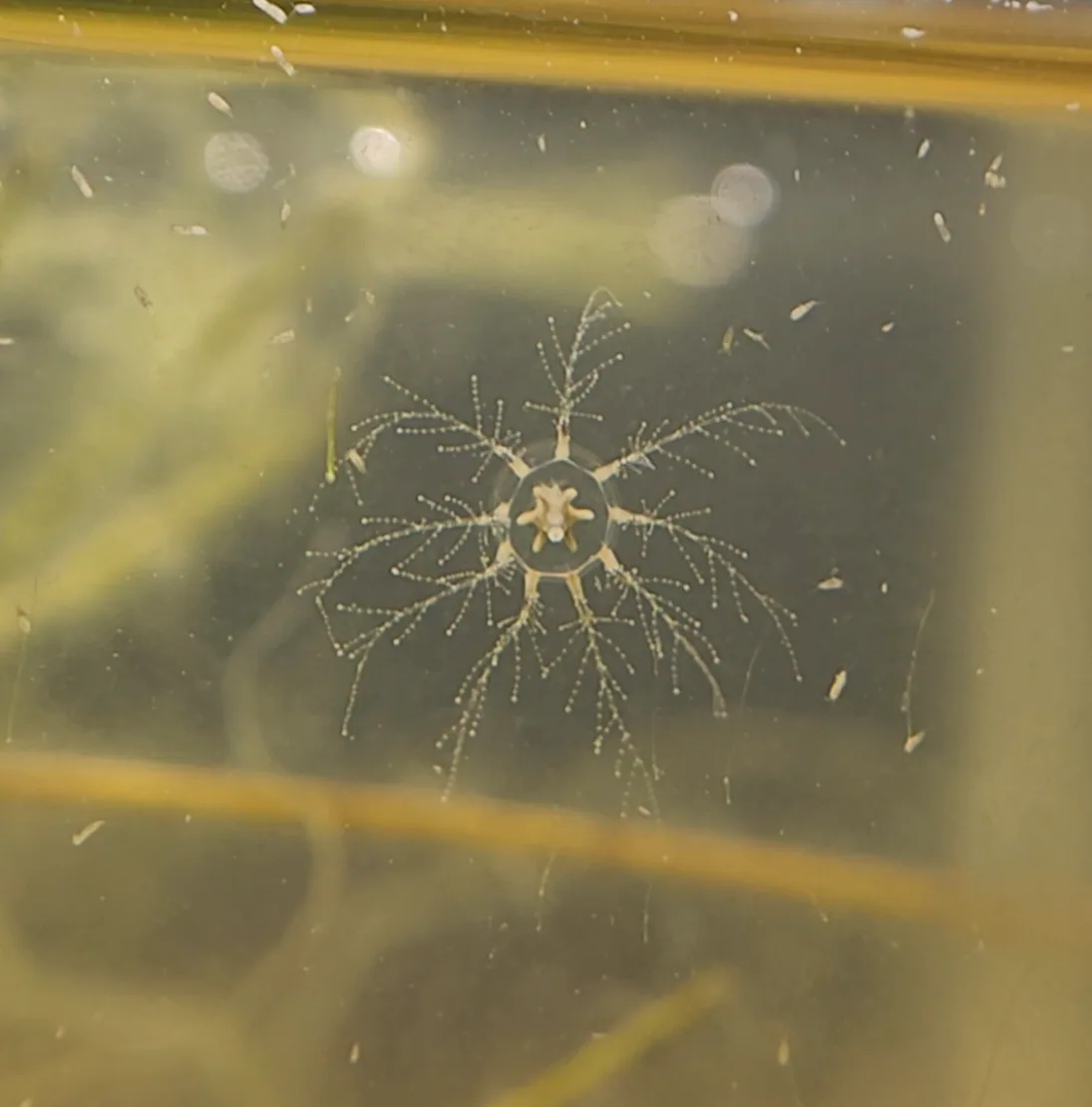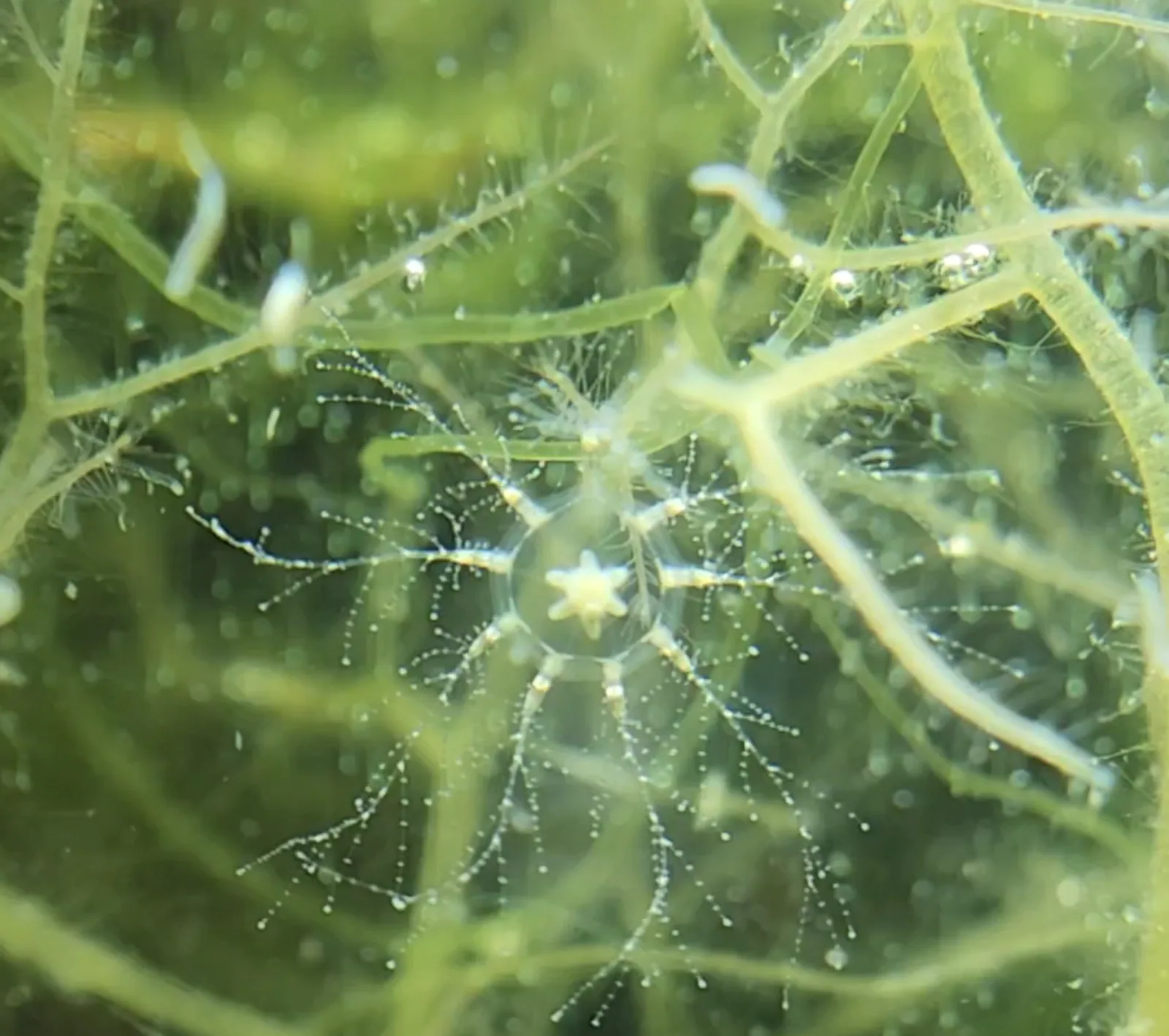
Cladonema radiatum

Cladonema Jelly

A miniature hydromedusa in the Seagrass Meadow, tiny enough to fit on a fingernail, that both swims and crawls along surfaces on branched stinging tentacles, capturing copepods and small zooplankton; a sessile polyp stage on the glass wall may persist unseen between medusa sightings.

Visual Data Unavailable

Overview

The Cladonema Jelly (Cladonema radiatum) is a miniature hydromedusa (not a true jellyfish but a member of the hydroid lineage) that alternates between a sessile polyp stage on hard substrate and a tiny free-swimming medusa stage that can also crawl along surfaces using its branched tentacles. Two individuals are on record, but no introduction date, source, or observation record documents their presence or current status in the Seagrass Meadow.

Identity

  • Common name: Cladonema Jelly
  • Alternate names: hydroid jellyfish, cladonema, hydromedusa, branching jellyfish
  • Scientific name: Cladonema radiatum
  • Identification confidence: Species-level. Cladonema radiatum is inferred from the common name and is the most frequently recorded Cladonema species in temperate and subtropical aquarium systems; the branched tentacles of the medusa are distinctive within the genus.
  • Uncertainty label: Uncertain. Species ID is reasonable from the common name; all aspects of presence, population, and status are undocumented.

Taxonomy

  • Kingdom: Animalia
  • Phylum: Cnidaria
  • Class: Hydrozoa
  • Order: Anthoathecata
  • Family: Cladonematidae
  • Genus: Cladonema
  • Species: C. radiatum

Natural History

Range and Florida Relevance

Cladonema radiatum has a cosmopolitan distribution in temperate to subtropical coastal marine environments, recorded in the Mediterranean, Atlantic, Pacific, and Gulf coasts. It is a common aquarium hitchhiker and a frequently observed hydromedusa in enclosed marine systems worldwide. In natural settings it is found in shallow coastal waters, seagrass beds, tidal pools, and sheltered bay environments, habitats broadly comparable to miniBIOTA's Seagrass Meadow.

Habitat

Cladonema radiatum has a two-stage life cycle: a sessile polyp stage that attaches to hard surfaces (glass, rock, shell, coralline algae) and a medusa stage that both swims and crawls. The medusa can use its branched, adhesive tentacles to anchor to surfaces and creep along the substrate, a behavior uncommon among medusae and useful in low-flow enclosed systems. The polyp stage is cryptic and easily overlooked; medusae are more visible but still very small. In miniBIOTA, both stages would be expected on hard surfaces in the Seagrass Meadow.

Diet

Cladonema radiatum medusae are micro-predators, capturing copepods, amphipod larvae, small worms, and other small zooplankton with stinging tentacles. The polyp stage also captures small prey. In a closed system with limited zooplankton production, Cladonema can place measurable predation pressure on copepod populations.

Reproduction

Cladonema alternates between asexual polyp reproduction (budding new polyps and releasing medusae) and sexual medusa reproduction (release of eggs and sperm, producing planula larvae that settle to form new polyps). In an enclosed system, the polyp stage can persist and bud medusae repeatedly if food and substrate are available, making Cladonema capable of establishing a self-sustaining population in marine aquarium systems without external input. This is notable and potentially relevant to miniBIOTA population dynamics.

Tolerance Ranges

Cladonema radiatum tolerates a range of marine to near-marine salinities and temperatures across its cosmopolitan range. It is recorded in systems from 15-30 degrees C. Sensitive to extremes of salinity and temperature; not documented for specific miniBIOTA conditions.

Ecological Role

Cladonema Jelly is a micro-predator in the Seagrass Meadow water column and on hard surfaces, consuming copepods and small zooplankton. In a system with active microcrustacean populations, it can suppress copepod densities. The polyp stage occupies hard-surface biofouling niches alongside barnacles, bryozoans, and encrusting algae. Unlike most species in the Seagrass Meadow, Cladonema is capable of reproducing in place through asexual polyp budding, which means even a small founding population could theoretically persist or grow without external introduction.

miniBIOTA Evidence

Introduction Context

No introduction date, source, or method is on record. Cladonema radiatum is a known aquarium hitchhiker, arriving most commonly on live rock, coral rubble, or macroalgae. Hitchhiker arrival with an early saltwater introduction is the most probable pathway. Two individuals are documented; neither has a dedicated observation record.

Observation Timeline

No observation files found.

What Is Confirmed

  • Cladonema Jelly (Cladonema radiatum) is documented in miniBIOTA with two individuals recorded.

What Is Inferred

  • Likely arrived as a hitchhiker on live rock or macroalgae during an early saltwater introduction.
  • Two individuals on record suggest at least two medusae were observed at some point.
  • Given the species' capacity for asexual reproduction from the polyp stage, population dynamics in miniBIOTA may be more complex than the "2 individuals" snapshot suggests.

What Remains Unknown

  • Introduction date, source, and method.
  • Whether individuals are currently present in the Seagrass Meadow.
  • Whether a polyp colony is established on any hard surface.
  • Current population count and status.