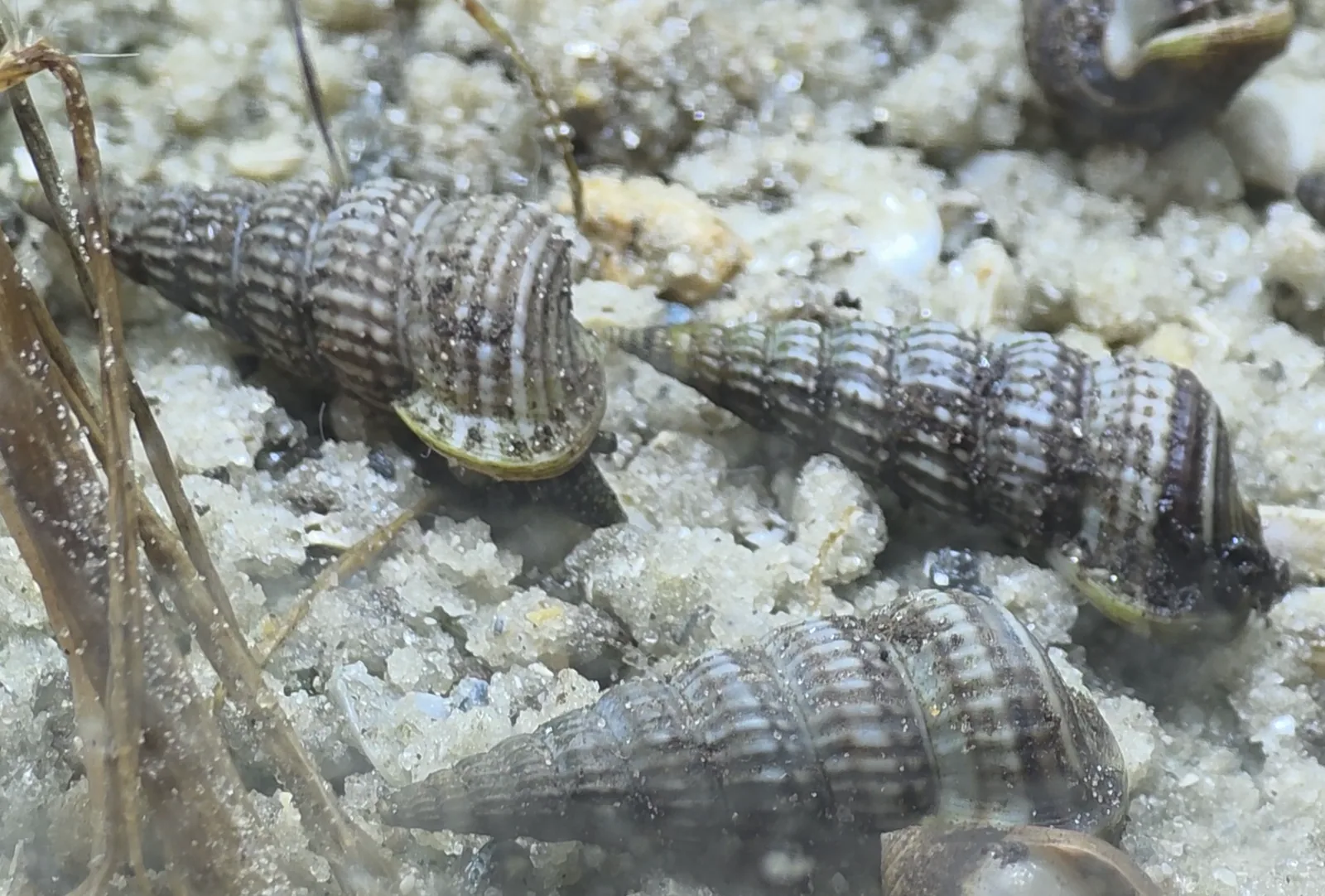
Cerithidea scalariformis

Ladder Hornsnail

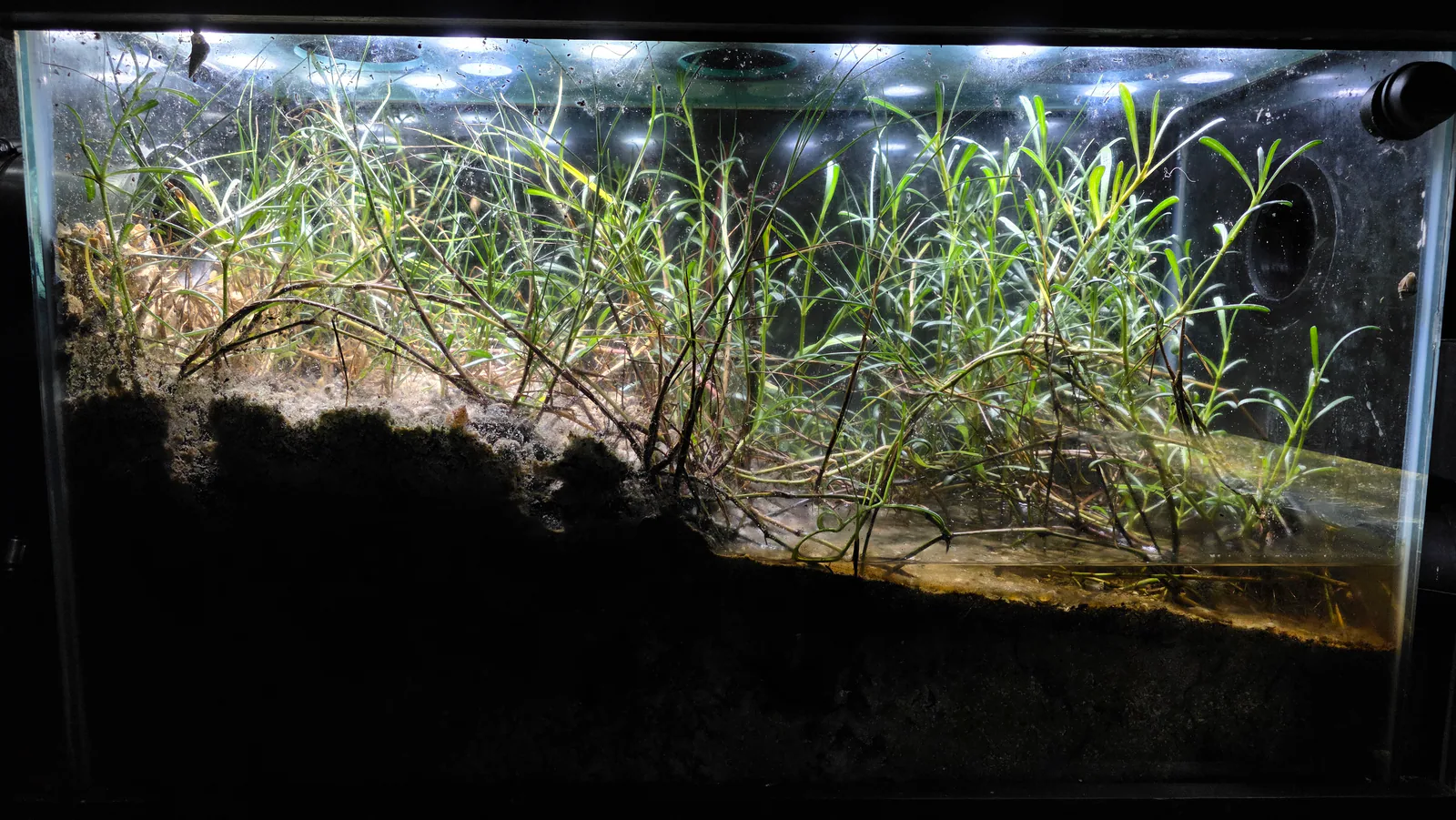
Moving along the Marine Shore margin with its ridged spiral shell, this small snail grazes dead grass detritus and biofilm from the tidal zone and climbs shoreline vegetation to avoid submersion at high tide.

Visual Data Unavailable

Overview

The Ladder Hornsnail (Cerithidea scalariformis) is a small semi-aquatic gastropod introduced to miniBIOTA's Marine Shore on April 23, 2026, collected the day before from a brackish tidal ditch in Spring Hill, Florida. It was added alongside Eastern Melampus as part of a shoreline detritivore batch. The species grazes dead grass detritus and biofilm from the tidal margin and climbs shoreline vegetation to avoid submersion during high tide, a behavior that links the benthic sediment layer to the emergent plant canopy. Population status is Uncertain and adaptation to the Marine Shore is still being observed.

Identity

  • Common name: Ladder Hornsnail
  • Alternate names: horn snail, ladder horn snail, saltmarsh horn snail, cerithid snail, marsh snail, cerithidea, hornsnail
  • Scientific name: Cerithidea scalariformis
  • Identification confidence: Species confirmed by research at time of collection
  • Uncertainty label: Confirmed

Taxonomy

  • Kingdom: Animalia
  • Phylum: Mollusca
  • Class: Gastropoda
  • Order: Caenogastropoda
  • Family: Potamididae
  • Genus: Cerithidea
  • Species: scalariformis

Natural History

Range and Florida Relevance

Cerithidea scalariformis is native to intertidal and estuarine habitats along the Gulf Coast and Atlantic coast of North America, with a core range centered on Florida and the Gulf States. In Florida, the species is abundant in saltmarsh, mangrove-edge, and brackish tidal habitats along both coasts. It is a characteristic species of Florida's tidal mudflats and grass marsh margins, where it is frequently the most abundant invertebrate grazer on detritus. The Spring Hill collection site (a brackish tidal ditch) is a typical C. scalariformis habitat.

Shell and Appearance

The ladder hornsnail has a turreted (tower-shaped) shell with defined whorls crossed by axial ribs, creating a latticed or "ladder" pattern that gives the species its common name. The shell is typically small, a few centimeters at adult size, and ranges from grayish to tan, often worn or fouled with sediment in natural settings. The operculum (a hardened plate) seals the shell opening when the snail retracts, providing protection during desiccation and predator encounters.

Habitat

Cerithidea scalariformis is a semi-aquatic gastropod of the intertidal zone. It inhabits the transition zone between shallow water and the air, silty-sand shoreline margins, exposed mudflats, and the bases of intertidal grasses. It is equally comfortable emersed and submerged and regularly climbs grass stems and other shoreline vegetation during high tide to escape full submersion or to thermoregulate by getting above hot substrate. This vertical migration behavior links the sediment layer to the emergent vegetative canopy. In miniBIOTA, the species occupies the Marine Shore intertidal margin.

Diet

Ladder Hornsnails are detritivores and biofilm grazers. They feed on dead and decaying plant material, particularly cordgrass and shoreline paspalum detritus, and on the microbial biofilms (bacteria, cyanobacteria, microalgae) that colonize moist intertidal surfaces. They do not primarily graze living plants. By processing dead organic matter and biofilm, they recycle nutrients from accumulated plant material back into the sediment and water column.

Reproduction

Cerithidea scalariformis breeds annually in autumn, typically September through November. Females deposit bright green, jelly-clad spiral egg clutches on sediment or plant bases. The species undergoes direct development: eggs hatch as fully formed juvenile crawlers rather than passing through a planktonic larval stage. This limits dispersal but reduces dependence on open-water conditions. Expected lifespan is one to two years. No breeding has been observed in miniBIOTA as of June 2026; autumn is the next expected breeding window.

Tolerance Ranges

Ladder Hornsnails are highly resilient intertidal snails adapted to the extreme fluctuations of salt marsh and estuarine environments. They tolerate a wide thermal range (approximately 10 to 35 degrees Celsius), broad salinity variation from brackish to full marine, and pH from approximately 7.2 to 8.4. They survive extended exposure and desiccation by sealing their operculum. They prefer low-energy environments: calm shoreline pools, intertidal mudflats, and protected shoreline margins rather than wave-exposed areas.

Parasites

In natural populations, Cerithidea scalariformis is a known primary intermediate host for trematode flatworm parasites (family-level, multiple species). Trematode larvae (cercariae) use the snail as their first host before completing their life cycle in birds and other vertebrates. This parasitic relationship is common in wild populations. Whether miniBIOTA individuals carry trematode infections is unknown; individuals collected from the wild may harbor parasites at introduction.

Ecological Role

The Ladder Hornsnail functions as a detritivore and biofilm grazer in the Marine Shore intertidal margin, processing dead grass detritus and microbial surface growth into nutrients available to higher consumers and the sediment food web. Its vertical migration between the substrate and emergent vegetation transfers organic material and energy vertically across the tidal gradient, linking the benthic sediment layer to the plant canopy.

Empty shells become microhabitats for small hermit crabs, a secondary ecological contribution that has not yet been observed in miniBIOTA but is documented in natural populations.

In miniBIOTA, the Ladder Hornsnail was introduced alongside Eastern Melampus to fill the shoreline detritivore niche in the Marine Shore. Both species graze the tidal margin but differ slightly in habitat preference and food source; Eastern Melampus tracks the tide to graze grass detritus from shoreline surfaces while Ladder Hornsnails occupy the mud and vegetation bases of the intertidal zone.

Known predators in natural settings include crabs (such as the Gulf Marsh Crab), shoreline spiders, and large marine scavengers. No predation events have been confirmed in miniBIOTA.

miniBIOTA Evidence

Introduction

Ladder Hornsnails were collected from a brackish tidal ditch in Spring Hill, Florida on April 22, 2026 during a field collection trip. They were introduced to the Marine Shore biome on April 23, 2026, alongside Eastern Melampus, as part of a planned shoreline detritivore addition. Species identity was confirmed by research at the time of collection.

Observation Timeline

  • April 22, 2026: Field collection from a brackish tidal ditch, Spring Hill, Florida.
  • April 23, 2026: Introduced to the Marine Shore biome. Video documented close-up clips of the introduction.
  • June 10, 2026: Last observed date on record. No dedicated observation file for this date; date reflects a live record check.

What Is Confirmed

  • Cerithidea scalariformis collected April 22, 2026 from a brackish tidal ditch, Spring Hill, Florida.
  • Introduced to the Marine Shore on April 23, 2026, with Eastern Melampus, as a shoreline detritivore batch (video).
  • Species still on record as active as of June 10, 2026.

What Is Inferred

  • The brackish tidal ditch collection site is entirely consistent with the species' published habitat range and Florida distribution.
  • The Marine Shore intertidal margin provides habitat and food resources consistent with the species' natural niche.
  • Individuals collected from the wild may carry trematode parasite infections introduced with the snails.

What Remains Unknown

  • Current population count and distribution across the Marine Shore margin.
  • Whether the individuals have established a stable presence or experienced any dieback.
  • Whether parasites entered the system with the introduced snails.
  • Whether breeding will occur in miniBIOTA during the autumn 2026 window.
  • Long-term persistence, as documented by Story Thread 23 (active tracking of adaptation, movements, and persistence).