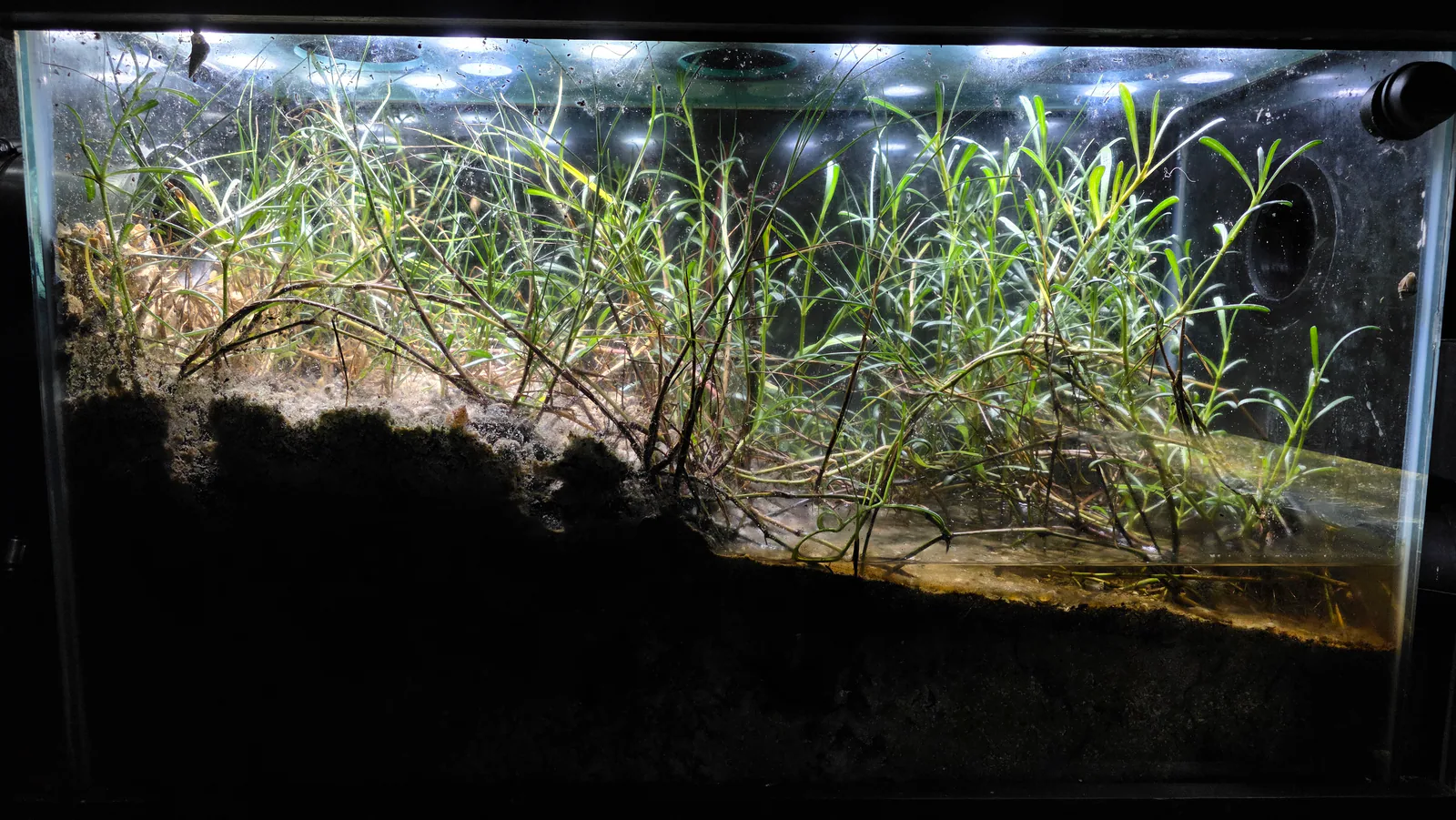
Littoraria angulifera

Mangrove Periwinkle

Found on hard surfaces in the Marine Shore, this small intertidal snail grazes algae and biofilm from coastal substrates and climbs above the waterline between tide cycles.

Overview

Mangrove Periwinkle (Littoraria angulifera) are small intertidal snails that live on hard surfaces above the waterline in mangrove and coastal habitats, grazing algae, biofilm, and surface films from bark, rock, and other substrates. Approximately eight individuals were introduced to the miniBIOTA Marine Shore on June 4, 2026, identified by Josue as a candidate for the intertidal nutrient-transfer role along the coastal edge. No follow-up behavior has been observed as of June 2026. The species identification is Likely based on field identification; no independent expert verification has been recorded. Population status is Uncertain with establishment, persistence, and reproduction all unconfirmed.

Identity

  • Common name: Mangrove Periwinkle
  • Alternate names: angular periwinkle, mangrove littorina, mangrove snail
  • Scientific name: Littoraria angulifera
  • Identification confidence: Species identification Likely; field ID by Josue during June 4, 2026 observation intake; no independent expert verification recorded
  • Uncertainty label: Likely

Taxonomy

  • Kingdom: Animalia
  • Phylum: Mollusca
  • Class: Gastropoda
  • Order: Littorinimorpha
  • Family: Littorinidae
  • Genus: Littoraria
  • Species: angulifera

Natural History

Range and Florida Relevance

Littoraria angulifera is native to subtropical and tropical coastal habitats along the Atlantic coast of the Americas and the Gulf of Mexico, from South Florida through the Caribbean and along the Atlantic coast of South America to Brazil. In the United States, it is found primarily in South Florida, where it is closely associated with red mangrove habitat. This species does not range as far north as its congener the Marsh Periwinkle (L. irrorata), which extends into the Mid-Atlantic states along Spartina salt marshes. The Florida populations of L. angulifera occur in the same mangrove-dominated coastal zones where miniBIOTA sources many of its saltwater organisms.

Habitat

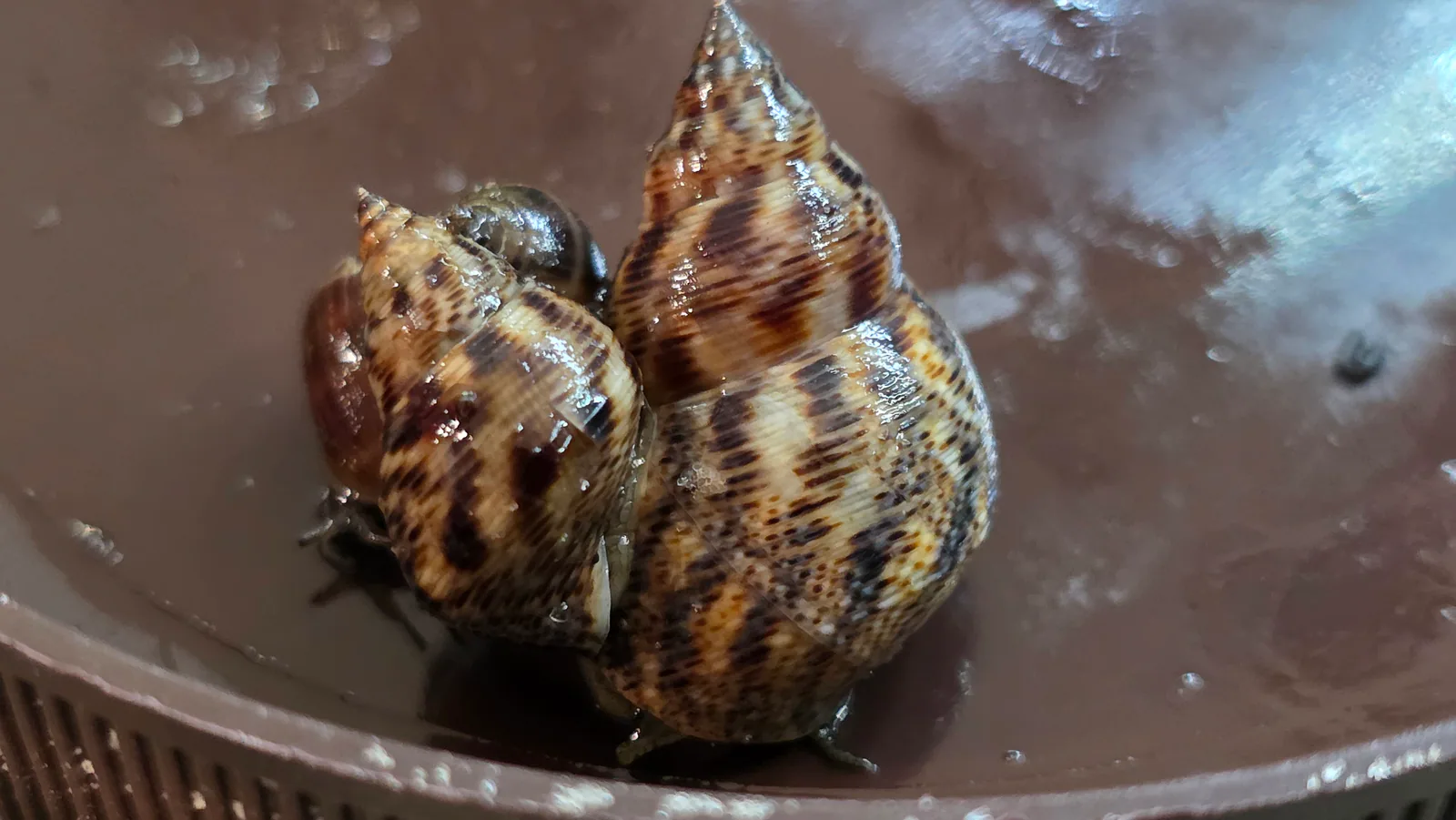
Mangrove Periwinkles live on hard surfaces above the waterline. In natural habitats they are most abundant on the bark and prop roots of red mangroves, where they form visible clusters and graze the thin surface films of algae and microorganisms growing on the wood. They also occur on rock faces, wooden pilings, and other hard coastal substrates. The characteristic behavior of this species is climbing: individuals move up their substrate when tides rise and descend again during low water to graze. They spend most of their time in air rather than submerged. The shell is conical with a somewhat angular spire, typically 1 to 2.5 centimeters, and varies in color from gray and brown to cream with spiral patterning.

Diet

Mangrove Periwinkles graze algae, biofilm, diatoms, cyanobacteria, and surface fungi from hard substrates. They use a radula, a rasping tongue-like structure, to scrape thin microorganism films from bark, rock, and wood. This surface grazing is the primary ecological function of the species in mangrove systems, where it helps control algal and microbial accumulation on tree roots and bark. No feeding behavior has been directly observed in miniBIOTA as of June 2026.

Reproduction

Littoraria angulifera is a broadcast spawner. Adults release eggs and sperm into the water column, where fertilization occurs. Larvae pass through a planktonic veliger stage before settling onto hard substrates. Reproduction in similar littorinids is often correlated with warmer water temperatures and may show seasonal patterns. No reproduction has been observed in miniBIOTA as of June 2026. The founding group of approximately eight individuals is small relative to what would typically support consistent breeding activity.

Tolerance Ranges

Mangrove Periwinkles are adapted to full marine salinities and the subtropical temperature range typical of South Florida coastal environments. They tolerate extended air exposure above the waterline, which is a basic requirement of their intertidal lifestyle. The species is regularly found in areas with strong wetting and drying cycles. No miniBIOTA-specific tolerance measurements have been taken.

Ecological Role

In natural mangrove systems, Littoraria angulifera plays an important surface maintenance role. By grazing algae, biofilm, and microorganism films from mangrove bark and prop roots, it reduces surface competition for young mangrove tissues and recycles that microbial biomass into the food web. At high population densities, littorinid snails can significantly influence which microorganisms persist on mangrove surfaces. Their droppings and body waste also return organic matter to the substrate and water below.

In miniBIOTA, the Mangrove Periwinkle is introduced to the Marine Shore as a candidate for the intertidal grazing role on hard surfaces along the coastal edge. The observer noted at introduction that this species was being evaluated for its potential to move biological activity between aquatic and terrestrial surfaces, with the expectation that direct observation would determine whether it establishes successfully. No predators have been observed in miniBIOTA. In natural habitats, predators include wading birds, fish during brief submersion, and potentially crabs. No symbiotic relationships have been documented in miniBIOTA.

miniBIOTA Evidence

Introduction

Approximately eight Mangrove Periwinkle snails were collected and introduced to the Marine Shore on June 4, 2026. At the time of introduction, the observer noted that this was a new species for miniBIOTA, that the intertidal nutrient-transfer role along the coastal edge was an active search area, and that it was uncertain which species would ultimately establish. Video was recorded. The observer planned to introduce the snails and observe their behavior directly rather than predict the outcome in advance. No follow-up observations have been recorded as of June 2026.

Observation Timeline

  • June 4, 2026: Introduction. Approximately eight individuals collected and introduced to the Marine Shore. Observer noted them as candidates for the intertidal nutrient-transfer role. Video documented.

What Is Confirmed

  • Introduction of approximately eight individuals on June 4, 2026.
  • Video documentation of the introduction.
  • Field identification as Littoraria angulifera by Josue on June 4, 2026.

What Is Inferred

  • The species' published biology makes it a reasonable candidate for the intertidal grazing role along the Marine Shore edge.
  • A group of eight is a small founding population and may not be sufficient for long-term persistence or breeding.

What Remains Unknown

  • Whether the eight individuals are still present and active in the Marine Shore.
  • Whether any grazing behavior has occurred on Marine Shore substrates.
  • Whether the species will establish, persist, or reproduce in miniBIOTA.
  • The collection source location.