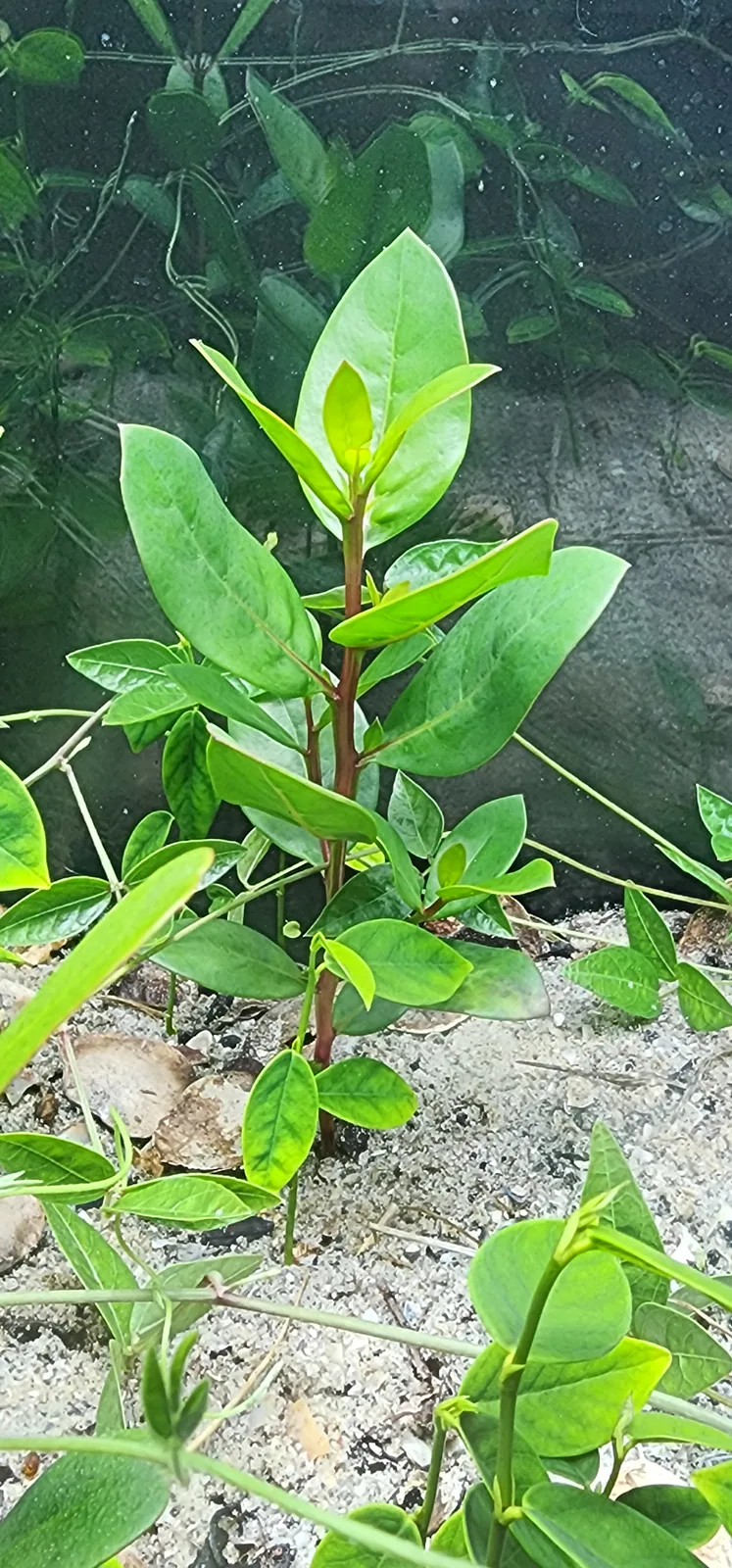
Avicennia germinans

Black Mangrove

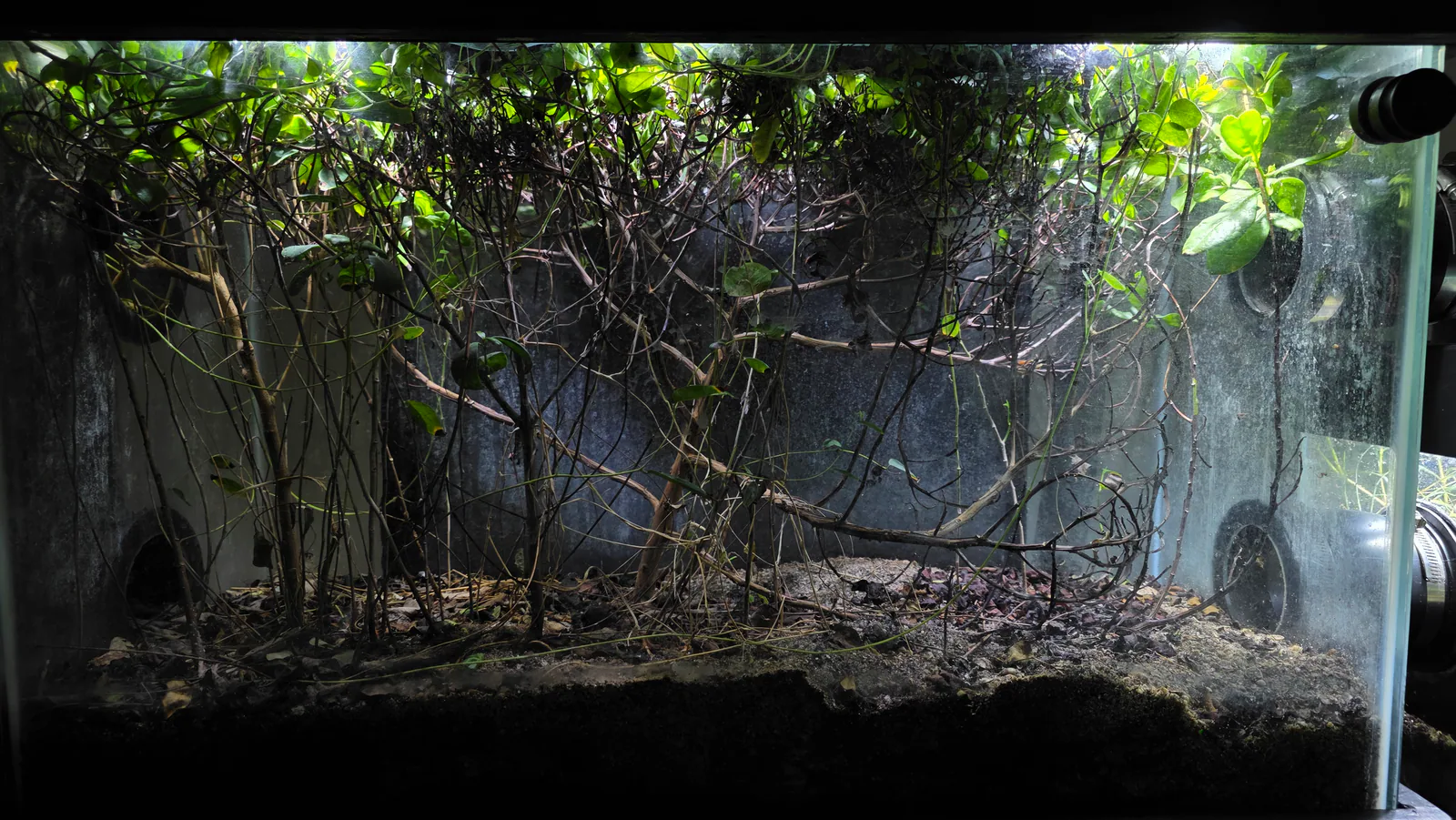
Growing between Red and White Mangrove in miniBIOTA's Mangrove Forest, Black Mangrove sends fields of pencil-like breathing roots upward through the substrate around its base and excretes visible salt crystals through pores on both leaf surfaces.

Visual Data Unavailable

Overview

Black Mangrove occupies the mid-zone of miniBIOTA's Mangrove Forest between the outermost Red Mangrove and the uppermost White Mangrove, and is the most cold-tolerant of the three. Its two defining features are the field of pencil-like pneumatophore roots that project upward from the sediment around its base and the leaves that actively excrete salt through surface pores, often leaving a visible crystalline coating. No dedicated observation records exist for this species; it is present as a founding structural component of the Mangrove Forest.

Identity

  • Common name: Black Mangrove
  • Alternate names: black mangle, honey mangrove, estero negro
  • Scientific name: Avicennia germinans
  • Identification confidence: Species-level
  • Uncertainty label: Confirmed

Taxonomy

  • Kingdom: Plantae
  • Phylum: Tracheophyta
  • Class: Magnoliopsida
  • Order: Lamiales
  • Family: Acanthaceae
  • Genus: Avicennia
  • Species: A. germinans

Natural History

Avicennia germinans is distributed from Florida south through the Caribbean basin and along both coasts of Central and South America, with populations also present in West Africa. It is one of three mangrove species protected under Florida state law. Of the three Florida mangroves, Black Mangrove extends furthest north, into areas where winter freezes periodically occur, because it can resprout from the base after freeze damage in a way Red Mangrove and White Mangrove cannot. Its cold tolerance is reflected in its ability to dominate the mid-intertidal zone across a broad geographic range.

The defining structural feature is the pneumatophore field: hundreds of slender, pencil-like vertical roots 10 to 30 centimeters tall that project upward from the sediment surface in a ring around the tree. These roots absorb oxygen from the air through lenticel pores, supplying the root system in the otherwise anaerobic substrate. In natural settings, the pneumatophore field traps sediment and supports algae, small invertebrates, and periwinkle snails that climb the roots to avoid submersion during tidal flooding.

Salt management in Black Mangrove is active and visible: specialized salt glands in the epidermis of both leaf surfaces excrete salt ions directly through the leaf. In salt-stressed conditions the leaves appear whitish, grayish, or lightly crystalline on both surfaces. This excretion mechanism is shared with White Mangrove and contrasts with Red Mangrove, which excludes salt at the root rather than excreting it at the leaf surface. The leaves are elliptical to oval, opposite, and dark green on the upper surface.

Black Mangrove flowers are small, white, and fragrant, producing nectar that attracted bees in Florida's coastal habitat, which accounts for the "honey mangrove" common name. Propagules are viviparous, germinating on the parent tree, but less dramatically elongated than Red Mangrove's pendant hypocotyl. Seedlings establish in the mid-intertidal zone. Black Mangrove can reach 15 to 20 meters in height in protected stands but is often shorter in exposed or marginal conditions.

Ecological Role

In the Mangrove Forest, Black Mangrove occupies the structural middle layer between the water-adjacent Red Mangrove and the upland-fringe White Mangrove. Its leaf litter contributes to the same detrital pathway fed by all three mangroves: Florida Woods Cockroaches, Surinam Cockroaches, isopods, and millipedes process fallen leaves on the forest floor. The pneumatophore field creates vertical substrate for organisms that climb or attach to surfaces; in Florida's natural mangrove systems, Marsh Periwinkles (Littoraria irrorata), algae, and sessile invertebrates use the pneumatophore surfaces, though these interactions depend on tidal flooding cycles not present in miniBIOTA's enclosed system.

Sediment trapping by the pneumatophore field contributes to substrate accumulation in natural coastal mangrove forests. In miniBIOTA's constructed habitat, this function is limited but the root structure itself provides physical complexity to the substrate layer.

miniBIOTA Evidence

Introduction context: No introduction event is formally recorded. Introduction method, source, and date of first introduction are all not documented. Black Mangrove was present at or near the founding of the Mangrove Forest (established December 10, 2023) and is treated as a structural component of the biome rather than an individually tracked introduction.

Observation record:

  • No dedicated observation records exist for Black Mangrove. The species has no last-observed date on record.
  • Black Mangrove is referenced in biome-level documentation as one of three structural mangrove species, but no individual-focused observation records have been filed.

Confirmed:

  • Black Mangrove present as a structural component of the Mangrove Forest; documented in biome records
  • Species-level identification (Avicennia germinans) is confident from morphology and habitat context

Inferred:

  • Leaf litter production contributing to the Mangrove Forest detrital pathway
  • Pneumatophore field present in the mid-zone substrate, providing physical complexity

Unknown:

  • Current tree count, height, canopy health, and growth state
  • Whether the pneumatophore field is visible and intact in the current substrate
  • Exact introduction date and source