Aratus pisonii

Mangrove Tree Crab

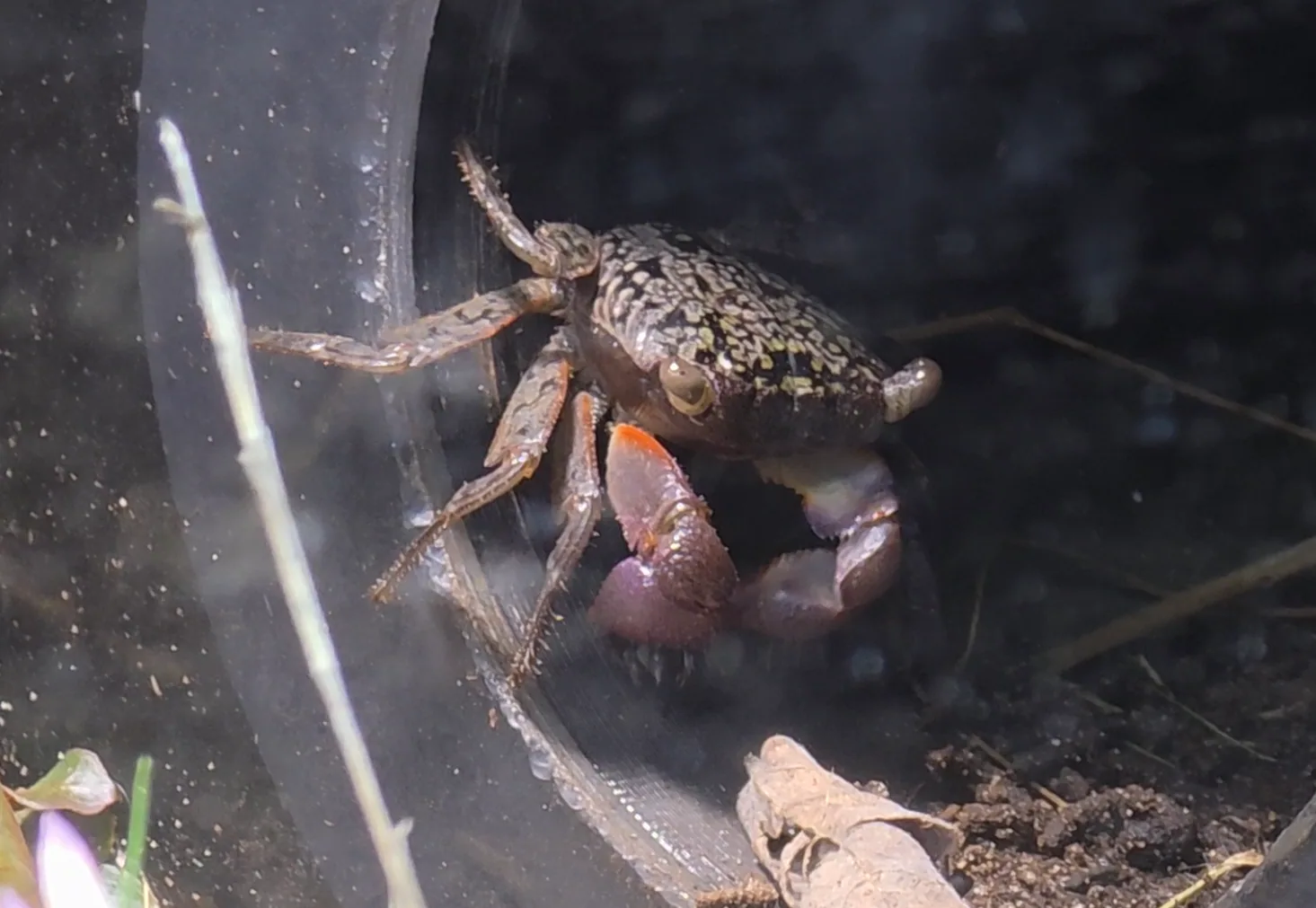
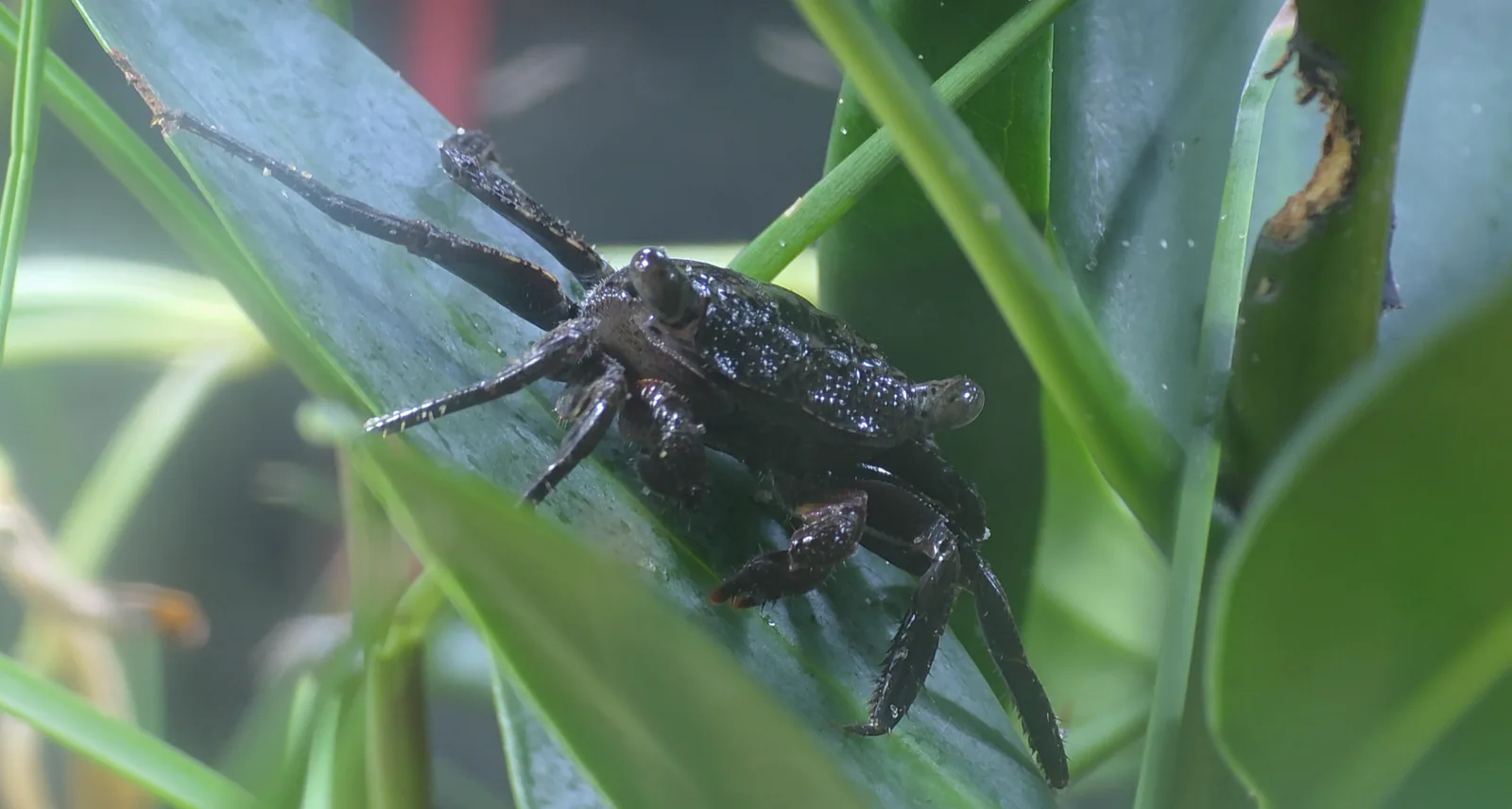
Found climbing through mangrove branches and shoreline vegetation in the Marine Shore, this small arboreal crab feeds on red mangrove leaves, fallen leaf litter, and detritus while ranging freely between Mangrove Forest and Lakeshore edges.

Overview

Found climbing through mangrove branches and shoreline vegetation in the Marine Shore, this small arboreal crab feeds on red mangrove leaves, fallen leaf litter, and detritus while ranging freely between the Mangrove Forest and Lakeshore edges. Six individuals were introduced on June 4, 2026, the first confirmed true Mangrove Tree Crabs in miniBIOTA after a long-established crab was identified as a separate species.

Identity

  • Common name: Mangrove Tree Crab
  • Scientific name: Aratus pisonii
  • Identification confidence: Confirmed. Identified by Josue directly from the June 4, 2026 collection.
  • Uncertainty label: Likely. Species ID is solid; ecological role and long-term establishment in miniBIOTA remain unresolved.

Taxonomy

  • Kingdom: Animalia
  • Phylum: Arthropoda
  • Class: Malacostraca
  • Order: Decapoda
  • Family: Sesarmidae
  • Genus: Aratus
  • Species: A. pisonii

Natural History

Range and Florida Relevance

Aratus pisonii is native to mangrove systems throughout the tropical and subtropical Western Atlantic, from Florida south through the Caribbean and into South America. In Florida, it is a common resident of red mangrove (Rhizophora mangle) stands along coastal edges, estuaries, and tidal shorelines. It is one of the few truly arboreal crabs, spending most of its time in the canopy and branches of mangrove trees rather than on the ground or in the water.

Habitat

The Mangrove Tree Crab is highly mobile across vertical and horizontal space. It climbs mangrove trunks, roots, branches, and overhanging vegetation, and moves freely between adjacent terrestrial edges. While primarily associated with red mangrove canopy, it also forages on the ground among leaf litter and shoreline debris. It tolerates a wide salinity range and does not require submersion, making it more of a terrestrial-edge species than a fully aquatic one.

Diet

The primary diet is red mangrove leaves, including live foliage, fallen brown leaves, and leaf litter in various stages of decomposition. Aratus pisonii also grazes algae, biofilm, and surface growth on mangrove bark and prop roots, and will scavenge detritus and organic scraps. It occasionally feeds on invertebrates opportunistically. Its feeding activity on mangrove leaves makes it an early processor in the mangrove detritus chain, breaking down leaf material before it reaches the sediment.

Reproduction

Females brood eggs under the abdomen, as with most crabs. Larvae are released into the water as zoea and go through pelagic development before settling. Reproduction in miniBIOTA has not been observed and is not expected in the short term given the small founding group and uncertain conditions. Specific lifespan data for miniBIOTA populations is unknown.

Tolerance Ranges

Aratus pisonii is a hardy species tolerant of a wide salinity range, from near-freshwater to full marine conditions, reflecting its mangrove edge habitat where salinity fluctuates with tides and rain. It is also tolerant of air exposure and temperature variation typical of Florida's intertidal and shoreline environments. Specific tolerance ranges for temperature, pH, and flow in miniBIOTA conditions have not been measured.

Ecological Role

Aratus pisonii is a mobile detritivore and opportunistic herbivore that connects canopy, shoreline, and terrestrial edges through its movement and feeding. By consuming mangrove leaves at multiple stages of decomposition and depositing waste across biomes, it contributes to cross-biome nutrient redistribution. Its grazing of algae and biofilm from mangrove bark and prop roots adds a cleaning function to hard coastal surfaces.

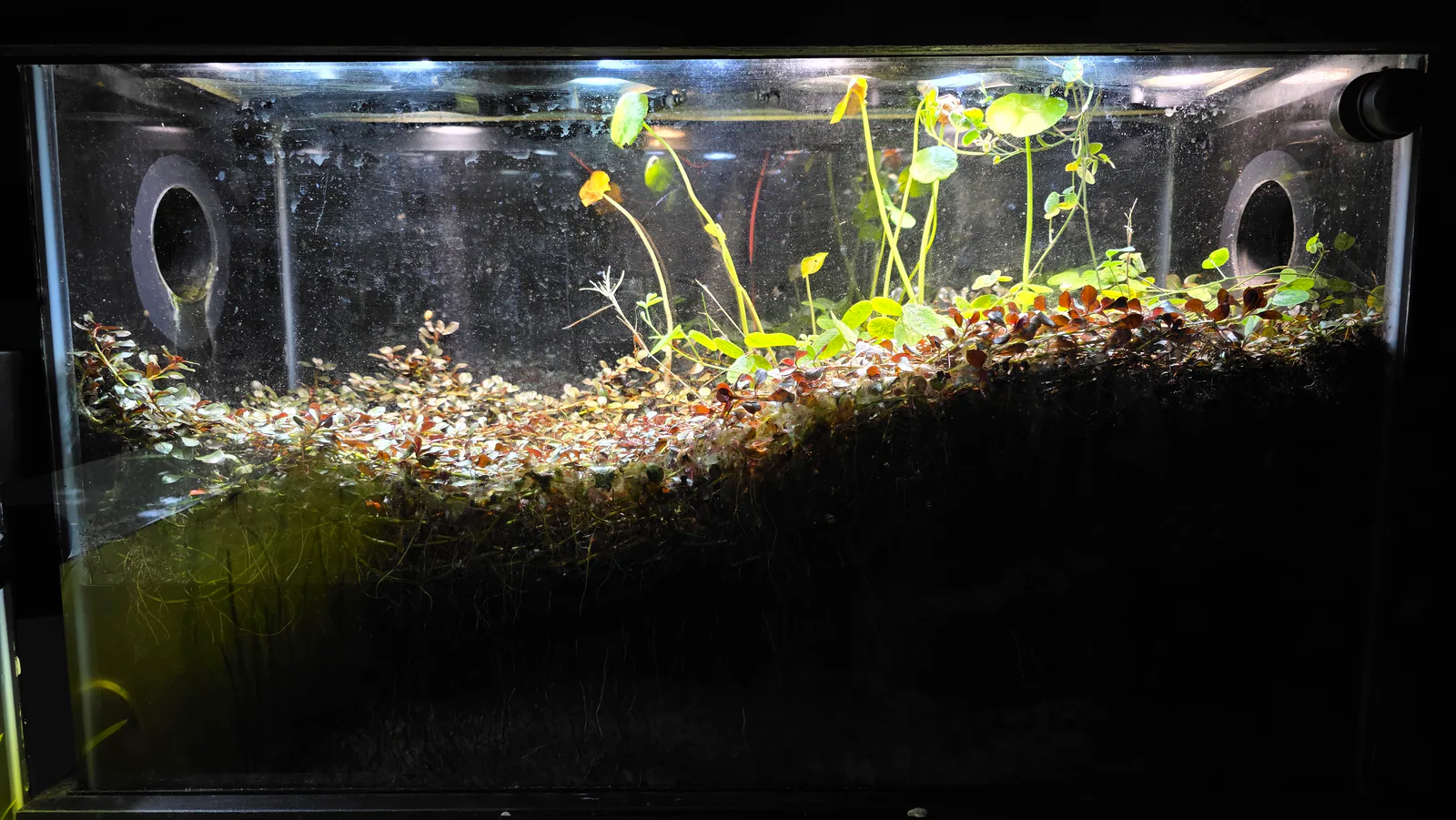
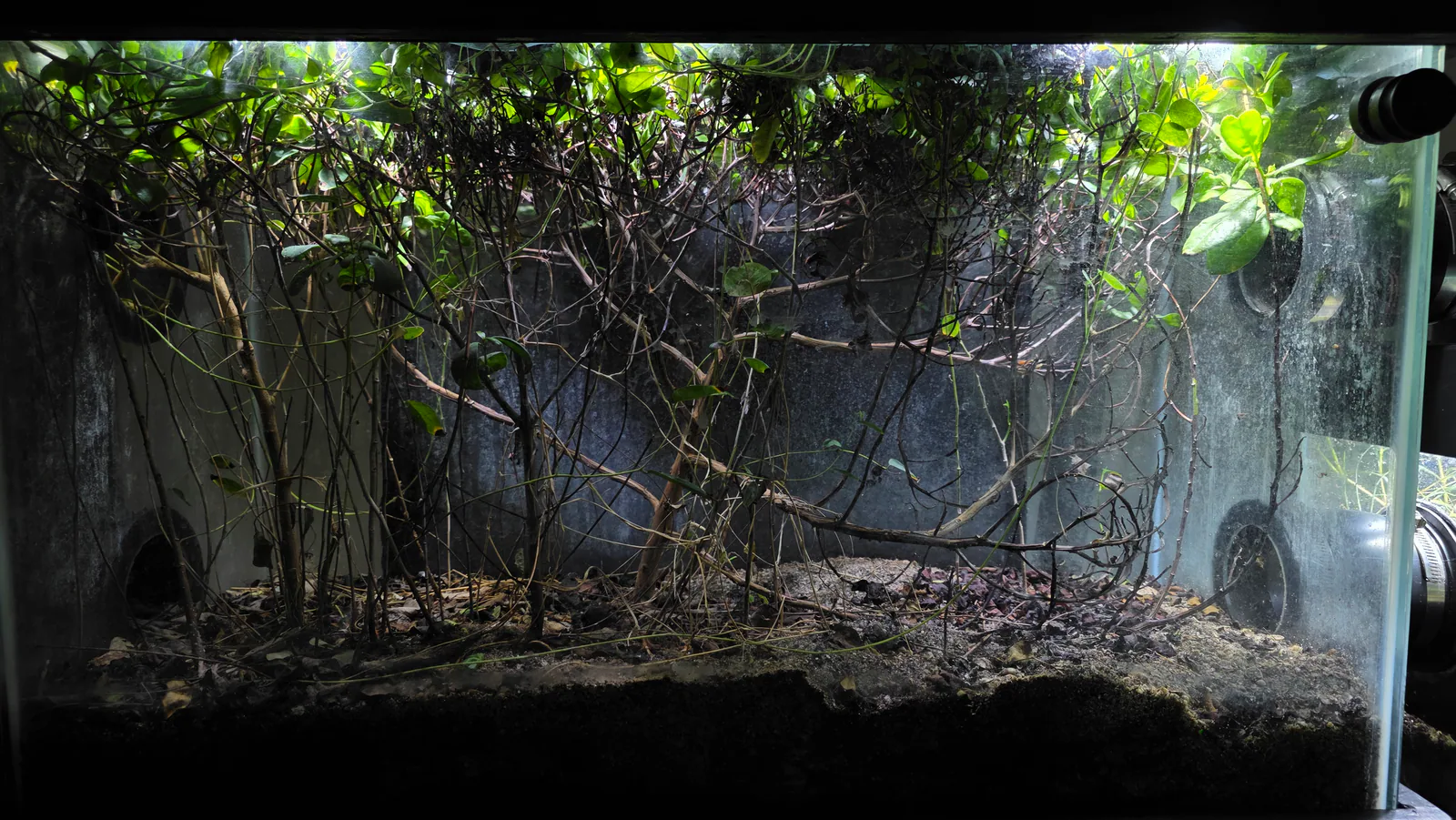
In miniBIOTA, the group has been observed using Marine Shore as their primary base while ranging into Mangrove Forest canopy and Lakeshore terrestrial areas. Within less than a week of introduction, individuals were documented climbing actively, feeding on fallen leaves and red mangrove vegetation, and using vertical space more freely than other crab species observed in the system. This cross-biome movement makes them potentially useful for processing organic matter across connected terrestrial and coastal zones, though nutrient redistribution at the ecosystem scale has not been measured.

Closed-system considerations: Mangrove Tree Crabs are active climbers and may access areas outside expected zones. Their leaf feeding directly impacts living red mangrove vegetation, which should be watched. Population size is currently small enough that grazing pressure is low.

miniBIOTA Evidence

Introduction

Six true Mangrove Tree Crabs were collected and introduced to the Mangrove Forest on June 4, 2026. Their introduction also served as the identity-correction anchor, clarifying that the long-established crab was a different species.

Observation Timeline

  • June 4, 2026: Six individuals introduced to the Mangrove Forest. Introduction noted alongside identity correction for the long-established crab now routed as Humic Marsh Crab.
  • June 9, 2026: Group documented primarily in Marine Shore with movement into Mangrove Forest and Lakeshore terrestrial areas. Observed behaviors include climbing through canopy and vegetation, perching on red mangrove, grazing red mangrove leaves, feeding on fallen brown leaves and detritus, and using vertical space freely. Video documented.
  • June 11, 2026: One Mangrove Tree Crab observed in the lakeshore biome in a multi-species interaction with two Caribbean hermit crabs and one Humic Marsh Crab (Armases ricordi). No aggression between any individuals; buffer spacing maintained throughout. The four crabs passed sequentially through a narrow passage toward the lowland meadow. Approximately 13-14 minutes of video documented. Most recent confirmed lakeshore observation.
  • June 22, 2026: One individual found in the Lowland Meadow; four observed individuals remained in the coastal biome. The sixth individual was not accounted for in this observation. Cross-biome ranging continues more than two weeks after the June 4, 2026 introduction. Whether the individual in the Lowland Meadow is locating food and shelter resources there or passing through has not been established. Observation record, June 22, 2026.
  • June 26, 2026: Crabs directly observed scraping and consuming tissue from silverhead leaves and picking material from seashore paspalum stems, extending the confirmed diet beyond red mangrove to include both of these co-occurring Marine Shore plants. The red mangrove has been consumed to the point where recovery is uncertain; the species' naturally slow growth rate suggests current grazing pressure may exceed regenerative capacity. Fecal pellets distributed across various surfaces confirm the crabs are actively feeding and obtaining sufficient nutrition from available resources. Observation record, June 26, 2026.

What Is Confirmed

  • Six Aratus pisonii introduced June 4, 2026.
  • Active use of Marine Shore, Mangrove Forest, and Lakeshore edges within the first five days.
  • Observed feeding on fallen leaves, detritus, and red mangrove vegetation.
  • Confirmed climbing and canopy use, consistent with species natural history.
  • Observed in close proximity to Caribbean hermit crabs and Humic Marsh Crab in the lakeshore on June 11, 2026, with no aggression and sequential passage through a bottleneck.
  • Cross-biome ranging confirmed again June 22, 2026: one individual in the Lowland Meadow, four in the coastal biome. Sixth individual not accounted for in this observation.
  • Mangrove Tree Crabs directly observed consuming silverhead leaf tissue and seashore paspalum stems on June 26, 2026.
  • Fecal pellets distributed across various surfaces confirmed June 26, 2026, consistent with active and sustained feeding.

What Is Inferred

  • Cross-biome movement likely redistributes organic matter across Marine Shore, Mangrove Forest, and Lakeshore edges.
  • Leaf feeding contributes to early-stage decomposition of mangrove leaf litter.

What Remains Unknown

  • Whether all six individuals are still present and surviving.
  • Whether the group will persist long-term in miniBIOTA conditions.
  • Whether the red mangrove will recover from current grazing pressure given its naturally slow growth rate.
  • Whether continued Mangrove Tree Crab grazing will drive red mangrove decline or loss from the biome.
  • Whether reproduction is possible in this system.
  • Long-term biome use and ranging patterns.