Coenobita clypeatus

Caribbean Hermit Crab

Ranging freely across the Mangrove Forest, Lowland Meadow, Lakeshore, and Marine Shore, this large land hermit crab feeds on fallen mangrove leaves, preys on land snails, and scavenges animal carcasses through the terrestrial biome network.

Visual Data Unavailable

Overview

Ranging freely across the Mangrove Forest, Lowland Meadow, Lakeshore, and Marine Shore, this large land hermit crab feeds on fallen mangrove leaves, preys on land snails, and scavenges animal carcasses through the terrestrial biome network.

Identity

  • Common name: Caribbean Hermit Crab
  • Alternate names: Land hermit crab, purple pincher, purple claw hermit crab, soldier crab
  • Scientific name: Coenobita clypeatus
  • Identification confidence: Species-level; Coenobita clypeatus is the dominant large land hermit crab of the Caribbean and southeastern Florida
  • Uncertainty label: Observed

Taxonomy

  • Kingdom: Animalia
  • Phylum: Arthropoda
  • Class: Malacostraca
  • Order: Decapoda
  • Family: Coenobitidae
  • Genus: Coenobita
  • Species: Coenobita clypeatus

Natural History

Coenobita clypeatus is the largest and most widespread land hermit crab species in the Caribbean and Gulf Coast region, ranging from Florida and the Bahamas through the Lesser Antilles and coastal South America. In Florida, it is native to the Keys and the southeastern coastal fringe, where it inhabits tropical hammocks, shoreline vegetation, beaches, and mangrove edges. It is primarily nocturnal, foraging broadly for leaf litter, fruit, detritus, carrion, fungi, and occasionally small live animals. The species is a generalist omnivore adapted to the full range of organic material available in coastal terrestrial habitats.

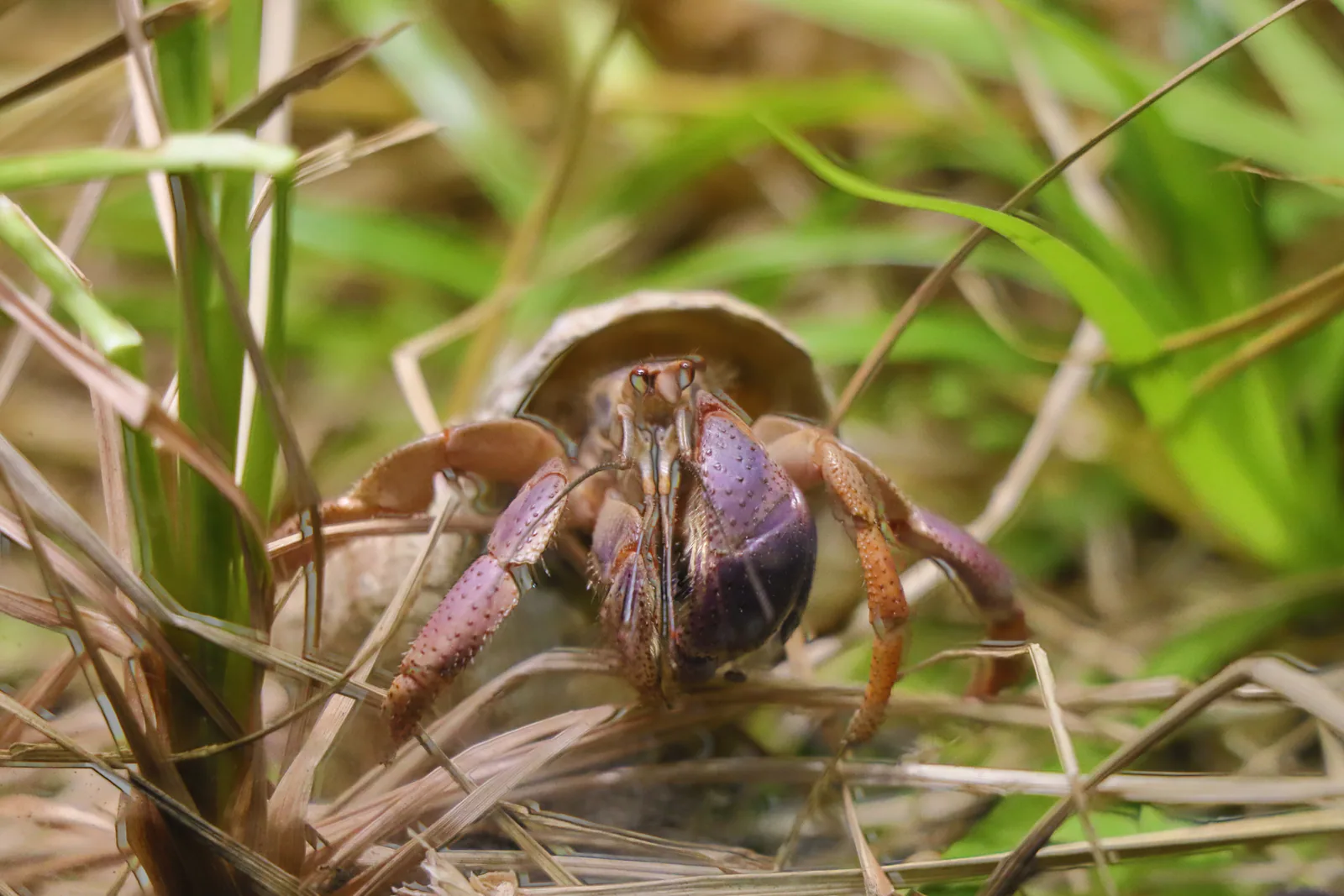
The defining feature of all hermit crabs is their dependence on empty gastropod shells to protect the soft, unarmored abdomen. Coenobita clypeatus selects and upgrades shells throughout its life as the body grows, searching for larger shells and sometimes competing with or displacing other hermit crabs. Without an adequate shell, the crab's abdomen is vulnerable to desiccation and physical damage. The left claw is enlarged and shaped to seal the shell opening when the crab withdraws, giving the species its common name "purple pincher" from the distinctive purple-violet coloration of that claw.

Despite being fully terrestrial as adults, Caribbean Hermit Crabs have an obligate marine larval stage. Gravid females must travel to the ocean, where they release eggs at the waterline. Larvae develop through planktonic marine stages before metamorphosing into small juvenile crabs that emerge onto land. This means the species cannot reproduce in any closed terrestrial system without direct ocean access; established adults in miniBIOTA are permanent non-reproducing residents.

Caribbean Hermit Crabs are long-lived; individuals in captivity have survived 20-30 or more years with proper care. They are social in the sense that they tolerate heterospecific and conspecific proximity without consistent aggression, particularly in areas with abundant food or shared movement corridors.

Ecological Role

As wide-ranging omnivores and scavengers, Caribbean Hermit Crabs play a meaningful role in nutrient cycling across multiple biome types. They consume dead plant material, processing fallen leaves into fragments available to soil decomposers. They prey on slower-moving invertebrates, connecting the land snail population to the predator guild. They scavenge animal carcasses, converting dead biomass into hermit crab tissue and waste that re-enters the nutrient cycle. Their movement across four biomes means these nutrient transfers occur across the full breadth of the terrestrial realm rather than being confined to a single zone.

In miniBIOTA, the Caribbean Hermit Crab is the most thoroughly documented wide-ranging omnivore in the terrestrial realm. Confirmed feeding records in miniBIOTA span fallen mangrove leaves in the Mangrove Forest, a live Southern Flatcoil snail in the Lowland Meadow, and the carcass of the female Ridgeback Sand Grasshopper in the Lowland Meadow after her death in June 2026. Each feeding event confirmed a distinct trophic role: leaf detritivore, active predator, and carcass scavenger. The lakeshore functions as a shared movement corridor with other crab species; a June 2026 observation documented two Caribbean Hermit Crabs navigating the lakeshore alongside Mangrove Tree Crabs and a Humic Marsh Crab without any aggression, passing through a narrow bottleneck sequentially.

The crab's presence across all four terrestrial and coastal biomes makes it one of the most spatially connected species in the system, physically linking nutrient pools that are otherwise separated by biome boundaries.

miniBIOTA Evidence

The Caribbean Hermit Crab was present in miniBIOTA prior to the earliest archived observation. The introduction date, source, and introduction method are unrecorded. The earliest archived observation (April 3, 2025) describes the crab as already spending "much of its time" in the Mangrove Forest, implying an established pattern prior to the observation records start. Two individuals were confirmed present in the June 11, 2026 multi-species Lakeshore observation; total population is unknown.

Introduction: Unknown; pre-dates the observation record. Earliest archived observation April 3, 2025.

Observation timeline:

  • April 3, 2025: Caribbean Hermit Crab documented foraging on fallen mangrove leaves in the Mangrove Forest alongside the Humic Marsh Crab
  • April 6, 2025: Observed exploring the Marine Shore biome for the first time
  • April 23, 2025: Confirmed eating a live Southern Flatcoil snail in the Lowland Meadow; the observation notes this "confirms snails as a protein source"
  • June 11, 2026: Two Caribbean Hermit Crabs observed in the Lakeshore in a multi-species interaction with one Mangrove Tree Crab and one Humic Marsh Crab; no aggression; approximately 13-14 minutes of video; crabs passed sequentially through a narrow passage toward the Lowland Meadow
  • June 13, 2026: Caribbean Hermit Crab observed actively scavenging the carcass of the female Ridgeback Sand Grasshopper in the Lowland Meadow; carcass condition suggested the grasshopper had died prior to being found

Confirmed:

  • Foraging on fallen mangrove leaves in the Mangrove Forest
  • Exploring the Marine Shore (first recorded April 6, 2025)
  • Active predation on a live Southern Flatcoil snail in the Lowland Meadow
  • Scavenging the Ridgeback Sand Grasshopper carcass in the Lowland Meadow, June 13, 2026
  • Multi-biome ranging across Mangrove Forest, Marine Shore, Lowland Meadow, and Lakeshore
  • At least 2 individuals present as of June 11, 2026
  • Behavioral tolerance for multi-species crab proximity without aggression

Inferred:

  • Consuming additional leaf litter, fruit, and organic debris beyond directly observed events
  • Foraging across the biome network on a regular rather than incidental basis
  • Contributing nutrient input to each biome through waste deposition during ranging

Unknown:

  • Total population size
  • Introduction date, source, and method
  • Whether population numbers are stable, increasing, or declining
  • Shell shell shell availability and adequacy in the terrestrial biome