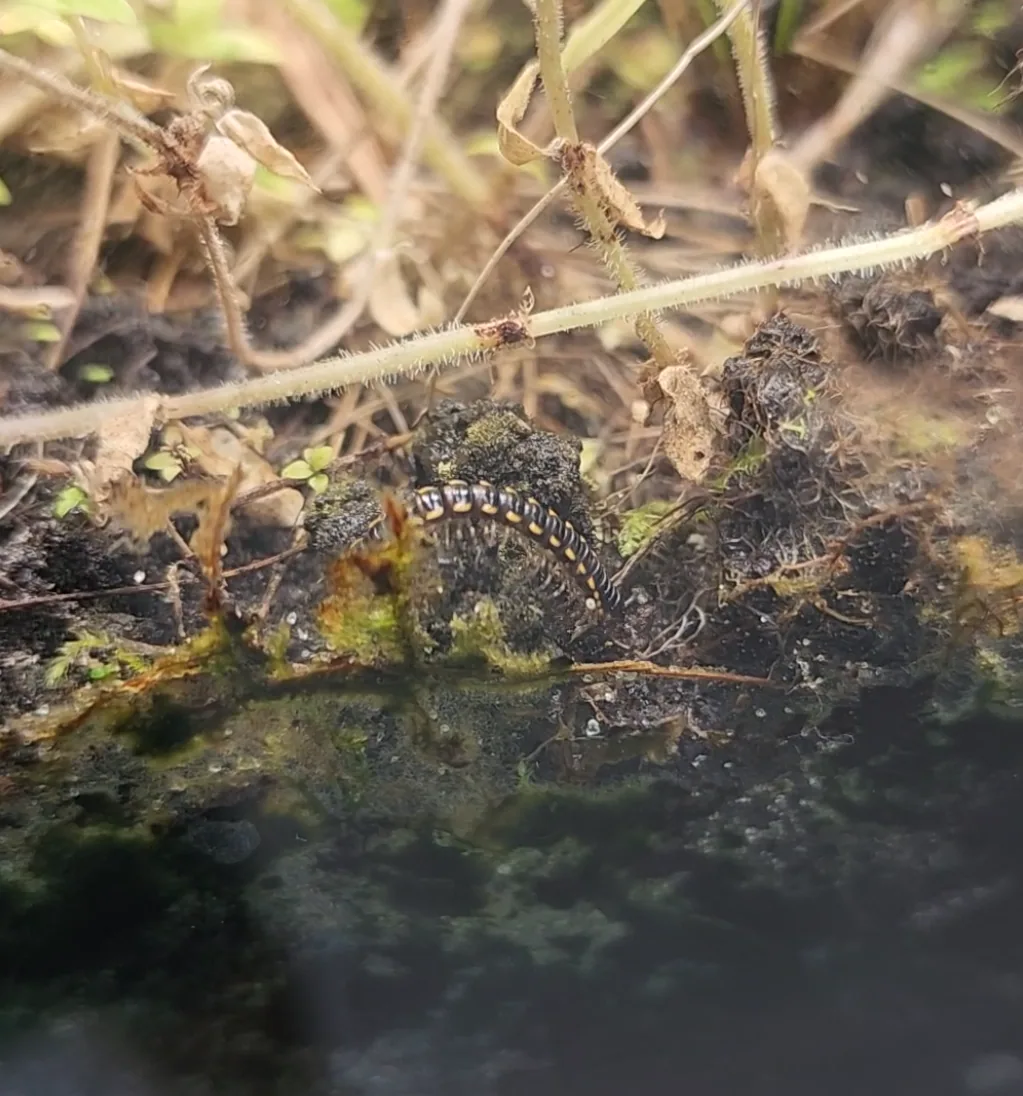
Oxidus gracilis (flat-backed millipede, garden millipede) is a small polydesmid millipede native to East Asia and now widely established in tropical and subtropical regions globally through the horticultural and greenhouse trade. Adults typically reach 18 to 22 mm in length. The body is distinctly flattened dorso-ventrally, with prominent lateral paranota (keels) projecting from each body segment; this flattened profile is the most visible feature separating O. gracilis from the cylindrical spirobolid millipedes (such as the Rusty Millipede). Coloration is typically dark brown to grayish-black, with pale to cream or reddish-orange margins on the paranota. The flattened body shape is characteristic of the order Polydesmida and allows these millipedes to press tightly against substrate surfaces when disturbed.
O. gracilis is a detritivore, feeding on decaying plant matter, fungi, and soft organic debris in the leaf-litter layer and moist soil. It is strongly associated with moist microhabitats and is desiccation-sensitive, retreating under debris, bark, or into soil during dry conditions. In South Florida gardens and disturbed moist habitats, O. gracilis is one of the most commonly encountered millipede species, often found under potted plants, leaf litter, wood debris, and organic mulch.
As a member of the order Polydesmida, O. gracilis possesses ozopores on the paranota connected to defense glands capable of producing hydrogen cyanide (HCN). When disturbed, the millipede may release this chemical defense, which deters many invertebrate predators. The effectiveness of this defense varies with predator size and species.
Unlike Trigoniulus corallinus, which coils into a tight cylinder when threatened, O. gracilis typically flattens against the substrate rather than conglobating. This difference in defensive posture reflects the fundamental body-plan difference between the two orders.