
Cladocera sp. (unidentified)

Unidentified Tiny Daphniid

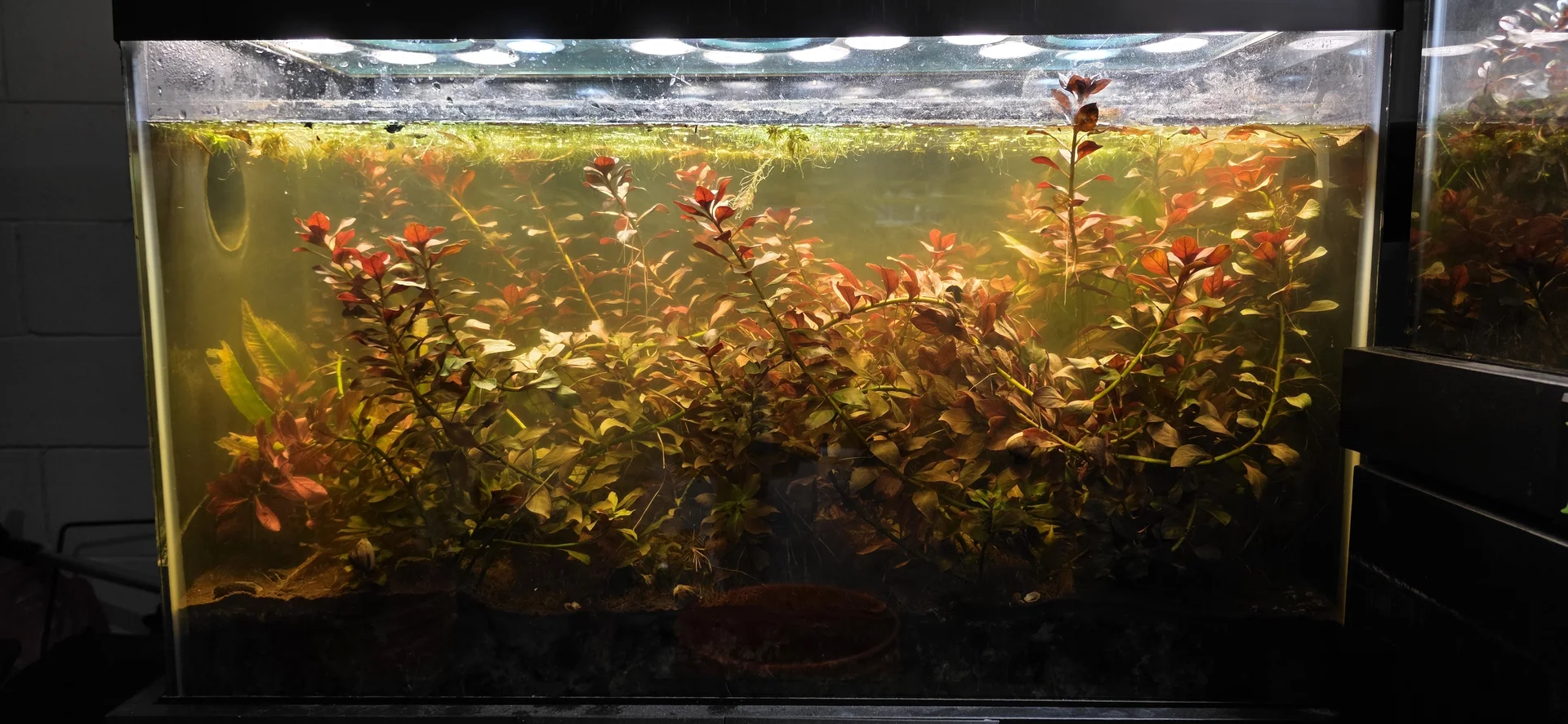
An unidentified Daphnia-like microcrustacean present in thousands in the Freshwater Lake, clustering near the water surface by day and dispersing to feed through the water column at night, diving rapidly when illuminated; egg-bearing individuals observed on May 21, 2026 distinguish it from the larger Moina population.
Visual Data Unavailable

Overview

This species record covers a tiny, currently unidentified Daphnia-like microcrustacean first distinguished from Moina on May 21, 2026, when close inspection revealed that very small individuals were already carrying eggs, ruling out the initial interpretation that they were juvenile Moina. Thousands are present in the Freshwater Lake, clustering near the water surface by day and dispersing through the water column at night with strong light-avoidance behavior. Identity is unresolved and requires sampling and microscopic examination.

Identity

  • Common name: Unidentified Tiny Daphniid
  • Alternate names: tiny daphniid, tiny Daphnia-like microcrustacean, small water flea, unidentified water flea, Daphnia-like organism
  • Scientific name: Cladocera sp. (unidentified)
  • Identification confidence: Unknown. Genus, family, and species are all unresolved. Order Cladocera is assumed from body form and egg-carrying behavior
  • Uncertainty label: Possible

Taxonomy

  • Kingdom: Animalia
  • Phylum: Arthropoda
  • Class: Branchiopoda
  • Order: Cladocera
  • Family: Unknown
  • Genus: Unknown
  • Species: Unknown

Natural History

This organism is an unidentified member of the order Cladocera, the water fleas, a diverse group of small freshwater crustaceans that includes Daphnia, Moina, Bosmina, and many other genera. They are distinguished from each other by body proportions, head shape, carapace structure, and antenna form, features that require microscopic examination to resolve with confidence. Based on observed egg-bearing behavior, this organism is a direct developer: eggs are retained within a brood pouch in the adult body and released as miniature juveniles rather than as free-swimming larvae.

Beyond the cladoceran order, little can be stated with confidence about this organism's biology without identification. What can be drawn from observation is that it is very small (smaller than Moina), negatively phototactic (strongly avoiding light), and capable of forming very large populations rapidly. Its daytime surface-edge clustering and nighttime dispersal through the water column are consistent with the diel vertical migration behavior documented in many cladoceran species, where individuals use deep or sheltered water to avoid visual predators during daylight.

Whether this organism is native to Florida or introduced, whether it reproduces parthenogenetically or sexually under current conditions, and how long individuals live are all unknown from the present evidence.

Ecological Role

The Unidentified Tiny Daphniid likely filters suspended algae, phytoplankton, microbes, and fine organic particles from the Freshwater Lake water column, functioning in the same general niche as Moina and Daphnia. At thousands of individuals, their collective grazing would add meaningful pressure to the suspended-particle load. Whether this translates to measurable water-quality improvement in miniBIOTA has not been assessed.

Their egg-bearing confirms active reproduction and suggests the population is self-sustaining rather than declining from an initial introduction. However, because identity is unresolved, their specific ecological role, predator relationships, and long-term trajectory in the system cannot be stated with confidence.

They are likely prey for Ghost Shrimp and other small freshwater predators in the Freshwater Lake, as is typical for small cladocerans, though no predation event has been documented for this species specifically.

miniBIOTA Evidence

This organism was first formally recognized as a distinct species on May 21, 2026. It may have arrived earlier as part of the May 1, 2026 Moina trail-pool introduction, but the introduction mechanism is not confirmed.

May 21, 2026: Close inspection of organisms initially taken for juvenile Moina revealed that these tiny individuals were already carrying eggs, ruling out the juvenile interpretation. The note described the population as extremely abundant, with thousands present throughout the water column. During the day they were observed forming dense clusters along the water surface near the biome edges; at night they dispersed more evenly through the water column and appeared to actively feed. A strong light-avoidance response was noted: individuals rapidly swam downward when illuminated. Additional sampling and microscopy were flagged as needed for proper identification. Video evidence: short close-up clips showing clusters near the water surface.

Confirmed:

  • Presence in the Freshwater Lake by May 21, 2026
  • Population of thousands on May 21, 2026
  • Egg-bearing individuals observed; reproductive adults confirmed
  • Distinct from Moina by size and egg-carrying status
  • Daytime surface-edge clustering behavior
  • Nighttime dispersal and apparent active feeding through the water column
  • Strong negative phototaxis: rapid downward swimming when illuminated
  • Video evidence from May 21, 2026

Inferred:

  • Active reproduction in the Freshwater Lake; egg-bearing implies the population is self-sustaining
  • Filter feeding on suspended algae and fine organic particles, consistent with cladoceran biology
  • Likely arrived via the May 1, 2026 Moina trail-pool sample as a hitchhiker

Unknown:

  • Species identity; genus and family not determined
  • Whether the organism is native to Florida or introduced
  • When it first appeared in the Freshwater Lake
  • Current population status beyond May 21, 2026
  • Whether Mesostoma, Ghost Shrimp, or other lake predators are consuming individuals