
Cladocera sp. (unidentified)

Water Fleas

Tiny filter-feeding crustaceans that thrived in the Lakeshore's submerged vegetation as a predator refuge while Flagfish suppressed their numbers in the open lake, documented under flashlight as a striking, rapidly darting cloud in the lakeshore water column.
Visual Data Unavailable

Overview

Tiny filter-feeding branchiopod crustaceans that represent the ambient zooplankton layer in the Freshwater Lake and Lakeshore. The population entered the system around September 2025 and maintained a dense refuge in the Lakeshore's submerged vegetation while Flagfish predation suppressed numbers in the open lake. Observations from January and February 2026 documented the biome contrast directly, including video of a striking, darting mass under flashlight at the lakeshore glass edge. This node is distinct from the Daphnia introduced as a separate batch in April 2026.

Identity

  • Common name: Water Fleas
  • Alternate names: Cladocera, cladoceran, water flea, Daphnia (used generically in observations)
  • Scientific name: Cladocera sp. (unidentified)
  • Identification confidence: Order level (Cladocera); no genus or species confirmed
  • Uncertainty label: Uncertain

Taxonomy

  • Kingdom: Animalia
  • Phylum: Arthropoda
  • Subphylum: Crustacea
  • Class: Branchiopoda
  • Superorder: Diplostraca
  • Group: Cladocera (paraphyletic assemblage; water fleas)
  • Genus/Species: Unidentified

Natural History

Cladocera, commonly called water fleas, are a group of small branchiopod crustaceans found in freshwater habitats worldwide. Most are tiny, ranging from roughly 0.2 to 5 millimeters, and their bodies are enclosed in a transparent bivalved carapace. The jumping, jerky swimming motion produced by their large antennae gives them both their common name and their distinctive visual signature in a water column illuminated by light.

Cladocera are filter feeders. They use a set of setose (feathered) thoracic limbs to create a current that draws suspended particles into a filter chamber, where algae, bacteria, protists, and fine organic detritus are captured and ingested. This makes them primary consumers that translate algal and microbial biomass directly into animal tissue available to fish, invertebrate predators, and scavengers.

Reproduction in Cladocera is predominantly parthenogenetic under favorable conditions: females produce clonal eggs directly, without fertilization, allowing populations to build rapidly. A single female can produce several clutches per lifetime. When conditions deteriorate (low food, temperature extremes, overcrowding), males appear and sexual reproduction produces dormant resting eggs called ephippia, which can survive desiccation, freezing, and gut passage. In closed aquatic systems, ephippia can persist in substrate indefinitely.

Population densities in natural freshwater systems vary enormously with food availability, temperature, and predation. Cladocera are among the most intensively predated zooplankton taxa: fish, predatory invertebrates, and larger aquatic insects all target them. In systems with high fish density, larger-bodied Cladocera are selectively removed, and only small, faster-reproducing individuals persist at low densities.

Ecological Role

Water fleas occupy the primary consumer trophic position in the Freshwater Lake and Lakeshore, translating suspended algae, bacteria, and fine organic matter into animal biomass. They are a key link connecting primary producers and the microbial loop to larger predators. In miniBIOTA, this means the water flea population feeds on suspended algae and particles in the water column and provides food to fish and aquatic invertebrates.

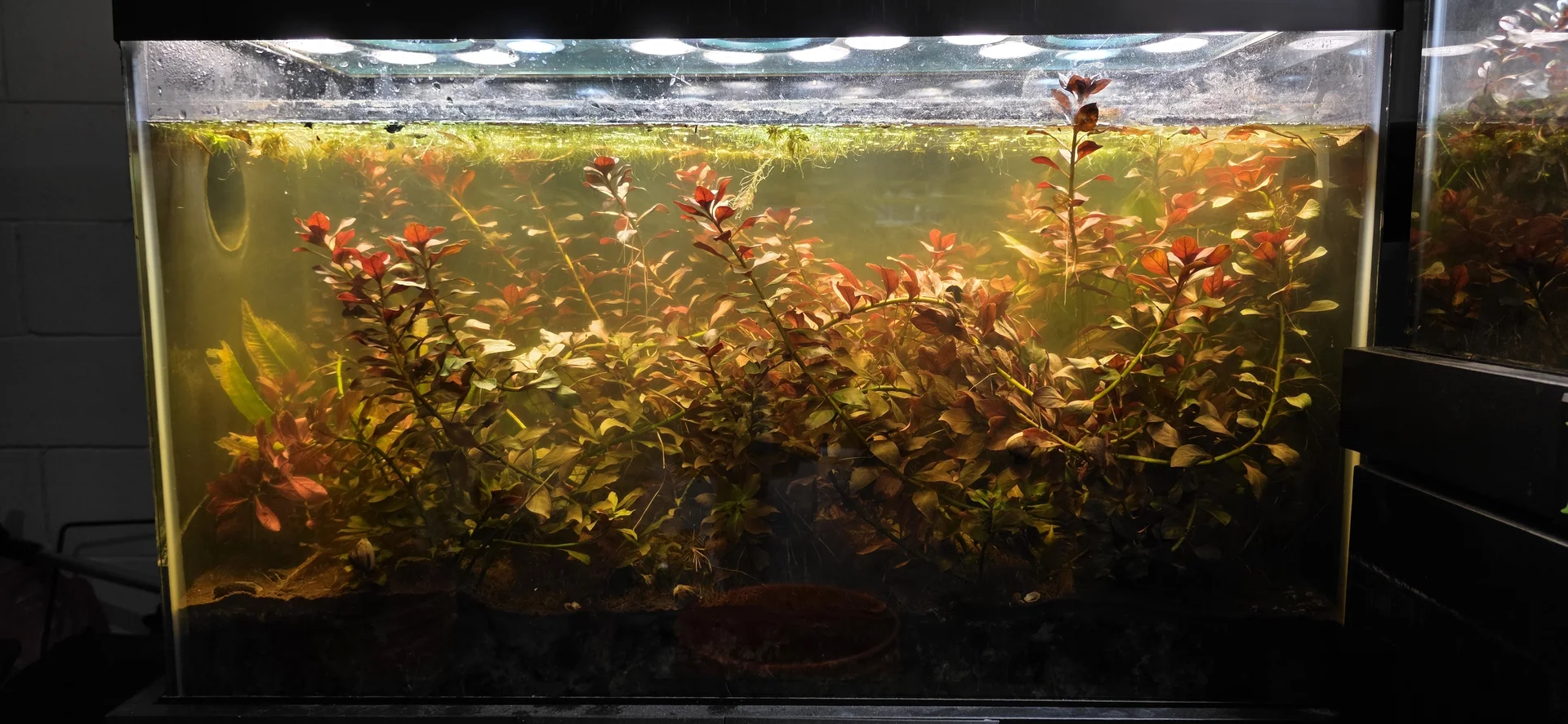
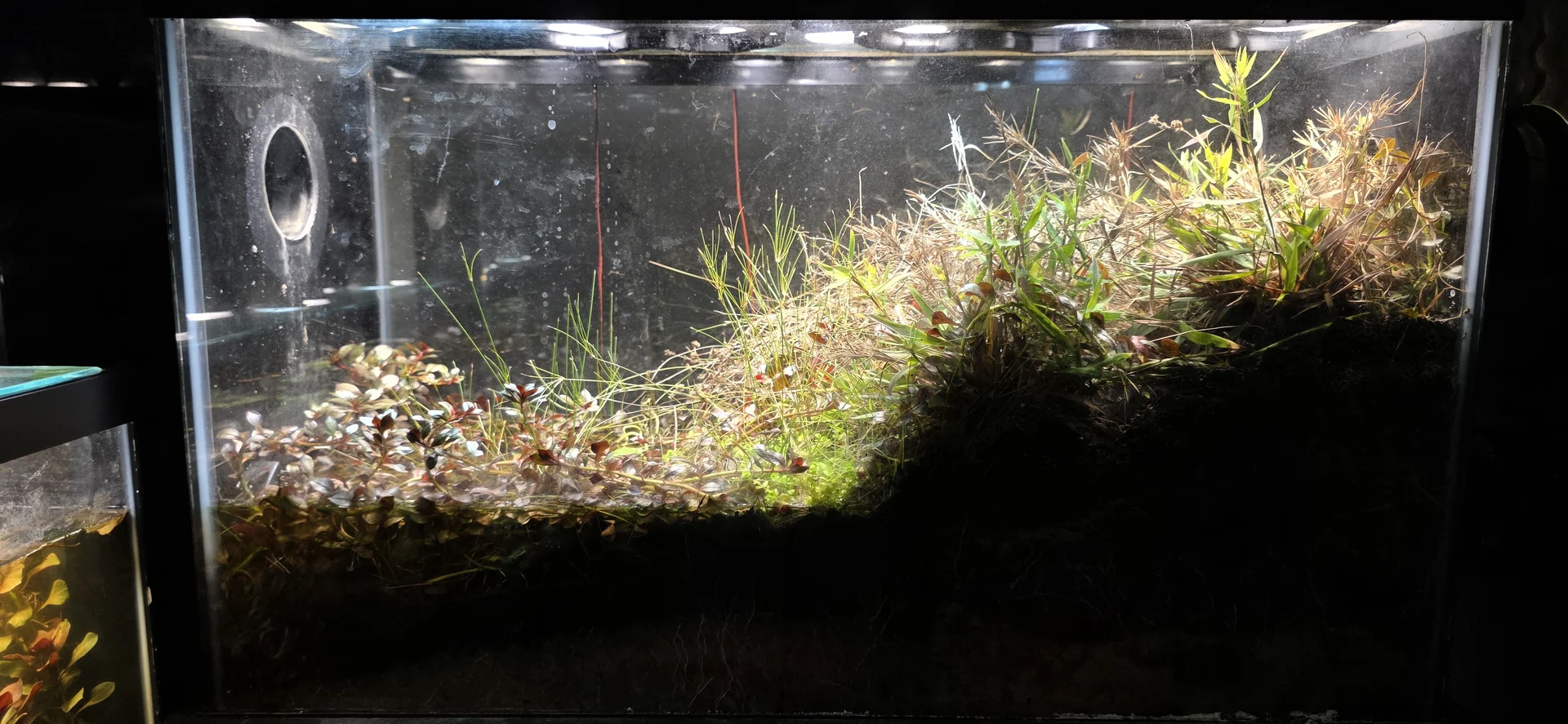
The clearest ecological story from the observation record is the biome contrast documented in February 2026. The Lakeshore's submerged vegetation provided a refuge from Flagfish predation, supporting a dense, visibly thriving water flea population. In the open Freshwater Lake, the same cladocerans were sparse and largely hidden, emerging into the water column mainly when Slough Crayfish disturbed the substrate. Flagfish and Ghost Shrimp were identified as the likely predation pressure limiting open-lake numbers.

This refuge-main body dynamic is well documented in natural lake ecology: macrophyte beds act as structural refugia that physically interrupt predator search paths and reduce encounter rates, allowing zooplankton populations to persist at much higher densities in vegetated margins than in open water with equivalent fish density. The Lakeshore vegetation appears to have performed exactly this function.

Flagfish were removed from the system on April 5, 2026. Based on what happened to other microcrustacean populations after that removal (the Freshwater Amphipod shifted to open-water foraging; Freshwater Copepods expanded; the lake cleared within eight days), it is likely the water flea population extended into the open lake after April 2026. No observation directly confirms this for the Water Fleas population.

In a closed system, a healthy water flea population provides continuous turnover of algal biomass into prey biomass, contributes feces and carcasses to detrital pathways, and may support water clarity by grazing suspended algae. These functions make water fleas a structurally important layer in the freshwater food web even when they are largely invisible.

miniBIOTA Evidence

Observation timeline:

  • January 24, 2026: Lake biome murky hours after tapegrass addition. Very high abundance of microcrustaceans visible via flashlight, described as a "striking density darting rapidly in response to light." Crayfish visible climbing tapegrass leaves; Seminole Ramshorn Snails grazing. Video evidence.
  • February 20, 2026: Pre-dawn flashlight observation at the Lakeshore underwater front glass edge showing a dense Daphnia community actively darting through the water column, with amphipods feeding and small freshwater limpets on glass. Explicit contrast with the Freshwater Lake, which showed only copepods and small Daphnia, with no adult-sized Daphnia or amphipods. Predation pressure from Flagfish and Ghost Shrimp inferred as the limiting factor in the open lake. Video evidence.
  • February 21, 2026: Dense, thriving Daphnia population documented in the Lakeshore biome where dense vegetation provides shelter. In the lake biome, water fleas present but sparse and mostly hidden, emerging when Slough Crayfish disturbed the substrate. Flagfish predation explicitly identified as the likely driver limiting lake biome density. Tapegrass establishment noted as potentially improving refuge availability over time.

Confirmed:

  • Dense cladoceran population in the Lakeshore's submerged vegetation (February 20-21, 2026, direct observation)
  • Sparse, suppressed population in the open Freshwater Lake during the Flagfish era (February 2026)
  • Flagfish predation as the inferred limiting factor for open-lake abundance (February 2026 obs, consistent with known ecology)
  • Video evidence of dense darting masses in the Freshwater Lake and Lakeshore water column (January and February 2026)

Inferred:

  • Entry into the system around September 2025, possibly as hitchhikers with a freshwater plant or substrate addition
  • Clonal parthenogenetic reproduction as the primary mode during the favorable winter-spring period
  • Population expansion into the open lake following Flagfish removal in April 2026
  • Resting egg (ephippia) production as a persistence mechanism under predation pressure or unfavorable conditions

Unknown:

  • Species-level identity (genus and species within Cladocera unresolved)
  • Exact introduction pathway and source
  • Population size at any given time; a figure of 100 is on record as an estimate, not a documented count
  • Current status in the system after February 2026
  • Whether the April 2026 Daphnia batch represented new individuals or supplemented the existing population
  • Whether the population persisted after Flagfish removal or declined for other reasons