
Pomacea sp. (unidentified)

Apple Snail

A large freshwater snail that arrived in the Freshwater Lake as a tiny individual and persisted through months of crayfish predation pressure, continuing to develop while grazing algae, biofilm, and plant matter across the lake floor and glass.
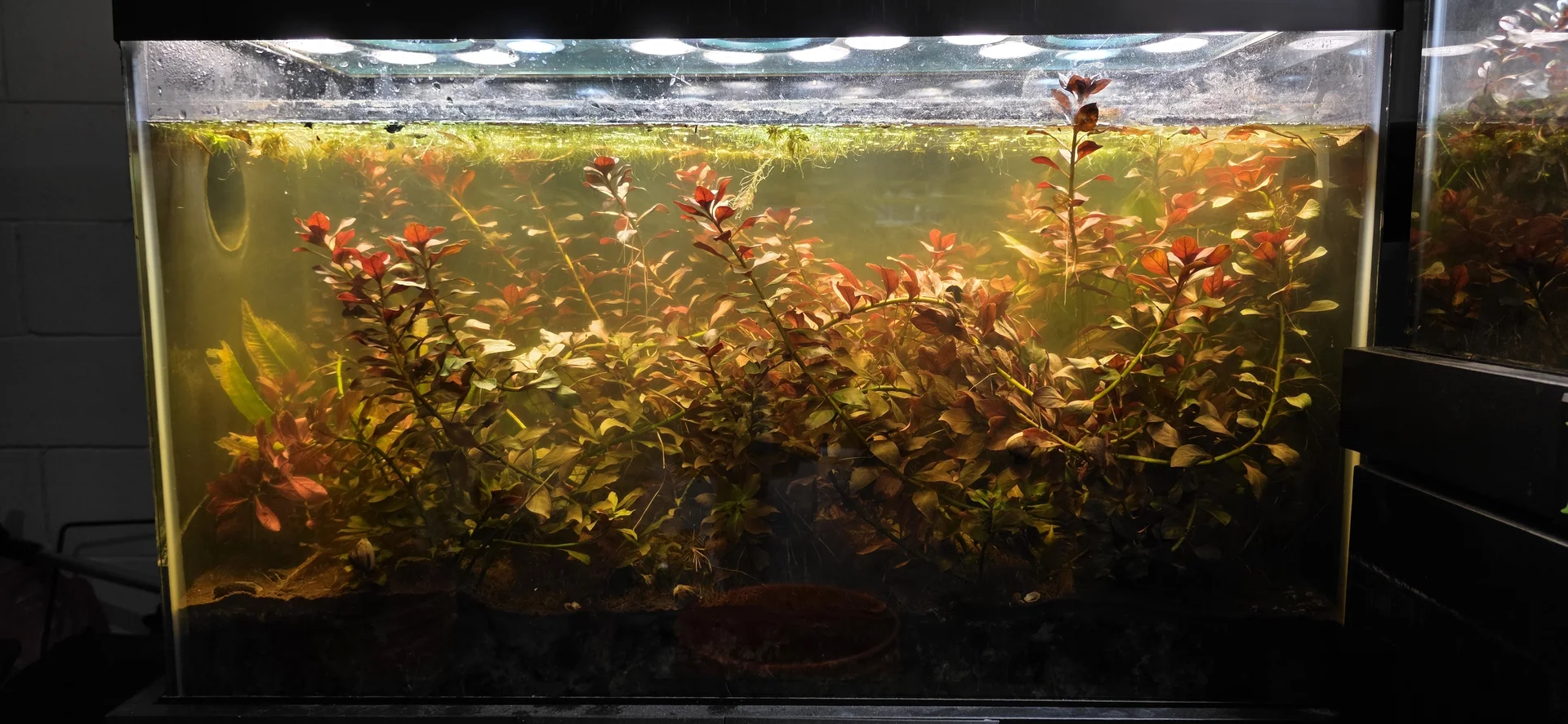
Visual Data Unavailable

Overview

A large freshwater snail of the genus Pomacea present in the Freshwater Lake since at least July 2025. Two individuals were deliberately introduced on July 20, 2025, and at least one more may have arrived earlier as a hatchling with tapegrass plants. By April 14, 2026, one or two very small individuals were still observed actively developing despite Slough Crayfish pressure; the observer noted this may represent a newly establishing species in the lake. Species-level identity is uncertain; the April 2026 observation suggests Pomacea paludosa (Florida apple snail), but this has not been confirmed.

Identity

  • Common name: Apple Snail
  • Alternate names: Florida apple snail, mystery snail, golden apple snail
  • Scientific name: Pomacea sp. (unidentified)
  • Identification confidence: Genus level (Pomacea); species uncertain
  • Uncertainty label: Observed

Taxonomy

  • Kingdom: Animalia
  • Phylum: Mollusca
  • Class: Gastropoda
  • Order: Architaenioglossa
  • Family: Ampullariidae
  • Genus: Pomacea
  • Species: Unidentified

Natural History

Apple snails of the genus Pomacea are large freshwater gastropods native to South America and the Caribbean. Several species have naturalized in Florida. Pomacea paludosa, the Florida apple snail, is the only species native to North America and is endemic to Florida and parts of adjacent states, where it is a key food source for limpkins and snail kites. Other introduced Pomacea species (P. canaliculata, P. insularum) are invasive agricultural pests in Asia and parts of the Americas; these are not native to Florida and have distinct invasion histories.

Adult Pomacea are typically 2 to 6 centimeters in diameter and may reach even larger sizes in some species. The shell is globose, with a large, rounded aperture sealed by a hard operculum when the snail is threatened or dormant. Apple snails are amphibious: they breathe underwater via a gill and above water via a lung, and can emerge from the water to lay egg masses, feed on emergent vegetation, or escape unfavorable conditions.

The most distinctive reproductive behavior of apple snails is their egg-laying strategy. Females climb above the waterline onto vertical surfaces (glass, plant stems, rocks) and deposit tightly clustered egg masses of dozens to several hundred eggs. Fresh egg masses are typically bright pink-orange or white; they hatch in 2 to 3 weeks under warm conditions, and hatchlings are tiny (1 to 2 millimeters) when they enter the water.

Apple snails are broadly herbivorous. They graze algae and biofilm from surfaces and consume aquatic macrophytes, including submerged vegetation, floating plants, and emergent stems. Pomacea paludosa feeds preferentially on aquatic vegetation such as tapegrass and spatterdock in Florida's natural systems. Some Pomacea species are serious macrophyte consumers that can strip a planted aquarium or small pond of vegetation rapidly; this risk is smaller with P. paludosa than with the introduced agricultural pests, but it is not negligible.

In Florida, apple snails can tolerate a broad range of conditions typical of warm, slow-moving freshwater: temperatures from roughly 18 to 30 degrees C, neutral to slightly alkaline pH (6.5 to 8.5), and low to moderate dissolved oxygen. Their ability to breathe air allows them to survive in hypoxic water that would kill most aquatic invertebrates.

Ecological Role

Apple snails are large-bodied primary consumers that convert algae, biofilm, and aquatic vegetation into snail biomass. Their grazing on glass surfaces and substrate controls biofilm accumulation and removes soft algal growth. In natural Florida systems, Pomacea paludosa plays a structuring role in freshwater macrophyte communities; high densities can reduce plant cover significantly.

In miniBIOTA, the apple snail's ecological role is currently limited by its small body size: as of April 2026, the individual(s) present were described as "very small," implying they entered as hatchlings and have not yet reached adult size. A small juvenile snail has a correspondingly small impact on the system, but its grazing footprint will expand as it grows. A full-grown Pomacea in the Freshwater Lake, with tapegrass as the primary macrophyte, represents a potential macrophyte-grazing risk that is worth monitoring.

The snail's ability to lay egg masses on the glass walls above the waterline would, if it happens, produce a visually distinctive and documentable event. No egg-laying has been recorded; the individual(s) present in April 2026 are not likely to have reached reproductive maturity yet.

The persistence of one or two individuals through nine months of Slough Crayfish co-habitation as of April 2026 is itself a notable outcome. Slough Crayfish are capable of attacking and consuming smaller snails, particularly those with thinner or smaller shells. The fact that the juvenile apple snail(s) survived this period suggests either that the crayfish found them difficult to locate or handle, or that the tapegrass provided adequate refuge.

miniBIOTA Evidence

Introduction context: Two Apple Snails were introduced deliberately on July 20, 2025, along with approximately 20 Malaysian Trumpet Snails and 10 Rasp Elimia, described in the obs note as diversifying the detritivore population and enhancing nutrient cycling. A date of first introduction of July 9, 2025 is on record, 11 days earlier than the documented batch; this may reflect an earlier arrival of one or more hatchlings as hitchhikers with tapegrass plants added around that time. The April 2026 observer specifically theorizes a tapegrass-hitchhiker origin for the surviving individual, suggesting the deliberate July 20 introductions may not have persisted while the hatchling did.

Observation timeline:

  • July 9, 2025: Earliest possible arrival as a hatchling hitchhiker with tapegrass plants (observer inference, not directly observed).
  • July 20, 2025: Two Apple Snails introduced with Malaysian Trumpet Snails and Rasp Elimia; described as part of a batch to diversify the detritivore population.
  • April 14, 2026: One or two very small Apple Snails observed persisting in the Freshwater Lake; individual(s) described as "very small," likely Florida apple snails that hitchhiked in as hatchlings with the original tapegrass addition. Individual has persisted and continues to develop despite abundant Slough Crayfish. Observer notes this may represent a newly established species in the lake.

Confirmed:

  • Two Apple Snails introduced July 20, 2025
  • At least one, possibly two, small individuals present and actively developing as of April 14, 2026 (direct observation)
  • Persistence through at least 9 months despite Slough Crayfish co-habitation

Inferred:

  • One or more individuals may have arrived as hatchlings with tapegrass plants around July 9, 2025, prior to the deliberate July 20 batch (April 2026 observer inference; not confirmed)
  • The surviving individual(s) in April 2026 are likely distinct from the deliberately introduced July 20 individuals, which may have been lost to predation or other causes
  • Continued growth toward adult size is expected if conditions remain suitable

Unknown:

  • Species-level identity (Pomacea paludosa inferred but not confirmed)
  • Whether the July 20 introduced individuals survived or were lost
  • Whether the tapegrass arrival theory is correct
  • Current population size and status after April 14, 2026
  • Whether the individual(s) have reached or will reach reproductive maturity in the system